

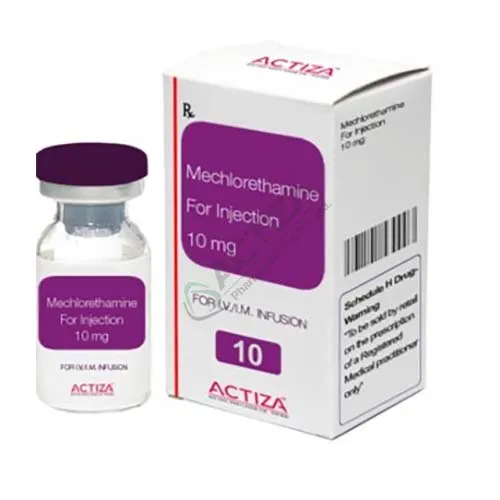
Mechlorethamine Injection
| Product/Composition:- | Mechlorethamine Injection |
|---|---|
| Strength:- | 10mg |
| Form:- | Injection |
| Production Capacity:- | 1 Million Injection/Month |
| Therapeutic use:- | Anti Cancer |
| Package Insert/Leaflet:- | Available upon request |
Introduction
Actiza Pharmaceutical manufactures Mechlorethamine for Injection 10 mg as a sterile cytotoxic finished dosage formulation in a WHO-GMP certified dedicated cytotoxic block.
Mechlorethamine is the original nitrogen mustard and remains in use in Hodgkin lymphoma protocols and for intracavitary treatment of malignant effusions.
It is also a Schedule 1 chemical under the Chemical Weapons Convention, and its international transfer is subject to treaty obligations that sit above ordinary pharmaceutical export rules.
We supply only to licensed institutional buyers in eligible jurisdictions, against verified end-use, and we complete the applicable national and OPCW-related declarations.
Complete CTD dossiers, CoPP and FSC are available to qualified counterparties.
Product Overview Table
| Field | Details |
| Product Name | Mechlorethamine for Injection |
| INN / Generic Name | Chlormethine hydrochloride (mechlorethamine hydrochloride) |
| Therapeutic Class | Cytotoxic antineoplastic bifunctional nitrogen mustard alkylating agent |
| Mechanism (brief) | Bifunctional alkylating agent; interferes with DNA replication and RNA transcription, disrupting nucleic acid function. Also possesses weak immunosuppressive activity. |
| Regulatory Status Treaty | CWC Schedule 1 chemical. Transfer permitted only between States Parties, only for medical, pharmaceutical, research or protective purposes, with no onward retransfer to a third State. |
| Indications | Hodgkin lymphoma (MOPP regimen), lymphosarcoma, chronic myelocytic and lymphocytic leukaemia, polycythemia vera, mycosis fungoides, bronchogenic carcinoma; intracavitary use for malignant effusions per approved local labelling |
| Presentation | 10 mg vial, sterile powder for reconstitution |
| Routes | Intravenous, administered into a running infusion; intracavitary (intrapleural, intraperitoneal, intrapericardial) for effusions |
| Oral Route | NOT to be given orally extremely irritating to tissue, despite being orally absorbed |
| Vesicant Status | EXTREME vesicant extravasation causes severe tissue injury. Sodium thiosulfate is the recognised extravasation management agent. |
| Solution Stability | Highly unstable once reconstituted prepare immediately before use and discard residue |
| Sterilisation Method | Aseptic processing terminal sterilisation not applicable |
| Manufacturing Facility | WHO-GMP certified DEDICATED cytotoxic sterile block |
| Dossier Available | CTD / ACTD / eCTD released to qualified counterparties only |
| MOQ | Not published. Quantities are constrained by treaty and by declared allocation see Section 5G. |
Presentation, Sterility & Handling
Mechlorethamine for Injection 10 mg
The single global presentation, supplied as a sterile powder in a 10 mg vial for reconstitution immediately before administration.
Mechlorethamine is administered intravenously into a running infusion, or intracavitarily for malignant effusions, where it produces a sclerosing inflammatory reaction on serous membranes causing adherence of serosal surfaces which is the basis of its effect in that setting rather than a systemic cytotoxic action.
The Two Handling Facts That Govern This Product
Extreme vesicant. Extravasation causes severe local tissue injury. Reference practice uses sodium thiosulfate for extravasation management alongside standard measures.
Administration into a running infusion is a labelling instruction, not a technique preference, and it must appear in full in local leaflet and artwork.
Extreme solution instability. Once reconstituted, mechlorethamine degrades rapidly it is transformed so quickly in the body that unchanged drug becomes undetectable in blood within minutes of an intravenous dose.
The practical consequence is that the solution must be prepared immediately before administration and any residue discarded; it cannot be batched, held, or carried between wards.
These two properties together mean the product is only usable where a hospital pharmacy can prepare cytotoxics on site, immediately before administration, with extravasation management protocols in place.
That is a real constraint on which customers you can serve responsibly, and it should be treated as a qualification question rather than a footnote.
Sterility Assurance & Release Testing
Regulatory, Dossier & Treaty Compliance
Dossier Availability
CTD, ACTD and eCTD formats available released to qualified counterparties under confidentiality, not published or offered for open download
Module 3 quality documentation including aseptic process and media fill validation, container closure qualification, residual moisture control, degradation product characterisation and reconstitution behaviour
Stability data real-time and accelerated, plus in-use stability defining the post-reconstitution window
Country-specific dossier customisation and regulatory query response support for eligible jurisdictions
Bioequivalence Self-Evident, and Unmeasurable Anyway
Mechlorethamine is given intravenously, so absorption is not a variable and regulators treat bioequivalence (BE) as self-evident for a parenteral product containing the same active and inactive ingredients at the same concentration as the reference.
A second factor reinforces this: mechlorethamine is transformed so rapidly after intravenous administration that unchanged drug is undetectable in blood within minutes and less than 0.01% is excreted unchanged in urine.
A conventional plasma pharmacokinetic comparison is therefore not merely unnecessary it is not technically feasible.
The condition remains Q1/Q2 sameness against the reference registered in the target market
Comparative characterisation of the reconstituted solution appearance, pH, assay, degradation profile and reconstitution time supports the waiver argument
Drug Master File (DMF)
DMF reference available for cross-referencing in registration dossiers, released to qualified counterparties only
API sourced against a qualified vendor under the same treaty-controlled conditions that apply to the finished product
Manufacturing Compliance
WHO-GMP certified facility, audit-ready, with inspection reports shared on an NDA basis
Site Master File (SMF) available for regulatory submissions
Dedicated cytotoxic sterile block dedicated premises, equipment and air handling under a controlled pressure regime, with containment and aseptic requirements resolved through cascaded airlocks
Operator protection controls are exceptionally strict on this compound given its vesicant nature; exposure control is documented alongside the quality system rather than derived from it
Cleaning validation against a toxicologist-authored HBEL / Permitted Daily Exposure
Material accountability: because this is a treaty-scheduled chemical, quantitative reconciliation of input, output, reject and waste is a compliance obligation, not only a GMP yield control. Records must support declaration reporting.
Documentation Package (Per Consignment)
| Document | Purpose |
| Certificate of Analysis (CoA) | Confirms batch quality against the agreed specification |
| Certificate of Pharmaceutical Product (CoPP / CPP) | Required for MOH registration in importing countries |
| Free Sale Certificate (FSC) | Confirms the product is freely sold in the country of manufacture |
| Method of Analysis (MOA) | Analytical methodology mandatory dossier component |
| GMP Certificate | Confirms site compliance, including the dedicated cytotoxic sterile block |
| Stability & In-Use Data | Including the post-reconstitution window |
| Sterility & Bacterial Endotoxin Reports | USP <71> and USP <85> |
| Media Fill Validation Summary | Aseptic assurance no terminal sterilisation step exists |
| End-Use / End-User Certificate | Treaty compliance identifies the institution that will administer the product |
| Non-Retransfer Undertaking | Written confirmation that the consignment will not be onward-transferred to a third State |
| Export Licence / National Authority Approval | Issued under the national CWC implementing legislation |
| Cytotoxic & Vesicant Handling Guidance | For destination pharmacy PPE, extravasation management, spillage and waste |
Vesicant Handling & Destination Pharmacy Support
Cytotoxic and vesicant handling guidance supplied with each consignment in the destination language, covering PPE, preparation immediately before use, spillage response and waste segregation
Extravasation management guidance included, referencing sodium thiosulfate per approved labelling this belongs with the product, not in a textbook the ward does not have
Artwork carries cytotoxic and vesicant identification so the product is unmistakable in a hospital pharmacy
Because the reconstituted solution cannot be held, we advise buyers to confirm that receiving sites have on-site cytotoxic preparation capability before the first order a site that batches preparations centrally and transports them cannot use this product safely
Chemical Weapons Convention Compliance
Schedule 1 chemicals may be produced, acquired, retained, transferred or used only for research, medical, pharmaceutical or protective purposes, in types and quantities strictly limited to what can be justified for those purposes.
The obligations that follow are treaty obligations implemented through national legislation, and they bind the exporter irrespective of what the importing customer is willing to sign.
A State Party may transfer Schedule 1 chemicals outside its territory only to another State Party. A prospective destination that is not a State Party to the Convention is not a market, whatever its pharmaceutical registration position.
Chemicals transferred shall not be onward-transferred to a third State. This is the provision that breaks the ordinary distributor model a regional distributor who re-exports across neighbouring markets cannot be used for this product. Supply must be direct to the end-use jurisdiction.
Aggregate national holdings and annual acquisition for these purposes are capped under the Convention, and production above defined thresholds is subject to declaration and to OPCW verification.
Your available allocation is therefore finite and is not a commercial variable you can flex against demand.
Every consignment requires identification of the institution that will administer the product, and a written non-retransfer undertaking. We do not supply against a general trading order.
Export proceeds only under licence from the national authority established under the domestic CWC implementing legislation. Confirm current requirements with that authority for each transaction; treaty implementation detail differs between States Parties and changes over time.
Clinical Indications & Therapeutic Information
Mechlorethamine is a bifunctional alkylating agent. It interferes with DNA replication and with transcription of RNA, disrupting nucleic acid function, and it also possesses weak immunosuppressive activity.
Indications per reference labelling include Hodgkin lymphoma mechlorethamine is the “M” component of the MOPP regimen together with lymphosarcoma, chronic myelocytic and chronic lymphocytic leukaemia, polycythemia vera, mycosis fungoides and bronchogenic carcinoma
Intracavitary administration for malignant pleural, peritoneal and pericardial effusions works differently from the systemic route: it produces a sclerosing inflammatory reaction on serous membranes causing adherence of serosal surfaces. Local labelling must describe both routes distinctly.
Mechlorethamine is absorbed orally but must not be administered by that route, being extremely irritating to tissue. This instruction must be explicit in local labelling.
Standard cytotoxic warnings apply myelosuppression, immunosuppression and infection risk alongside the vesicant precautions in Section 4, and all must carry through to leaflet and artwork in full
Market reality worth stating internally: mechlorethamine has been substantially displaced in modern Hodgkin protocols by regimens such as ABVD and BEACOPP, and it has been discontinued or withdrawn in several markets.
Demand is therefore small, specialised and declining, concentrated in centres following older protocols or treating specific presentations.
This is not a growth product, and a business case built on volume forecasts will be wrong.
Packaging & Controlled Distribution
Packaging Configuration
| Component | Specification |
| Vial | 10 mg sterile powder in Type I glass single-dose vial with elastomeric stopper and flip-off seal |
| Protective sleeve | Vial protection sleeve to reduce breakage risk a breakage event with a vesicant is a serious exposure incident, not a stock loss |
| Carton | Individual carton with leaflet, cytotoxic AND vesicant identification, and handling guidance |
| Shipper | Tamper-evident, damage-resistant construction with consignment-level serialisation for accountability |
Labelling
Mandatory artwork content: cytotoxic and vesicant identification, route restrictions including the prohibition on oral administration, running-infusion instruction, immediate-use-after-reconstitution statement, extravasation management reference, storage statement and country-specific registration fields
Direct consignment to the licensed importer or end-use institution in the destination jurisdiction no intermediate resale
Consignment-level records retained to support declaration reporting and any subsequent verification
Incoterms selected so that chain-of-custody is unbroken and documented; DAP or CIP to a named licensed consignee is preferred over terms that pass control to an intermediary
Lead time is governed by licensing and allocation, not by production scheduling advise buyers of this at first contact so it is not read as poor service later
Why Source From Us?
Frequently Asked Questions
Q1. Can you export Mechlorethamine Injection to my country?
Only if your country is a State Party to the Chemical Weapons Convention, because Schedule 1 chemicals may be transferred only between States Parties.
That is the first question we answer, before registration, pricing or volumes.
We verify current status against the OPCW published list at the time of each transaction rather than relying on a stored list.
Q2. Can we buy through our regional distributor and redistribute across neighbouring markets?
No. Chemicals transferred under these provisions may not be onward-transferred to a third State, so a regional redistribution model cannot be made compliant.
Supply must be direct to the end-use jurisdiction, to a licensed importer or the end-use institution, against a written non-retransfer undertaking.
Q3. What documentation do you require before you will quote?
Identification of the end-use institution, confirmation of the importer’s licence status, a non-retransfer undertaking, and confirmation that the receiving site can prepare cytotoxics on site immediately before administration.
Export then proceeds under licence from the national implementing authority. We do not quote against a general trading enquiry.
Q4. Why can the reconstituted solution not be prepared in advance?
Because mechlorethamine is extremely unstable in solution it is transformed so rapidly in the body that unchanged drug is undetectable in blood within minutes of an intravenous dose.
The product must be prepared immediately before administration and any residue discarded. It cannot be batched centrally, held, or transported between wards after preparation.
Q5. What extravasation support do you provide?
Vesicant handling and extravasation management guidance is supplied with every consignment in the destination language, referencing sodium thiosulfate per approved labelling, alongside PPE, spillage and waste guidance.
Mechlorethamine is an extreme vesicant and extravasation causes severe local tissue injury, so this guidance belongs with the product rather than in a reference the ward may not hold.
Q6. Do you offer private label manufacturing for this product?
No. Private label is available across most of our portfolio but not on this molecule, because placing a third-party brand between the manufacturer and the end-use institution is incompatible with the traceability and material accountability obligations that apply to a treaty-scheduled chemical.
Q7. Is a bioequivalence study required?
Generally not. The product is given intravenously, so absorption is not a variable and bioequivalence is treated as self-evident for a parenteral product matching the reference in active and inactive ingredients at the same concentration.
A plasma pharmacokinetic comparison would in any case not be technically feasible, given how rapidly the drug is transformed after administration.
Q8. What quantities can you supply?
Less than you may expect, and the constraint is legal rather than industrial.
Annual acquisition and aggregate holdings of Schedule 1 chemicals are capped under the Convention and subject to declaration, so available allocation is finite.
We would rather agree a small, reliable, correctly documented supply than accept a commitment that cannot be lawfully met.
Call to Action
Enquiries from qualified institutional buyers
Supply of Mechlorethamine for Injection is available to licensed institutional buyers in eligible jurisdictions, subject to Chemical Weapons Convention compliance screening and export licensing.
Qualified counterparties are invited to contact our regulatory affairs team directly with the end-use institution, importer licence details and destination jurisdiction.
Dossier extracts and quality documentation are released under confidentiality once eligibility is confirmed.