

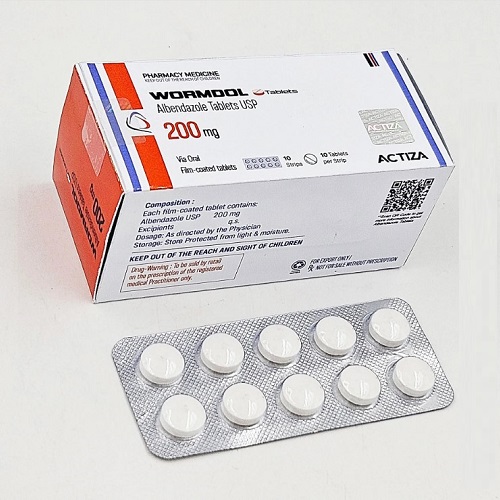



Albendazole Tablets
| Product/Composition:- | Albendazole Tablets |
|---|---|
| Strength:- | 300mg,400mg |
| Form:- | Tablets |
| Production Capacity:- | 10 Million Tablet/Month |
| Packaging:- | 10 X 10 Tablets / Box, 10 X 5 Tablets / Box |
| Therapeutic use:- | GIT Agent |
| Package Insert/Leaflet:- | Available upon request |
Understanding Albendazole Tablets
Albendazole is a broad medicine utilized to treat many types of parasitic worm infections. This medicine is a benzimidazole. It works by blocking tubulin polymerization. This leads to fewer microtubules in the parasites’ intestinal cells. This impairs their metabolism and results in their eventual demise. Albendazole is extensively prescribed in both human and veterinary medicinal requirements.
Uses of Albendazole Tablets
Albendazole is used for the treatment of numerous parasitic infections, including:
How Albendazole Tablets Work?
In parasite worms, Albendazole works by stopping the production of microtubules. This causes the worms to die by running out of energy and damaging their cells.
This helps reduce pain and inflammation for people with parasitic illnesses.
If you have neurocysticercosis, and the larvae are dying and causing inflammation in the brain, this mixture is very helpful.
Advantages of Albendazole Tablets
Efficacious against a wide landscape of parasitic diseases. Utilized in international deworming initiatives owing to its extensive anthelmintic properties
Applicable for both single-dose regimens and extended therapies. Offered in multiple formulations, including chewable tablets and suspensions, facilitating administration to children
Economical treatment alternative. Generally well-tolerated with negligible adverse effects in the majority of patients
Before Taking This Tablet
Who Should Take Albendazole Tablets?
Albendazole is indicated for:
Patients diagnosed with helminthic infections. Children and adults in endemic regions necessitating deworming
Individuals receiving therapy for neurocysticercosis and hydatid disease. Participants in mass deworming initiatives to avert parasite transmission
Dosage Guidelines for Albendazole Tablets
The dosage of Albendazole is proportional to infection type and patient characteristics:
Missed Dose
Take the forgotten dose as quickly as you can. If it is close to the next dose, skip the forgotten dosage and go on with the regular schedule.
Potential Side Effects
Interactions
Albendazole interacts with certain medications, which may alter its effectiveness:
Route of Administration
Both the tablet and the liquid forms of Albendazole are administered orally. Chewing or swallowing tablets whole with water is recommended based on the formulation.
The suspension, on the other hand, is usually prescribed to children or people who cannot swallow tablets. Albendazole works better with food, especially fatty foods.
They help the body absorb it more easily. The parasite infection type affects the treatment dose and duration.
A person with a systemic infection, like neurocysticercosis or hydatid disease, may require more treatment and higher doses. A doctor should monitor them.
Drug-Drug Interactions Checker List
Concerns
It starts functioning within a few hours; one can notice peak levels in 2–5 hours.
It remains effective for 2–3 days after administration.
No, alcohol increases the risk of liver toxicity. So, it should be completely avoided.
No, Albendazole is not addictive. Therefore, a habit will not form.
This medication is not suggested in the first trimester, only if benefits are worth taking a chance.
There is very short information on this. Speaking with a doctor before starting this medication while nursing might be wiser.
Precautions, Warnings, and Safety Measures
Long-term use of Albendazole in people with liver disease can increase liver enzymes. This means regular liver function tests are needed.
Albendazole is not to be consumed during the first trimester of expecting. This is because it may cause teratogenic effects.
Women who have chances of pregnancy need to utilize effective contraception during therapy and one month after as well.
Albendazole can cause low white blood cell counts or other blood problems. So, patients with bone marrow issues need careful monitoring.
Alcohol might cause liver damage during therapy, so avoid it. Refrain yourself from taking this medicine if you are allergic to benzimidazoles.
Take Albendazole with food, especially fatty meals. This helps it absorb better and work effectively. Finally, patients should finish treatment to avoid reinfection or resistance.
Storage Conditions
Store between 15-30°C in a cool, arid location
Shield against humidity and direct sunshine
Store out of children’s reach