


Introduction
Samoa is facing a rising cancer burden, with more patients needing treatment each year.
The country depends a lot on imported oncology APIs because local production is low.
According to the WHO, Samoa imports over 95% of its medicines.
Samoa’s rising demand has created a small but important micro-market.
Indian exporters of APIs are finding reliable, specialized markets there.
Overview of Cancer Burden in Samoa
Cancer cases are rising in Samoa and are becoming a serious public health concern.
Below, we explain key cancer numbers, major cancer types, and treatment challenges.

Key Cancer Statistics
Cancer is now the second leading cause of death in Samoa. Cases have risen in recent years.
This trend affects both men and women, especially older adults.
Government Recognition of Cancer as a Priority
The government of Samoa now treats cancer as a major national health priority.
Here are the national strategies, medicine policies, and global partnerships that support cancer care.
NCD Strategy
Samoa’s Non-Communicable Diseases (NCD) Strategy includes cancer.
It groups cancer with diabetes and heart disease. The 2024-2029 action plan focuses on four key areas.
It aims to prevent issues, promote early screening, ensure access to treatment, and raise community awareness.
Essential Medicines
Cancer treatment drugs are on Samoa’s Essential Medicines List (EML).
This follows World Health Organization guidance. It helps people get vital, life-saving cancer medicines.
Global Partnerships
Samoa works with the World Health Organization.
It also teams up with the United Nations Development Programme and the Pacific Community.
They work on better cancer control, health systems, training, and teamwork in the area.
How Samoa Procures Oncology APIs & Finished Formulations
Samoa follows a structured system to buy cancer medicines and raw materials safely.
Below are the centralized processes, budget system, and tender method used.

Centralized Procurement System
Samoa uses a centralized system to buy oncology APIs and finished medicines.
The system ensures quality control. It keeps costs low and promotes fair competition.
This is done using clear international tender processes.
Tender-Based Requirements
Samoa has strict tender rules. These rules help ensure that cancer medicines are safe, effective, and affordable.
They make sure suppliers meet high international standards.
Here are the key requirements that suppliers need to follow.
Emergency/Spot Procurement
In Samoa, emergency or spot procurement is used to deal with stock-outs or urgent shortages of oncology drugs.
This system speeds up buying life-saving medicines. It helps when regular tenders are slow.
The rules for documentation can be pretty flexible in some cases.
However, when it comes to approvals, quality checks, and meeting deadlines, things need to move quickly to ensure that patient care is protected.
Oncology APIs & Key Molecules in High Demand
The demand for cancer treatment is rising in many Pacific countries, such as Samoa.
As the number of patients needing therapy grows, so does the need for key ingredients used in cancer medicines.
Below are the most commonly requested cancer treatment molecules in the region.

Most Requested APIs
Several traditional APIs for chemotherapy and hormone therapy continue to be in high demand.
These medicines are used as first-line treatments.
Below are the key molecules commonly requested in the Pacific region.
Biologics & Newer Therapies (Emerging Demand)
Demand for advanced cancer medicines is slowly increasing in Pacific markets, including Samoa.
These newer therapies provide targeted treatment. They also lead to better outcomes for some patients.
Here are the main biologics and new immunotherapy drugs that are getting noticed.
Trastuzumab
This is used for HER2-positive breast and gastric cancers.
Biosimilars help make treatment more affordable and accessible.
Rituximab
Using biosimilars can be a big help in treating certain blood cancers and autoimmune diseases.
They also lower the overall cost of treatment.
Pembrolizumab
This is a high-end treatment that involves using the body’s immune system to fight disease.
It’s a rare and expensive medicine. It’s often imported from abroad for special cases where it’s the best choice.
Supportive-Care Products Also Imported
Samoa imports medicines to help manage side effects. These medicines make patients feel better.
They help during treatments like chemotherapy. Here are key supportive care products used in cancer care:
Antiemetics (Ondansetron)
It stops and manages queasiness and vomiting that can happen during chemo treatments.
Filgrastim
This helps the body make more white blood cells after going through chemo.
Dexamethasone
It helps with inflammation and makes severe nausea from treatment more manageable.
Samoa’s Supplier Profile: Who They Import From
Samoa depends a lot on importing medicines and ingredients for cancer treatment.
The main countries that supply oncology drugs and APIs are:

Dominant Supplier Countries
Samoa relies on trusted partners for its cancer medicines.
These partners are mostly from other countries.
These countries offer final products, generic cancer drugs, and basic active ingredients. The leading supplier nations are:
India (Largest Generic Supplier)
India is a leader in oncology generics. It allows for affordable chemotherapy and hormone therapies.
These medicines are widely used in public hospitals. There, the demand for essential cancer treatments is high.
Australia & New Zealand
Australia and New Zealand are helping Samoa.
They’re sending crucial medical supplies, including medicines and gear that need careful monitoring.
They help keep quality standards high and ensure that supply chains are reliable.
China (APIs & Commodities)
China supplies the basic ingredients and raw materials for medicines, as well as some common drugs.
They support local imports and meet the overall needs for buying pharmaceuticals.
Why Indian API Manufacturers Dominate
India has emerged as a top global source for oncology APIs.
Many small countries and island nations count on Indian API manufacturers.
They trust them for their reliability and good value.
Here are the key reasons why Indian API companies lead:
Cost Advantage
Indian oncology APIs are usually 40-60% cheaper than those from Australia and New Zealand.
Companies can keep prices low by producing on a large scale and managing costs well.
This way, they maintain quality while offering better deals.
Oncology Expertise
Indian manufacturers excel in oncology and HPAPI production.
They make complex chemotherapy drugs and hormone therapies in large amounts.
This helps meet the rising global demand for cancer treatment.
Global Certifications
Many Indian facilities have WHO-GMP and other global certifications.
These approvals matter a lot in government tender evaluations.
They can greatly enhance a company’s credibility and increase its chances of being chosen.
Documentation Strength
Indian suppliers give all the required regulatory documents.
They also provide stability data and technical files.
This excellent documentation support is very helpful for small island nations.
They often lack resources for regulation.
Documentation & Regulatory Requirements for Exporters

Exporting oncology medicines requires strict regulatory compliance and proper documentation.
Governments check quality, safety, and manufacturing standards before approving imports.
Below, we explain the key documents exporters must submit for approval.
Mandatory Documents
A supplier looking to export oncology APIs and finished medicines to Samoa needs to have its regulatory documents ready.
These papers show that the product is high-quality, safe, and stable in tropical conditions.
Below are the essential mandatory documents.
Samoa’s Regulatory Authorities
Samoa has its own set of rules and regulators in place to check if medicines are safe and follow the law.
They check that all imported cancer medicines meet quality and safety standards.
Here are the main groups that oversee regulation and clinical care.
Ministry of Health – Samoa
The Ministry of Health is the main regulatory authority.
It handles registering medicines, getting import permits, and doing quality checks and inspections.
It also makes sure everything complies with national pharmaceutical laws and safety standards.
National Health Service (NHS)
The National Health Service oversees public healthcare in the country.
They are in charge of ensuring hospitals get the medicines they require.
They purchase, store, and distribute these medicines.
They also follow the official list of essential medicines and treatment guidelines for the country.
Pharmacy Council of Samoa
The Pharmacy Council checks on pharmacists and how pharmacies run.
It sets standards for professionals. It lists who can practice and ensures safe medicine use in public and private healthcare.
Registration Timeline
Registering cancer medicines in Samoa is a simple process.
The authorities review the safety, quality, and supporting documents before giving the green light for import and use.
Below are the usual approval timelines and fast-track options.
Average approval time: 3-6 months
Fast-track approvals are possible for:
Procurement Cycle & Buying Behavior
The procurement cycle follows a yearly plan based on budgets.
Below, we explain how the annual calendar shapes tenders, emergency buying, and budget resets.
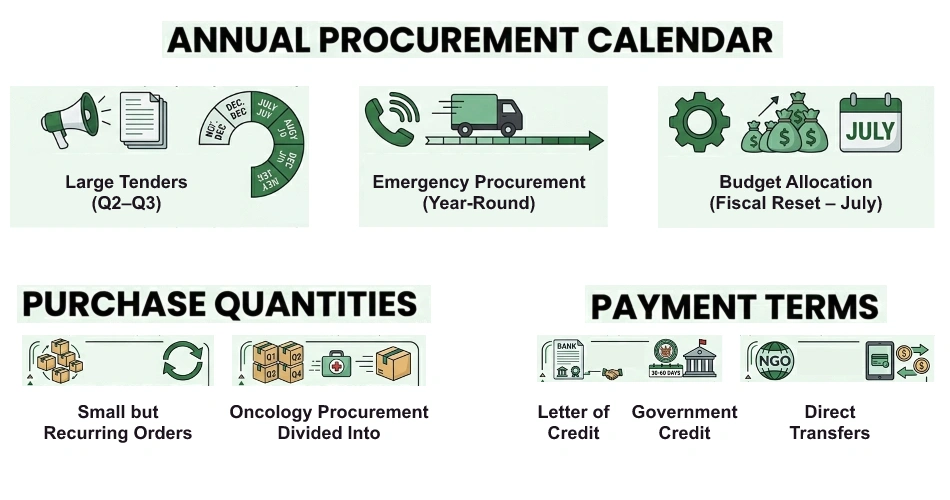
Annual Procurement Calendar
Most public and large organizations plan their buying based on the fiscal year.
Here’s how big tenders take place, how emergency buying works, and how yearly budget resets impact decisions.
Purchase Quantities
Purchase quantities in oncology are planned carefully.
Here are the order patterns, batch systems, emergency needs, and small purchases supported by NGOs.
Small but Recurring Orders
These are medicines that are ordered several times a year in small amounts.
They support regular treatment needs and avoid stock gaps.
Oncology Procurement Divided Into
Quarterly Batches
Large planned orders are placed every three months.
This helps to gain better prices and manage storage safely.
Emergency Shipments
Small urgent orders during stock-outs or sudden demand rise.
Ensures patients continue treatment without harmful delays.
NGO-Funded Procurement (Small Quantities)
Small orders are supported by donor or charity programs.
They are often used for rare cancers or special patient groups.
Payment Terms
Payment terms are set to reduce risk and ensure timely supply.
Below are the common payment methods used by government buyers and NGOs.
Letter of Credit
Most purchases are made using a Letter of Credit (LC).
The bank guarantees payment to the supplier after the required documents are submitted and verified.
Government Credit
Some suppliers allow 30–60 days of payment credit. This is often supported by a government guarantee.
This gives suppliers safety and helps buyers manage short-term funds.
Direct Transfers
NGOs often use direct bank transfers for payments. Funds are sent to suppliers electronically.
This speeds up the process and simplifies smaller, donor-funded purchases.
Logistics & Shipping Considerations for Oncology APIs
Safe delivery of oncology APIs needs careful planning and control.
Below are the temperature care, safe handling, compliance, and secure transport that are important for medicines.

Key Ports
Apia Port is the main entry point for oncology APIs into Samoa.
The port must handle refrigerated containers. It should provide safe storage.
Quick customs clearance is also needed.
Strong cold chain control, secure handling, and the right documents help prevent damage, delays, and lost products.
Shipping Requirements
Shipping oncology APIs needs strict rules to keep products safe and effective.
Required shipping requirements are:
Common Challenges
Shipping oncology APIs to small island nations comes with many risks.
Key problems include:
Cold-Chain Limits
Many small islands have limited refrigerated storage and few reefer containers.
They also face an unstable power supply.
This makes it tough to keep oncology APIs at safe temperatures during storage and transport.
Customs Delays
Slow document checks, few staff, and weak coordination between agencies can delay cargo release.
Even short delays may reduce product shelf life and increase storage and penalty charges.
High Freight Costs
Small shipments and long distances raise shipping costs.
Limited routes and fuel reliance make transport costly.
This is especially true for urgent and temperature-sensitive oncology APIs.
Market Opportunities for API Exporters
API exporters can find strong growth in oncology markets. New opportunities are emerging.
This is due to a growing need for treatment, changing health trends, and support from funders.

Growing Demand for Oncology Treatments
Demand for cancer treatment is rising across many countries.
Demand for oncology treatments is increasing due to:
Gaps That Indian Exporters Can Fill
Indian exporters excel in pharma production due to their strong skills and cost benefits.
They meet unmet needs in oncology APIs by focusing on:
Affordable Generics
Indian companies can offer low-cost generic oncology APIs. Their large-scale production keeps costs low.
This helps hospitals and governments cut treatment costs. They can do this without lowering quality.
HPAPI Capability
Indian manufacturers are investing in safe facilities. These facilities focus on high-potency APIs.
These advanced plants manage powerful oncology molecules.
They follow strict safety rules and have trained staff.
Regulatory Support
Exporters provide key documents such as DMFs and compliance certificates.
This speeds up approvals, eases customs clearance, and builds trust with global buyers.
Flexible Batches
Many buyers need small or mid-size quantities. Indian firms provide flexible production runs.
This makes it easier for them to supply smaller markets and special treatment programs.
Stable Formulations
Indian companies develop temperature-stable oncology APIs.
These products are easier to move, especially to warm areas. They also lower risks during long-distance shipping.
High-Opportunity Segments
The oncology API market is growing fast across the world. Here are the main product segments.
They have high demand, steady growth, and strong export potential for manufacturers.
Solid-Tumor APIs
Chemotherapy drugs for solid tumors are in high demand.
This includes drugs for breast, lung, and colon cancers.
These treatments are common, so their APIs are crucial for hospitals and cancer care centers.
Hormonal Therapies
Hormonal oncology APIs are typically used to treat breast and prostate cancers.
They help slow down cancer growth and are often taken over a long period, which leads to ongoing demand.
Supportive Injectables
Chemotherapy patients often need supportive care injectables.
These include medicines for nausea, infection control, and low blood counts.
This creates a similar demand for these drugs alongside cancer treatment.
Ready Documentation
Buyers prefer APIs with complete DMF and CTD files. Ready documentation speeds up approval.
It makes registration simpler and helps entry into regulated and semi-regulated markets easier.
Strategic Recommendations for Exporters
Exporters must plan carefully to succeed in small and tropical markets.
Below are the actions that improve compliance, speed, flexibility, and long-term partnerships with health authorities and global agencies.

Zone IVb Data
Maintain stability studies for hot and humid climates under Zone IVb conditions.
This confirms product quality over time. It also speeds up approvals in tropical countries that have strict rules.
Small MOQs
Offer low minimum order quantities for micro-markets. Smaller batches lower costs for buyers.
They also help serve island nations and small countries better.
Emergency Response
Build systems for quick supply during urgent tenders or stock-outs.
Keep buffer inventory and clear logistics plans. This helps to respond quickly to urgent procurement needs.
DG Packaging
Use certified packaging for dangerous goods. This is important for cytotoxic and hazardous oncology APIs.
To lower risks when transporting goods, correct labeling is key.
This helps avoid rejected shipments. Safety documents are also needed, and handlers must receive proper training.
Regulatory Support
Share complete dossiers, with CTD and DMF files, to help speed up product registration.
Quick responses to official requests speed up the approval process.
MOH & NGOs
Partner with Ministries of Health and agencies like the World Health Organization, United Nations Development Programme, and Pacific Community.
This will help to get long-term supply programs. It will also build a trusted supplier status.


