

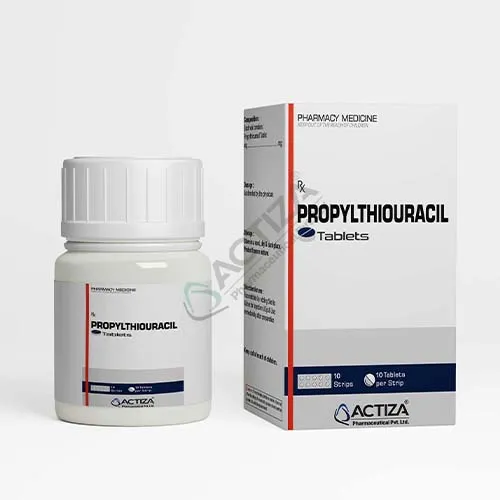
Propylthiouracil Tablet
| Product/Composition:- | Propylthiouracil Tablet |
|---|---|
| Strength:- | 50 mg |
| Form:- | Tablets |
| Production Capacity:- | 100 Million Tablets/Month |
| Packaging:- | 100 tablets in bottle |
| Therapeutic use:- | Hypothyroidism |
| Package Insert/Leaflet:- | Available upon request |
Introduction
Propylthiouracil is a thiocarbamide antithyroid agent used in Graves’ disease with hyperthyroidism and in toxic multinodular goitre.
It is a reserved second-line medicine carrying a boxed warning for severe liver injury, and our labelling carries that warning and the associated patient counselling text in full.
Complete CTD, ACTD and eCTD dossiers, in-vivo bioequivalence data, CoPP, FSC and ICH Zone IVb stability are supplied for MOH registration.
Product Overview Table
| Field | Details |
| Product Name | Propylthiouracil Tablets |
| INN / Generic Name | Propylthiouracil |
| Therapeutic Class | Antithyroid agent thiocarbamide (thiourea derivative) |
| Mechanism (brief) | Inhibits thyroid hormone synthesis; also inhibits peripheral conversion of T4 to T3 |
| Indications | Graves’ disease with hyperthyroidism and toxic multinodular goitre, in patients intolerant of methimazole and for whom surgery or radioactive iodine is not appropriate per approved local labelling |
| Positioning | Reserved second-line. Not first-line therapy. |
| Boxed Warning | Severe liver injury and acute liver failure, in some cases fatal, including cases requiring liver transplantation in adult and paediatric patients |
| Pregnancy Position | May be the treatment of choice when an antithyroid drug is indicated during or just prior to the First trimester, because of the risk of fetal abnormalities with methimazole. An alternative may be advisable after the first trimester. |
| Paediatric Use | Not recommended except in rare instances where methimazole is not tolerated and surgery or radioactive iodine are not appropriate |
| API Quality | Manufactured using DMF-grade Propylthiouracil |
| Pharmacopoeial Standard | USP Propylthiouracil Tablets USP; BP available |
| Available Strength | 50 mg tablets |
| Reference Regimen | Total daily dose usually given in 3 divided doses. Initial 300 mg daily; maintenance typically 100-150 mg daily per approved labelling |
| Solubility Note | Very slightly soluble in water classification is borderline and must be established from your own data |
| Other Key Warning | Agranulocytosis in approximately 0.2% to 0.5% of patients, typically within the first three months of therapy |
| Shelf Life | 36 Months |
| Storage | Store at 20-25°C, protect from light |
| Manufacturing Facility | WHO-GMP certified general oral solid dosage block, segregated from beta-lactam operations |
| Dossier Available | Yes, CTD / ACTD / eCTD format |
Strength, Presentation & Specification
Propylthiouracil Tablets 50 mg
The single global strength. The total daily dose is usually given in three divided doses, with an initial dose of 300 mg daily and a usual maintenance dose in the range of 100 to 150 mg daily.
That arithmetic matters for anyone building a forecast: an initiation-phase patient takes six 50 mg tablets a day, dropping to two or three on maintenance.
Per-patient consumption is therefore substantially higher during the first weeks than the maintenance figure suggests, and a buyer who forecasts on maintenance dosing alone will under-order at exactly the wrong moment.
Specification & Testing
Assay, content uniformity, dissolution and related substances against the declared monograph
Discriminatory dissolution method validated across the physiological pH range the drug substance is very slightly soluble in water, so dissolution deserves genuine method development rather than a compliance-only approach
Photostability data supporting the light-protection storage statement
Taste and coating considerations: the drug substance has a markedly bitter taste, which is worth confirming is adequately managed in your formulation, particularly where the tablet may be split or crushed
Typical excipient system per reference labelling includes corn starch, docusate sodium, magnesium stearate and microcrystalline cellulose
Pharmacopoeial Compliance
USP Propylthiouracil Tablets USP is the specification most widely requested for export
BP / IP confirm applicability to your SKU before claiming compliance
Regulatory & Dossier Support
Dossier Availability
CTD (Common Technical Document) ICH-aligned, for regulated and semi-regulated markets
ACTD (ASEAN Common Technical Dossier) Philippines, Vietnam, Myanmar, Indonesia, Cambodia
eCTD for authorities mandating electronic submission
Module 3 quality documentation including process validation, dissolution method validation, content uniformity and photostability
Stability data real-time and accelerated under ICH Zone IVb (30°C / 75% RH)
Module 1 labelling built around the boxed warning and the patient counselling text on this molecule that is the primary risk control, not a formality.
Bioequivalence & Classification Position
Reference labelling describes propylthiouracil as a white crystalline substance that is very slightly soluble in water.
At a 50 mg strength, however, the dose-to-solubility ratio sits close to the boundary used in BCS classification, so whether a BCS-based biowaiver is available is a question to be settled from your own solubility data across the physiological pH range rather than assumed in either direction.
We recommend generating that data before choosing a registration route, because the answer changes the cost of every subsequent submission.
In-vivo bioequivalence (BE) data available
Where a biowaiver is pursued, the argument requires demonstrated solubility across the pH range plus rapid and comparable dissolution for both test and reference product
rather than relying on the general solubility description in reference labelling
Comparative dissolution profiles held throughout shelf life
Drug Master File (DMF)
Drug Master File (DMF) reference for the Propylthiouracil API available for cross-referencing in your registration dossier
API sourced against a qualified vendor with impurity, residual solvent, polymorph and particle size characterisation
CDSCO / Indian DMF reference accepted by a large number of importing authorities
Manufacturing Compliance
WHO-GMP certified manufacturing facility, audit-ready, with inspection reports shared on an NDA basis
Site Master File (SMF) available for regulatory submissions
Propylthiouracil is neither a beta-lactam nor a cytotoxic and is not subject to international drug control conventions, so no dedicated block is required.
Production runs in a general oral solid dosage block physically segregated from beta-lactam operations, with validated cleaning between products.
Small-batch capability is the relevant manufacturing question on this molecule.
Demand is low and stable rather than high and growing, so the practical constraint is whether campaigns can be run economically at modest scale without compromising validation
Compliant with the requirements of NAFDAC (Nigeria), PPB (Kenya), FDA Philippines, DRAP (Pakistan) and INVIMA (Colombia)
Complete Documentation Package (Per Shipment)
| Document | Purpose |
| Certificate of Analysis (CoA) | Confirms batch quality against the agreed specification |
| Certificate of Pharmaceutical Product (CoPP / CPP) | Required for MOH registration in most importing countries |
| Free Sale Certificate (FSC) | Confirms the product is freely sold in the country of manufacture |
| Method of Analysis (MOA) | Analytical methodology mandatory dossier component |
| GMP Certificate | Confirms manufacturing site compliance |
| Stability Data | Real-time and accelerated ICH Zone IVb, plus photostability |
| BE Study Report or Biowaiver Justification | States explicitly which route was taken |
| Dissolution Profile Report | Across the physiological pH range |
| Content Uniformity Data | Batch-level |
| Approved Patient Leaflet, Translated | The primary risk control on this molecule |
| Excipient Declarations | For all inactive ingredients |
Why the Leaflet Is the Safety Control Here
The practical consequence for an exporter is that leaflet quality on this product is not a printing decision.
Reference labelling directs that if patients develop tiredness, nausea, anorexia, fever, pharyngitis or malaise, propylthiouracil should be discontinued immediately by the patient, a physician contacted, and a white blood cell count, liver function tests and transaminase levels obtained.
A patient who cannot read or understand that sentence in their own language has lost the only protection the product offers.
Full boxed warning and patient counselling text carried in every leaflet, translated into the destination language and reviewed by a native speaker rather than machine-translated
Symptom list printed in plain language, not clinical terminology the instruction has to work for the patient, not for the prescriber
Agranulocytosis counselling included alongside the hepatic warning.
Agranulocytosis occurs in approximately 0.2% to 0.5% of patients and typically within the first three months of therapy, and the warning signs overlap with the hepatic ones fever and sore throat appear on both lists
Pregnancy text stated precisely. The first-trimester position and the advisability of switching to an alternative afterwards are both part of the labelling, and compressing them into a single sentence loses the timing distinction that matters clinically
We supply leaflet artwork proofs for regulatory review before printing, and we will not shorten safety text to fit a smaller leaflet format.
Where carton size is the constraint, the carton changes, not the warning
Clinical Indications, Positioning & Honest Market Assessment
Propylthiouracil is a thiocarbamide antithyroid agent. It inhibits the synthesis of thyroid hormone and additionally inhibits the peripheral conversion of T4 to T3.
Approved use: Graves’ disease with hyperthyroidism, and toxic multinodular goitre, in patients who are intolerant of methimazole and for whom surgery or radioactive iodine therapy is not an appropriate option per approved local labelling
Boxed warning: severe liver injury and acute liver failure, in some cases fatal, have been reported, including cases requiring liver transplantation in adult and paediatric patients.
Propylthiouracil should be reserved for patients who cannot tolerate methimazole and in whom radioactive iodine therapy or surgery are not appropriate.
The pregnancy position is the reason this molecule remains essential.
Because of the risk of fetal abnormalities associated with methimazole, propylthiouracil may be the treatment of choice when an antithyroid drug is indicated during or just prior to the first trimester of pregnancy.
After the first trimester, use of an alternative antithyroid medication may be advisable, given the potential for maternal hepatotoxicity.
Not recommended in paediatric patients except in rare instances where methimazole is not well tolerated and surgery or radioactive iodine are not appropriate
Agranulocytosis occurs in approximately 0.2% to 0.5% of patients and is a potentially life-threatening effect, typically arising within the first three months of therapy
Market Assessment Write This Honestly
The commercial shape of this product is unusual and worth stating plainly to the sales team.
Because propylthiouracil is formally reserved to second line, volumes in any market are small and have been declining as methimazole consolidated as first-line therapy.
A supplier who forecasts growth on this molecule will be wrong. But volumes cannot fall to zero, because the first-trimester pregnancy position leaves a defined group of patients for whom there is no substitute and that group exists in every market, every year, in numbers that track births rather than prescribing fashion.
Forecast small, flat and durable not growing, not disappearing
Continuity is worth more than price here. A pregnant patient in the first trimester with Graves’ disease has no alternative to fall back on, so a stockout on this product is a clinical problem rather than a substitution inconvenience
The commercial win is being the supplier who will run a small batch reliably rather than the one quoting the lowest price on a large one. Position the relationship that way and expect it to last
Export Packaging & Supply Chain
Primary Packaging Options
| Presentation | Packaging Options |
| Propylthiouracil Tablets 50 mg | Alu-Alu blister 10×10 and 3×10, light-protective, in mono-carton with full leaflet |
| Hospital pack | HDPE bottle of 100 with induction seal, for institutional dispensing |
| Initiation pack | Configuration reflecting the higher initiation-phase dosing, where a buyer prefers it |
Two practical points on pack design.
First, leaflet size is a constraint that has to be solved in favour of the safety text the boxed warning and the patient counselling content.
Second, initiation dosing consumes six tablets daily against two or three on maintenance, so a single pack size serves the two phases very differently; buyers running obstetric or endocrinology services may prefer a configuration that matches the initiation phase.
Why Source Propylthiouracil Tablets From Us?
We Will Run the Small Batch: Demand on this molecule is low and stable. We schedule modest campaigns against committed forecasts rather than pushing buyers to over-order and carry expiry risk on a slow-moving line. On a reserved-use product, that willingness is the whole value proposition.
Leaflet Treated as a Safety Control, Not a Formality: Full boxed warning and patient counselling text, translated by native speakers, in plain language. Reference labelling states that laboratory monitoring is not expected to attenuate the risk of severe liver injury, which makes the leaflet the control that actually works.
Complete Dossier in CTD, ACTD and eCTD: Pre-compiled with regulatory query response support and country-specific customisation.
Honest Classification Position: Propylthiouracil sits near the BCS solubility boundary at this strength. We advise generating solubility data before choosing a registration route rather than assuming a biowaiver is or is not available.
Continuity Where It Cannot Be Substituted: A first-trimester patient with Graves’ disease has no alternative. We plan supply on that basis rather than on volume attractiveness.
WHO-GMP Certified Manufacturing: Segregated general oral solid facility with validated cleaning. GMP certificate and Site Master File (SMF) shared on request.
Frequently Asked Questions
Q1. Do you provide a dossier for Propylthiouracil Tablets?
Yes. We provide complete dossiers in CTD, ACTD and eCTD formats.
The dossier includes Module 3 quality documentation, process validation, dissolution method validation across the physiological pH range, content uniformity, ICH Zone IVb stability with photostability, and the bioequivalence or biowaiver justification.
Module 1 labelling carries the boxed warning and patient counselling text in full.
Q2. Why is propylthiouracil described as a reserved medicine?
Because of hepatotoxicity. Reference labelling carries a boxed warning for severe liver injury and acute liver failure, in some cases fatal, including cases requiring liver transplantation in adult and paediatric patients.
It is therefore reserved for patients who cannot tolerate methimazole and for whom radioactive iodine therapy or surgery are not appropriate.
Any supplier presenting this as a routine first-line antithyroid product has misread the label.
Q3. If it is second-line, why should we register it at all?
Because of the first trimester. Reference labelling states that propylthiouracil may be the treatment of choice when an antithyroid drug is indicated during or just prior to the first trimester of pregnancy, owing to the risk of fetal abnormalities associated with methimazole.
That group exists in every market every year and has no substitute, so the product cannot be absent from a formulary even though volumes are small.
Q4. What volumes should we realistically expect?
Small, flat and durable. Volumes have declined across markets as methimazole consolidated as first-line therapy, and we would rather tell you that before registration than after.
What the product offers is a stable, non-substitutable line rather than growth. If your commercial model requires a fast-moving product, this is not one.
Q5. Why do you place so much emphasis on the leaflet?
Because reference labelling states that biochemical monitoring of liver function and hepatocellular integrity is not expected to attenuate the risk of severe liver injury, given its rapid and unpredictable onset.
The control that works is the patient recognising symptoms and stopping the drug.
That makes leaflet content, translation quality and legibility a genuine clinical safeguard, and we will not shorten safety text to fit a smaller format.
Q6. Is a bioequivalence study required, or is a biowaiver available?
It depends on data you generate. Reference labelling describes the drug substance as very slightly soluble in water, but at a 50 mg strength the dose-to-solubility ratio sits near the BCS classification boundary.
We recommend establishing solubility across the physiological pH range before choosing a route, because assuming the answer in either direction is expensive.
Q7. Can you supply Propylthiouracil Tablets under our private label?
Yes, within a firm limit. We offer private label manufacturing with your brand name and artwork.
Safety content is fixed the boxed warning, reserved-use statement, pregnancy and first-trimester text, paediatric restriction and symptom counselling cannot be shortened, relocated to a QR code, or reduced in prominence to accommodate carton design.
Q8. What is the MOQ and lead time?
MOQ is deliberately modest on this product because demand is genuinely low, and we would rather run a small batch than see a buyer carry expiry risk.
Contact our export team with your market and expected annual patient numbers rather than a target order value, and we will size the supply to actual need.
Ready to Source Propylthiouracil Tablets FDF?
Share your target market and expected annual patient numbers, and our export team will respond with the applicable specification, registration route, leaflet and translation approach, pack options and pricing sized to real demand rather than to a minimum order.
If you are at technical evaluation stage, request the dissolution and stability summaries, the leaflet proof, and a sample CoA.