

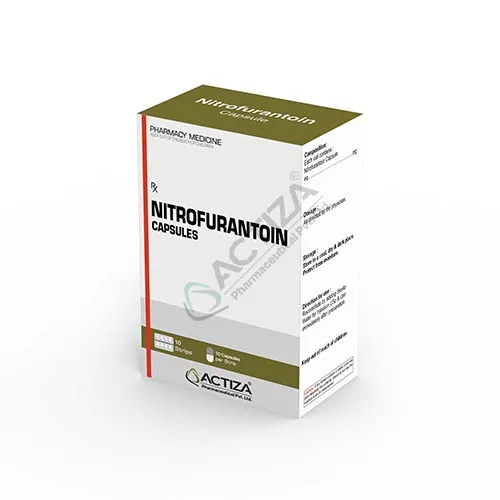
Nitrofurantoin Capsule
| Product/Composition:- | Nitrofurantoin Capsule |
|---|---|
| Strength:- | 100mg, 50mg |
| Form:- | Capsule |
| Production Capacity:- | 10 Million Capsule/Month |
| Packaging:- | 10 X 10 Capsule/Box |
| Therapeutic use:- | Bacterial infections of urinary tract |
| Package Insert/Leaflet:- | Available upon request |
Introduction
Actiza Pharmaceutical is a WHO-GMP certified pharmaceutical exporter supplying Nitrofurantoin Capsules as a finished dosage formulation not API to importers, distributors and hospital procurement across Africa, Southeast Asia, Latin America and the Middle East.
We supply both registered presentations: nitrofurantoin macrocrystals and nitrofurantoin monohydrate/macrocrystals, which are distinct formulations with separate reference products and separate bioequivalence requirements.
Nitrofurantoin remains widely used for uncomplicated lower urinary tract infection, where its narrow tissue distribution is a stewardship advantage rather than a limitation.
Complete CTD, ACTD and eCTD dossiers, in-vivo bioequivalence data, CoPP, FSC and ICH Zone IVb stability are supplied for MOH registration.
Product Overview Table
| Field | Details |
| Product Name | Nitrofurantoin Capsules |
| INN / Generic Name | Nitrofurantoin |
| Therapeutic Class | Nitrofuran antibacterial urinary tract anti-infective |
| Presentations | Two distinct products: nitrofurantoin macrocrystals, and nitrofurantoin monohydrate/macrocrystals. Not interchangeable |
| Indication | Urinary tract infection, per approved local labelling. Narrow tissue distribution not for systemic infection. |
| API Quality | Manufactured using DMF-grade Nitrofurantoin |
| Pharmacopoeial Standard | USP Nitrofurantoin Capsules USP; separate monograph applies to the monohydrate/macrocrystals presentation |
| Available Strengths | Macrocrystals: 25 mg, 50 mg, 100 mg. Monohydrate/macrocrystals: 100 mg. |
| Contraindicated Renal | Anuria, oliguria, or significant renal impairment (creatinine clearance under 60 mL/min, or clinically significant elevated serum creatinine) |
| Contraindicated Obstetric | Pregnant patients at term (38 to 42 weeks gestation), during labour and delivery, or when onset of labour is imminent |
| Key Warning G6PD | Haemolytic anaemia of the primaquine-sensitivity type has been induced. Haemolysis is linked to glucose-6-phosphate dehydrogenase deficiency. |
| Other Major Warnings | Acute, subacute and chronic pulmonary reactions; hepatic reactions; peripheral neuropathy, which may be severe or irreversible; optic neuritis reported rarely |
| Critical Quality Attribute | Crystal form and particle size distribution these govern dissolution, absorption and gastrointestinal tolerability |
| Administration | With food, per approved labelling improves absorption and tolerability |
| Patient Counselling Point | Urine may become dark yellow or brown harmless, but patients stop therapy over it if not forewarned |
| Shelf Life | 36 Months |
| Storage | Protect from light and moisture |
| Manufacturing Facility | WHO-GMP certified general oral solid dosage block, segregated from beta-lactam operations |
| Dossier Available | Yes, CTD / ACTD / eCTD format |
The Two Presentations, and Why the Difference Matters
Nitrofurantoin Macrocrystals Capsules
The original macrocrystalline presentation, supplied in 25 mg, 50 mg and 100 mg capsules.
The macrocrystal form exists for a specific reason: larger crystals dissolve more slowly than microcrystalline nitrofurantoin, which moderates the rate of absorption and materially improves gastrointestinal tolerability.
Nausea is the principal reason patients abandon nitrofurantoin therapy, so the crystal size is not a manufacturing detail it is the property that determines whether a course gets completed.
Nitrofurantoin Monohydrate/Macrocrystals Capsules 100 mg
A distinct product, not a variant. This presentation combines nitrofurantoin monohydrate with macrocrystals in a single capsule, producing a different release and absorption profile and a different approved dosing regimen from the macrocrystals presentation.
It has its own reference product, its own pharmacopoeial monograph and its own bioequivalence requirement.
Reference labelling for this presentation also notes that lower eradication rates should be weighed against the greater systemic toxicity and resistance potential of agents with broader tissue distribution a framing worth understanding before positioning the product.
Why This Distinction Costs Money If Missed
Different reference products means different comparator sourcing for bioequivalence studies
Different pharmacopoeial monographs apply confirm which governs your SKU before fixing the specification
Artwork must state the presentation explicitly, not merely “Nitrofurantoin Capsules 100 mg”
Specification & Testing
Crystal form and particle size distribution are the governing quality attributes and are specified explicitly, not inherited from the API supplier’s certificate
Discriminatory dissolution method validated across the physiological pH range nitrofurantoin is poorly soluble and dissolution governs both absorption and tolerability
Assay, content uniformity and related substances against the declared monograph
Photostability and moisture control across shelf life nitrofurantoin is light-sensitive and the capsule shell does not protect it once the blister is opened
Regulatory & Dossier Support
Dossier Availability
CTD (Common Technical Document): ICH-aligned, for regulated and semi-regulated markets
ACTD (ASEAN Common Technical Dossier): Philippines, Vietnam, Myanmar, Indonesia, Cambodia
eCTD: for authorities mandating electronic submission
Module 3 quality documentation including crystal form and particle size specification, process validation, dissolution method validation and photostability
Stability data: real-time and accelerated under ICH Zone IVb (30°C / 75% RH)
Separate dossiers maintained for the macrocrystals and monohydrate/macrocrystals presentations they are not variants of one submission
Bioequivalence Poorly Soluble, and Form-Specific
Nitrofurantoin is poorly water-soluble, so dissolution rather than assay governs absorption and a BCS-based biowaiver is not available.
In-vivo bioequivalence (BE) data against the reference product is required.
The point that trips applicants up is which reference: the macrocrystals and monohydrate/macrocrystals presentations have separate reference products, and a study conducted against the wrong one cannot support the registration regardless of how well it was executed.
Particle size distribution is the formulation variable that decides the outcome.
Because crystal size controls dissolution rate, a formulation matched on assay but not on particle size will not be bioequivalent this is the nitrofurantoin equivalent of the excipient-system point on the Cyclophosphamide page
Discriminatory dissolution method documented and validated, with profiles held throughout shelf life
Where an authority accepts a strength biowaiver within the macrocrystals range, proportional similarity and comparable dissolution must be demonstrated subject to the individual authority
Drug Master File
Drug Master File (DMF) reference for the Nitrofurantoin API available for cross-referencing in your registration dossier
API sourced against a qualified vendor with impurity, residual solvent and critically crystal form and particle size distribution characterisation
CDSCO / Indian DMF reference accepted by a large number of importing authorities
Manufacturing Compliance
WHO-GMP certified manufacturing facility, audit-ready, with inspection reports shared on an NDA basis
Site Master File (SMF) available for regulatory submissions
Nitrofurantoin is not a beta-lactam and is not a cytotoxic, so no dedicated block is required.
Production runs in a general oral solid dosage block physically segregated from beta-lactam operations, with validated cleaning between products
Particle size is protected through the process, not only at intake.
Milling, blending and encapsulation are controlled so that the crystal size distribution specified for the product is what actually reaches the capsule attrition during processing is a real failure mode on a macrocrystalline product
Light-protected handling through manufacture and packing, consistent with the photostability profile
Compliant with the requirements of NAFDAC (Nigeria), PPB (Kenya), FDA Philippines, DRAP (Pakistan) and INVIMA (Colombia)
Complete Documentation Package
| Document | Purpose |
| Certificate of Analysis (CoA) | Confirms batch quality against the agreed specification |
| Certificate of Pharmaceutical Product (CoPP / CPP) | Required for MOH registration in most importing countries |
| Free Sale Certificate (FSC) | Confirms the product is freely sold in the country of manufacture |
| Method of Analysis (MOA) | Analytical methodology mandatory dossier component |
| GMP Certificate | Confirms manufacturing site compliance |
| Stability Data | Real-time and accelerated ICH Zone IVb, plus photostability |
| BE Study Report | States explicitly which presentation and which reference product it covers |
| Particle Size Distribution Data | Batch-level the governing quality attribute on this molecule |
| Dissolution Profile Report | Discriminatory method across the physiological pH range |
| Presentation Declaration | States unambiguously whether the batch is macrocrystals or monohydrate/macrocrystals |
| Excipient Declarations | For all inactive ingredients, including capsule shell origin |
| BSE/TSE Declaration | For gelatin capsule shells; HPMC alternative available |
G6PD Deficiency Why This Warning Matters More in These Markets
The practical consequence is that leaflet content and prescriber information on this product should not simply be transcribed from a reference label written for a different population.
The G6PD warning deserves prominence proportionate to local prevalence, and the accompanying instruction is straightforward: haemolysis is an indication for discontinuing nitrofurantoin, and it ceases when the drug is withdrawn.
We carry the G6PD warning prominently rather than burying it in a general haematological reactions list, and we recommend buyers raise its placement with their regulatory authority rather than defaulting to reference-label layout
The obstetric contraindication is connected and equally market-relevant.
The product is contraindicated in pregnant patients at term (38 to 42 weeks gestation), during labour and delivery, and where onset of labour is imminent, because of the possibility of haemolytic anaemia arising from immature erythrocyte enzyme systems
The renal contraindication is the other one buyers underestimate. Anuria, oliguria and significant renal impairment creatinine clearance under 60 mL per minute, or clinically significant elevated serum creatinine are contraindications, because impaired excretion increases toxicity risk.
In markets with a high burden of undiagnosed renal disease, that is a meaningful prescribing constraint
Peripheral neuropathy risk is amplified by conditions common in these markets.
Reference labelling notes that renal impairment, anaemia, diabetes mellitus, electrolyte imbalance, vitamin B deficiency and debilitating disease may enhance its occurrence, and the neuropathy may be severe or irreversible
Pulmonary and hepatic reactions matter most in prophylactic use.
Where the product is used long term at low dose for recurrent infection, the chronic pulmonary and hepatic warnings become the governing safety consideration rather than a background caution
We supply the full warning set translated for the destination market, and we will not abbreviate the haematological, pulmonary, hepatic or neuropathy sections to fit a smaller leaflet format
Clinical Indications & Therapeutic Information
Nitrofurantoin is a nitrofuran antibacterial concentrated in the urine, where it achieves therapeutic levels while systemic tissue concentrations remain low.
That narrow distribution defines both its use and its limits.
Approved indication: urinary tract infection, per approved local labelling.
It is not appropriate for systemic infection, and reference labelling directs that where bacteriuria persists or reappears after treatment, agents with broader tissue distribution should be selected
The narrow distribution is a stewardship advantage.
Reference labelling frames the trade-off explicitly: lower eradication rates should be balanced against the increased potential for systemic toxicity and for the development of antimicrobial resistance when broader-spectrum agents are used instead.
In a period of intensifying stewardship pressure, that argument runs in this molecule’s favour
Administration is with food per approved labelling, which improves both absorption and gastrointestinal tolerability
Patients should be told that urine may turn dark yellow or brown.
It is harmless, but patients who are not forewarned discontinue therapy over it a small counselling point with a measurable effect on course completion
Market structure: urinary tract infection is among the most common bacterial infections presented in primary care across every market this page targets, and nitrofurantoin has retained useful activity where broader-spectrum oral agents have lost it.
Volumes are high, tender-driven and stable, so the differentiators are documentation quality, correct presentation identification and supply reliability
Target Export Markets
Africa
Active markets: Nigeria, Kenya, Ghana, Egypt, Tanzania, Uganda, Ethiopia, Zambia, Côte d’Ivoire
Registration support: NAFDAC (Nigeria), PPB (Kenya), FDA Ghana, TFDA (Tanzania) CoPP and FSC are the primary gatekeeping documents
Leaflet emphasis note: G6PD deficiency prevalence is materially higher across this region than in the markets where reference labelling originated.
Labelling: English and French artwork available for Anglophone and Francophone Africa
Southeast Asia
Active markets: Philippines, Vietnam, Myanmar, Cambodia, Indonesia, Bangladesh, Thailand
ACTD dossier format supplied as standard mandatory for ASEAN registrations
Stability: ICH Zone IVb data is a prerequisite, and moisture protection matters given the photostability and moisture sensitivity of the molecule
Latin America (LATAM)
Active markets: Colombia, Peru, Ecuador, Bolivia, Guatemala, Dominican Republic
USP pharmacopoeial standard preferred; Spanish and Portuguese labelling available
CTD format with local regulatory adaptation, legalisation and apostille support
Middle East & CIS
Active markets: Iraq, Jordan, Yemen, Uzbekistan, Kazakhstan, Azerbaijan
GMP Certificate and CoPP are the primary registration requirements across these authorities
Export Packaging & Supply Chain
Primary Packaging Options
| Presentation | Packaging Options |
| Nitrofurantoin Macrocrystals 50 mg / 100 mg | Alu-Alu blister 10×10 and 2×10, light and moisture protective, in mono-carton with leaflet |
| Nitrofurantoin Macrocrystals 25 mg | Alu-Alu blister 10×10; supports lower-dose prophylactic regimens |
| Nitrofurantoin Monohydrate/Macrocrystals 100 mg | Alu-Alu blister 2×10 and 1×14, aligned to a treatment course |
| Course packs | Configurations matching the approved course length, so a patient receives a complete course |
Alu-Alu is specified rather than offered as an upgrade.
Nitrofurantoin is light-sensitive and moisture-sensitive, and a capsule shell provides no protection once the primary pack is breached.
Course-matched packs deserve serious consideration on an antibacterial: a patient dispensed a partial course is the mechanism by which resistance develops, and pack size is one of the few levers a manufacturer actually controls.
Labelling & Customisation
Private label manufacturing with your brand name and artwork, subject to unchanged regulatory content
Multi-lingual labelling: English, French, Spanish, Portuguese, Arabic, Russian
Mandatory artwork content: the presentation stated explicitly (macrocrystals or monohydrate/macrocrystals), the G6PD and haematological warnings, the renal and obstetric contraindications, the take-with-food instruction, the urine discolouration note, storage statement and country-specific registration fields
Logistics & Supply
Incoterms: FOB, CIF, CFR, EXW as per buyer requirement
No cold chain required; protect from light, moisture and sustained heat in transit
High-volume primary care line: we plan against committed annual forecasts, and we hold the two presentations as separate stock lines rather than treating them as interchangeable inventory
Why Source Nitrofurantoin Capsules From Us?
We Ask Which Presentation Before We Quote: Macrocrystals and monohydrate/macrocrystals are different products with different reference products, dosing regimens and bioequivalence requirements.
We establish which you need first, which prevents the single most expensive error on this molecule.
Particle Size Controlled as a Critical Quality Attribute: Crystal size governs dissolution, absorption and gastrointestinal tolerability. We specify it explicitly and protect it through milling, blending and encapsulation rather than accepting whatever survives processing.
G6PD Warning Given the Prominence These Markets Require: Reference labelling notes this deficiency in around 10 percent of Black patients and in Mediterranean and Near-Eastern populations. We carry the warning prominently rather than transcribing a layout designed for a different population.
Both Dossiers Maintained Separately: CTD, ACTD and eCTD for each presentation, with the bioequivalence study stating explicitly which reference product it covers.
Course-Matched Pack Options: Partial courses drive resistance, and pack size is one of the few levers a manufacturer controls. We will configure to the approved course length rather than to a round number.
WHO-GMP Certified Manufacturing: Segregated general oral solid facility with validated cleaning and light-protected handling. GMP certificate and Site Master File (SMF) shared on request.
Frequently Asked Questions
Q1. Which nitrofurantoin capsule presentation do you supply?
Both, and the distinction matters.
Nitrofurantoin macrocrystals and nitrofurantoin monohydrate/macrocrystals are separate registered products with different crystal characteristics, different reference products, different approved dosing regimens and separate bioequivalence requirements.
They are not interchangeable. Tell us which your market’s registered reference product is and we will confirm which of our dossiers applies.
Q2. Do you provide a dossier for Nitrofurantoin Capsules?
Yes, and we maintain them separately for the two presentations.
Each dossier is available in CTD, ACTD and eCTD format and includes Module 3 quality documentation with crystal form and particle size specification, process validation, discriminatory dissolution method validation, ICH Zone IVb stability with photostability, and the bioequivalence study report.
Q3. Is a biowaiver available?
No. Nitrofurantoin is poorly water-soluble, so dissolution rather than assay governs absorption and the BCS-based biowaiver route is not available.
In-vivo bioequivalence data is required and critically, it must be against the correct reference product for the specific presentation.
A study run against the wrong comparator cannot support the registration however well it was conducted.
Q4. Why do you emphasise particle size?
Because it is the property that makes the product work.
Larger macrocrystals dissolve more slowly than microcrystalline nitrofurantoin, which moderates absorption and improves gastrointestinal tolerability.
Nausea is the main reason patients abandon nitrofurantoin, so crystal size determines whether courses get completed.
We specify it, and we protect it through processing rather than assuming it survives milling and encapsulation.
Q5. Why does the G6PD warning get special treatment on your labelling?
Because of where the product is going.
Nitrofurantoin has induced haemolytic anaemia of the primaquine-sensitivity type, linked to glucose-6-phosphate dehydrogenase deficiency, and reference labelling notes this deficiency in around 10 percent of Black patients and in ethnic groups of Mediterranean and Near-Eastern origin.
Those are the populations across our principal export markets, so we give the warning prominence proportionate to local prevalence rather than copying a reference layout.
Q6. What are the main contraindications buyers should know about?
Two that are frequently underestimated.
Anuria, oliguria and significant renal impairment creatinine clearance under 60 mL per minute, or clinically significant elevated serum creatinine are contraindications, because impaired excretion increases toxicity.
And the product is contraindicated in pregnant patients at term, during labour and delivery, and where onset of labour is imminent, because of the possibility of haemolytic anaemia from immature erythrocyte enzyme systems.
Q7. Can you supply under our private label?
Yes, with one firm exception. We offer private label manufacturing with your brand name, artwork and multi-lingual labelling.
The presentation macrocrystals or monohydrate/macrocrystals must appear in the product name on the carton, not in small print.
A pack reading simply “Nitrofurantoin Capsules 100 mg” is ambiguous between two different products with different dosing regimens.
Q8. What is the MOQ and lead time?
MOQ varies by presentation, strength and pack configuration, and the two presentations are held as separate stock lines rather than as interchangeable inventory.
Please contact our export team with your target market, required presentation and estimated annual volume for MOQ, lead time and a tailored quotation.
Ready to Source Nitrofurantoin Capsules FDF?
Tell us your target market and which presentation your registered reference product is macrocrystals or monohydrate/macrocrystals and our export team will confirm the applicable dossier, specification, bioequivalence position, pack options and pricing.
If you are unsure which applies, send us the reference product details and we will identify it for you before anything is quoted.