

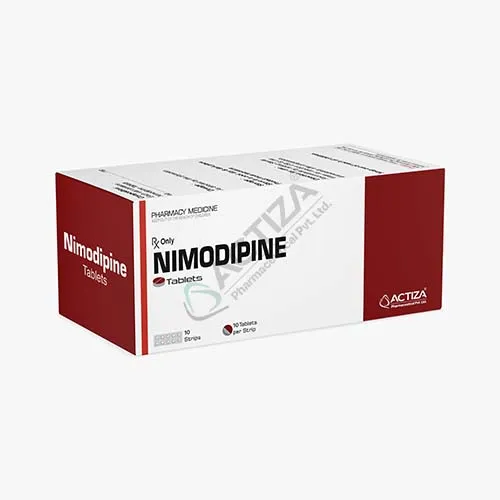
Nimodipine Tablet
| Product/Composition:- | Nimodipine Tablet |
|---|---|
| Strength:- | 30mg |
| Form:- | Tablets |
| Production Capacity:- | 10 Million Tablets/Month |
| Packaging:- | 10 X 10 Tablets / Box |
| Therapeutic use:- | subarachnoid hemorrhage |
| Package Insert/Leaflet:- | Available upon request |
Introduction
Actiza Pharmaceutical is a WHO-GMP certified pharmaceutical exporter supplying Nimodipine Tablets 30 mg as a finished dosage formulation not API to importers, hospital procurement and neurosurgical units across Africa, Southeast Asia, Latin America and the Middle East.
Nimodipine is a cerebroselective dihydropyridine calcium channel blocker used to improve neurological outcome following aneurysmal subarachnoid haemorrhage.
It is an enteral-only medicine: it must never be given intravenously, and our labelling and pack design are built around that restriction rather than merely disclosing it.
Complete CTD, ACTD and eCTD dossiers, in-vivo bioequivalence data, CoPP, FSC and ICH Zone IVb stability are supplied for MOH registration.
Product Overview Table
| Field | Details |
| Product Name | Nimodipine Tablets |
| INN / Generic Name | Nimodipine |
| Therapeutic Class | Cerebroselective dihydropyridine calcium channel blocker |
| Mechanism (brief) | Mechanism of clinical benefit in subarachnoid haemorrhage is not fully elucidated. Nimodipine dilates blood vessels and prevents vasoconstriction in small arterioles of roughly 70-100 µm diameter. |
| Indication | Improvement of neurological outcome by reducing the incidence and severity of ischaemic deficits in patients with subarachnoid haemorrhage from ruptured intracranial aneurysm per approved local labelling |
| Route Critical | Enteral Only oral, nasogastric tube or gastric tube. Never intravenous or any other parenteral route. |
| Boxed Warning | Death due to inadvertent intravenous administration. IV administration of capsule contents has caused death, cardiac arrest, cardiovascular collapse, hypotension and bradycardia. |
| API Quality | Manufactured using DMF-grade Nimodipine |
| Pharmacopoeial Standard | BP / USP |
| Available Strength | 30 mg film-coated tablets |
| Reference Regimen | 60 mg (two 30 mg tablets) every 4 hours for 21 consecutive days, commenced within 96 hours of SAH onset |
| Course Quantity | Approximately 252 tablets per patient course see Section 8, this drives pack design |
| Food Effect | Administer at least 1 hour before or 2 hours after meals |
| Key Interactions | CYP3A4 substrate. Grapefruit juice to be avoided. Strong CYP3A4 inhibitors and inducers require specific management per labelling. |
| Biopharmaceutics | Poorly water-soluble with low and variable oral bioavailability from extensive first-pass metabolism a Class II profile, no biowaiver |
| Storage | Tablets: protect from moisture and light |
| Shelf Life | 36 Months |
| Manufacturing Facility | WHO-GMP certified general oral solid dosage block, segregated from beta-lactam operations |
| Dossier Available | Yes, CTD / ACTD / eCTD format |
Presentation & the Dosage Form Argument
Nimodipine Tablets 30 mg
The single strength, film-coated, supplied for the reference regimen of 60 mg two tablets every four hours for twenty-one consecutive days, beginning as soon as possible and within 96 hours of the onset of subarachnoid haemorrhage.
Because dosing runs around the clock for three weeks, consumption per patient is both large and highly predictable, which makes this an unusually forecastable hospital line item.
Why the Tablet Presentation Matters Stated Honestly
The boxed warning on this molecule arose principally from the liquid-filled capsule presentation.
Where a patient cannot swallow which in subarachnoid haemorrhage is common the capsule labelling directs that a hole be made in both ends of the capsule with a needle and the contents extracted into a syringe for administration through a nasogastric tube.
That procedure produces a syringe of clear liquid at a bedside surrounded by intravenous lines, and it is from precisely that situation that fatal intravenous administrations have occurred.
We recommend buyers confirm their units stock these before the first order.
Specification & Testing
Assay, content uniformity, dissolution and related substances against the declared monograph
Discriminatory dissolution method validated across the physiological pH range the governing performance parameter for a poorly soluble molecule
Photostability data supporting the light-protection storage statement
Moisture control across shelf life, supporting the packing specified in Section 8
Regulatory & Dossier Support
Dossier Availability
CTD (Common Technical Document): ICH-aligned, for regulated and semi-regulated markets
ACTD (ASEAN Common Technical Dossier): Philippines, Vietnam, Myanmar, Indonesia, Cambodia
eCTD for authorities mandating electronic submission
Module 3 quality documentation including process validation, dissolution method validation, content uniformity and photostability
Stability data: real-time and accelerated under ICH Zone IVb (30°C / 75% RH), with photostability supporting the light-protection statement
Module 1 labelling built around the enteral-only restriction and the boxed warning
Bioequivalence: No Biowaiver, and a Study That Needs Care
Nimodipine is poorly water-soluble and undergoes extensive first-pass metabolism, giving low oral bioavailability.
That profile places it outside the BCS-based biowaiver route, so in-vivo bioequivalence (BE) data against the reference product is required for market authorisation in effectively every jurisdiction.
Because dissolution is the rate-limiting step for absorption, the dissolution method must be genuinely discriminatory rather than merely compliant.
Low and variable bioavailability has a study-design consequence.
High within-subject variability increases the sample size needed to demonstrate bioequivalence with adequate power, and a replicate design may be worth considering.
A study sized as if this were an ordinary immediate-release generic is the most common way applicants fail on this molecule
Food effect matters to the study, not only to the label. Reference labelling directs administration at least one hour before or two hours after meals, so the fed or fasted condition of the BE study must match the labelled condition
Comparative dissolution profiles across the physiological pH range held throughout shelf life
Drug Master File (DMF)
Drug Master File (DMF) reference for the Nimodipine API available for cross-referencing in your registration dossier
API sourced against a qualified vendor with impurity, residual solvent, polymorph and particle size characterisation particle size matters here, as on any poorly soluble molecule
CDSCO / Indian DMF reference accepted by a large number of importing authorities
Manufacturing Compliance
WHO-GMP certified manufacturing facility, audit-ready, with inspection reports shared on an NDA basis
Site Master File (SMF) available for regulatory submissions
Nimodipine is neither a beta-lactam nor a cytotoxic and is not subject to international drug control conventions, so no dedicated block is required.
Production runs in a general oral solid dosage block physically segregated from beta-lactam operations, with validated cleaning between products.
Light-protected handling and storage through manufacture and packing, consistent with the photostability profile
Compliant with the requirements of NAFDAC (Nigeria), PPB (Kenya), FDA Philippines, DRAP (Pakistan) and INVIMA (Colombia)
Complete Documentation Package (Per Shipment)
| Document | Purpose |
| Certificate of Analysis (CoA) | Confirms batch quality against the agreed specification |
| Certificate of Pharmaceutical Product (CoPP / CPP) | Required for MOH registration in most importing countries |
| Free Sale Certificate (FSC) | Confirms the product is freely sold in the country of manufacture |
| Method of Analysis (MOA) | Analytical methodology mandatory dossier component |
| GMP Certificate | Confirms manufacturing site compliance |
| Stability Data | Real-time and accelerated ICH Zone IVb, plus photostability |
| BE Study Report | In-vivo bioequivalence not waivable for this molecule; states design and fed/fasted condition |
| Dissolution Profile Report | Discriminatory method the governing performance parameter |
| Content Uniformity Data | Batch-level |
| Enteral-Only Administration Guidance | For destination pharmacy and nursing supplied with the consignment, see Section 5F |
| Excipient Declarations | For all inactive ingredients |
Route-Error Prevention What We Supply Beyond the Product
Artwork carries the enteral-only restriction prominently on the outer carton, not only in the leaflet, because route errors happen at the bedside where the leaflet is not present
“For enteral use only not for injection” appears on the blister foil, so the restriction survives the carton being discarded partway through a 21-day course. This is a small design decision with a disproportionate effect
Administration guidance supplied with each consignment in the destination language, covering nasogastric administration, the requirement for enteral-only syringes and connectors, and the instruction to store and label oral nimodipine separately from intravenous medicines
The separation instruction reflects established practice rather than our own preference reference practice is explicit that oral nimodipine should be labelled and kept separate specifically to avoid its administration intravenously
We raise enteral connector availability at the enquiry stage.
A unit without enteral-specific syringes is not equipped to run this product safely, and it is better for both parties to establish that before the first order rather than after an incident
Course-oriented pack options reduce loose-tablet handling across a 21-day regimen.
Clinical Indications & Therapeutic Information
Nimodipine is a dihydropyridine calcium channel blocker with a high degree of cerebroselectivity.
Reference labelling states that the mechanism of clinical benefit in subarachnoid haemorrhage has not been fully elucidated; nimodipine dilates blood vessels and prevents vasoconstriction in small arterioles of approximately 70 to 100 µm in diameter, and it is not established whether it prevents or relieves cerebral artery vasospasm.
Approved indication: improvement of neurological outcome by reducing the incidence and severity of ischaemic deficits in patients with subarachnoid haemorrhage from ruptured intracranial aneurysm, per approved local labelling
Boxed warning death due to inadvertent intravenous administration. Intravenous administration of nimodipine capsule contents has resulted in death, cardiac arrest, cardiovascular collapse, hypotension and bradycardia.
Administration is by the enteral route only. This warning must carry through to leaflet and artwork in full.
The reference regimen begins as soon as possible and within 96 hours of SAH onset, and runs at 60 mg every four hours for 21 consecutive days a fixed, protocol-driven course rather than a titrated therapy
Administration is at least one hour before or two hours after meals, and grapefruit juice is to be avoided; nimodipine is metabolised by CYP3A4, and strong inhibitors and inducers require specific management per labelling
If nimodipine is inadvertently given intravenously, reference labelling notes that clinically significant hypotension may require cardiovascular support with pressor agents, and that specific treatment for calcium channel blocker overdose should be given promptly.
This belongs in the leaflet in full it is the instruction a unit will need at the worst possible moment
Market structure: a hospital product used in a narrow, severe indication, so volumes track neurosurgical and stroke-unit capacity rather than population.
But because each patient consumes a fixed 21-day course, per-patient demand is exact and forecasting is unusually reliable once case volumes are known
Target Export Markets
Africa
Candidate markets: Egypt, Nigeria, Kenya, Ghana, Ethiopia, South Africa, Tanzania
Registration support: NAFDAC (Nigeria), PPB (Kenya), FDA Ghana, TFDA (Tanzania) CoPP and FSC are the primary gatekeeping documents
Demand concentrates in tertiary referral and teaching hospitals rather than in general distribution
Labelling: English and French artwork available for Anglophone and Francophone Africa
Southeast Asia
Candidate markets: Philippines, Vietnam, Thailand, Indonesia, Malaysia, Bangladesh
ACTD dossier format supplied as standard mandatory for ASEAN registrations
Stability: ICH Zone IVb data plus moisture and light protective packing is a prerequisite
Latin America (LATAM)
Candidate markets: Colombia, Peru, Ecuador, Dominican Republic, Guatemala
USP or BP standard per authority; Spanish and Portuguese labelling available
CTD format with local regulatory adaptation, legalisation and apostille support
Middle East & CIS
Candidate markets: Iraq, Jordan, Gulf states, Uzbekistan, Kazakhstan, Azerbaijan
GMP Certificate and CoPP are the primary registration requirements across these authorities
Arabic and Russian labelling available, including the enteral-only administration guidance
Export Packaging & Supply Chain
Pack Design Is Driven by the Regimen
The reference regimen is 60 mg every four hours for 21 consecutive days.
That is six doses a day, two tablets per dose, for three weeks approximately 252 tablets for a single patient course.
Pack configuration therefore has real operational consequences: a hospital pharmacy dispensing that quantity from bulk containers, six times daily across three weeks, is handling loose tablets hundreds of times for one patient.
Course-oriented packs reduce that handling and make it far easier to see at a glance whether a dose has been missed.
| Presentation | Packaging Options |
| Nimodipine Tablets 30 mg standard | Alu-Alu blister 10×10 and 3×10, light and moisture protective, in mono-carton with leaflet |
| Course pack | 21-day course configuration aligned to the reference regimen, reducing loose-tablet handling |
| Hospital / ICU pack | Unit-dose blister with enteral-only wording on the foil, for ward-level stock |
| Tender / Programme Supply | Bulk shipper configurations with programme overprinting |
Alu-Alu is specified rather than offered as an upgrade, because tablet labelling directs protection from both moisture and light.
Foil-level messaging matters more here than on almost any other product in this portfolio: a 21-day course means the outer carton is often discarded early, and the blister is what remains at the bedside for the following three weeks.
Labelling & Customisation
Private label manufacturing with your brand name and artwork, subject to unchanged regulatory content
Multi-lingual labelling: English, French, Spanish, Portuguese, Arabic, Russian
Mandatory artwork content: the boxed warning, the enteral-only route restriction on carton and foil, the food-timing instruction, grapefruit avoidance, the CYP3A4 interaction caution, storage statement and country-specific registration fields
Logistics & Supply
Incoterms: FOB, CIF, CFR, EXW as per buyer requirement
No cold chain required; protect from moisture, light and sustained heat in transit
Lead time: Subarachnoid haemorrhage is an emergency presentation and treatment must begin within 96 hours, so a unit that runs out cannot wait for resupply.
We advise buyers to hold buffer stock sized to their case volume rather than ordering against consumption, and we plan against committed annual forecasts
Why Source Nimodipine Tablets From Us?
A Tablet, Not a Liquid-Filled Capsule: The documented fatal error pathway on this molecule involves extracting capsule liquid into a syringe at an ICU bedside. The tablet removes that step. It does not remove the need for enteral-only discipline, and we say so plainly rather than overselling it.
Enteral-Only Wording on the Foil, Not Just the Carton: Across a 21-day course the carton is usually gone within days. The blister is what remains at the bedside, so that is where the route restriction belongs.
Route-Error Prevention Support: Administration guidance in the destination language covering nasogastric use, enteral-only syringes and the instruction to store oral nimodipine separately from intravenous medicines. We raise enteral connector availability before the first order.
BE Study Designed for a Variable Molecule: Nimodipine is poorly soluble with low, variable bioavailability, and a study sized like an ordinary generic fails. We advise on design and fed/fasted condition before your data package is built.
Course-Oriented Pack Options: Roughly 252 tablets per patient course. Pack design that reflects the regimen reduces handling and makes missed doses visible.
Complete Dossier in CTD, ACTD and eCTD: Pre-compiled with regulatory query response support, and WHO-GMP certified manufacturing with Site Master File (SMF) shared on request.
Frequently Asked Questions
Q1. Do you provide a dossier for Nimodipine Tablets?
Yes. We provide complete dossiers in CTD, ACTD and eCTD formats.
The dossier includes Module 3 quality documentation, process validation, discriminatory dissolution method validation, content uniformity, ICH Zone IVb stability with photostability, and the bioequivalence study report stating design and fed or fasted condition.
Country-specific customisation and regulatory query support are included.
Q2. Why does it matter that this is a tablet rather than a capsule?
Because of how the fatal errors happened. The capsule labelling directs that, where a patient cannot swallow, a hole be made in both ends with a needle and the contents drawn into a syringe producing a syringe of clear liquid at a bedside surrounded by intravenous lines.
Intravenous administration of capsule contents has caused death, cardiac arrest, cardiovascular collapse, hypotension and bradycardia.
The tablet removes that extraction step. It does not make the product safe to inject, and enteral-only handling discipline still applies.
Q3. Can the tablets be given through a nasogastric tube?
Yes, per approved labelling, for patients who cannot swallow which in subarachnoid haemorrhage is common.
It must be done using enteral-only syringes and connectors that cannot attach to an intravenous line, and reference practice directs that oral nimodipine be labelled and stored separately from intravenous medicines.
We supply administration guidance in the destination language with each consignment.
Q4. Is a bioequivalence study required, or is a biowaiver available?
A study is required. Nimodipine is poorly water-soluble with low and variable oral bioavailability due to extensive first-pass metabolism, so the BCS-based biowaiver route is not available.
Note also that the variability has a design consequence a study sized as though this were an ordinary immediate-release generic is the most common way applicants fail on this molecule.
Q5. How many tablets does one patient course require?
Approximately 252. The reference regimen is 60 mg two 30 mg tablets every four hours for 21 consecutive days, which is six doses daily for three weeks.
That figure is worth building into your forecast and your pack specification, because per-patient consumption on this product is fixed rather than variable.
Q6. Can you supply Nimodipine Tablets under our private label?
Yes, with one firm exception beyond the usual safety-labelling constraint.
The enteral-only wording on the blister foil is not removable for brand aesthetics.
Over a 21-day course the outer carton is typically discarded early, and the foil is the last surface a nurse sees before administration so that is where the route restriction has to stay.
Q7. Which markets do you supply?
Markets with a functioning neurosurgical or stroke service that manages aneurysmal subarachnoid haemorrhage, since that is the only approved indication.
We also confirm that receiving units use enteral-specific syringes and connectors before the first order, because a unit without them is not equipped to run this product safely.
Q8. What is the MOQ and lead time?
MOQ varies by pack configuration, and course-oriented packs differ from standard blister supply.
Because treatment must begin within 96 hours of a subarachnoid haemorrhage, we also recommend discussing buffer stock sized to your case volume rather than ordering against consumption.
Contact our export team with your market and expected annual case numbers.
Ready to Source Nimodipine Tablets FDF?
Share your target market and expected annual case volume, and our export team will respond with the applicable specification, dossier format, pack options including course configurations, buffer stock guidance and pricing.
If you are at technical evaluation stage, request the bioequivalence study abstract, dissolution and photostability summaries, and a sample CoA.