

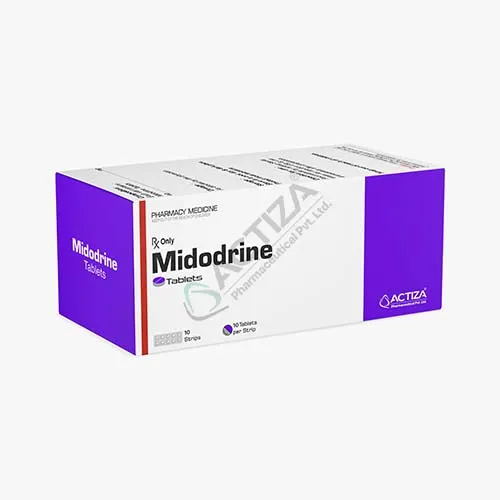
Midodrine Tablet
| Product/Composition:- | Midodrine Tablet |
|---|---|
| Strength:- | 2.5mg, 5mg |
| Form:- | Tablet |
| Production Capacity:- | 10 Million Tablets/Month |
| Packaging:- | 10 X 10 Tablets / Box |
| Therapeutic use:- | High blood pressure, Heart failure |
| Package Insert/Leaflet:- | Available upon request |
Introduction
Midodrine is a prodrug converted to desglymidodrine, an alpha-1 adrenergic agonist, and is classified as a vasopressor and antihypotensive agent for symptomatic orthostatic hypotension.
Its labelling carries a boxed warning that constrains both prescribing and promotional claims, and our Module 1 content reproduces it in full.
Complete CTD, ACTD and eCTD dossiers, in-vivo bioequivalence data, CoPP, FSC and ICH Zone IVb stability are supplied for MOH registration.
Product Overview Table
| Field | Details |
| Product Name | Midodrine Hydrochloride Tablets |
| INN / Generic Name | Midodrine hydrochloride |
| Pharmacological Classification | Vasopressor / antihypotensive |
| Mechanism (brief) | Prodrug converted to desglymidodrine, an alpha-1 adrenergic agonist producing peripheral vasoconstriction |
| Indication | Treatment of symptomatic orthostatic hypotension, per approved local labelling |
| BOXED WARNING | Can cause marked elevation of supine blood pressure (systolic above 200 mmHg). To be used in patients whose lives are considerably impaired despite standard clinical care. Indication rests primarily on a surrogate marker 1-minute standing systolic blood pressure. Clinical benefits, principally improved ability to carry out activities of daily living, have not been verified. |
| Positioning per Label | Reserved for patients still considerably impaired despite standard clinical care, including support stockings, fluid expansion and lifestyle measures |
| STOPPING RULE IN LABEL | Reference labelling directs that treatment be continued only for patients who report significant symptomatic improvement |
| CRITICAL TIMING INSTRUCTION | Last daily dose at least 3 to 4 hours before bedtime, and not after the evening meal. Avoid dosing if the patient will be supine for any length of time. |
| API Quality | Manufactured using DMF-grade Midodrine Hydrochloride |
| Pharmacopoeial Standard | USP: Midodrine Hydrochloride Tablets USP |
| Available Strengths | 2.5 mg, 5 mg and 10 mg tablets |
| Monitoring | Renal and hepatic function assessed before initiating and subsequently, since desglymidodrine is eliminated by the kidneys and the liver has a role in its metabolism |
| Interaction Counselling | Over-the-counter cold remedies and diet aids can raise blood pressure and may potentiate the pressor effect a counselling point patients routinely overlook |
| Governing Quality Attribute | Content uniformity at 2.5 mg this is a low-dose product |
| Shelf Life | 36 Months |
| Manufacturing Facility | WHO-GMP certified general oral solid dosage block, segregated from beta-lactam operations |
| Dossier Available | Yes, CTD / ACTD / eCTD format |
Strengths, Presentation & Specification
Midodrine Hydrochloride Tablets 5 mg
The central strength in the range and the one carrying most volume, used across the usual dosing pattern of two or three doses through the waking day.
Because dosing is confined to daytime hours by the supine hypertension constraint, the dosing schedule for this product is unusually rigid it cannot simply be spread evenly across twenty-four hours, and that shapes both patient counselling and pack sizing.
Midodrine Hydrochloride Tablets 2.5 mg
The initiation and fine-titration strength. At 2.5 mg this is a genuinely low-dose tablet, which makes content uniformity rather than assay the governing quality risk.
It also matters clinically: because the label reserves this product for patients still impaired despite standard care, and directs that treatment continue only where significant symptomatic improvement is reported, careful titration from a low starting dose is part of how the prescriber makes that judgement.
Midodrine Hydrochloride Tablets 10 mg
The higher strength, reducing tablet burden for patients established on larger daily doses.
Typically tendered alongside the other two rather than separately, since patients titrate between them.
An Artwork Point Specific to This Range
Specification & Testing
Content uniformity demonstrated at batch level, with blend uniformity data through granulation and compression at 2.5 mg this is where the product would fail if it were going to
Assay, dissolution and related substances against the declared monograph, with a validated dissolution method
Colourant declarations documented per strength, since the differentiation is part of the product design
Moisture control across shelf life.
Regulatory & Dossier Support
Dossier Availability
CTD (Common Technical Document): ICH-aligned, for regulated and semi-regulated markets
ACTD (ASEAN Common Technical Dossier): Philippines, Vietnam, Myanmar, Indonesia, Cambodia
eCTD: for authorities mandating electronic submission
Module 3 quality documentation including blend and content uniformity data, process validation and dissolution method validation
Stability data: real-time and accelerated under ICH Zone IVb (30°C / 75% RH)
Module 1 labelling reproduces the boxed warning in full, including the surrogate-endpoint statement see Section 5F for why abbreviating it is not an option
Bioequivalence & Biowaiver Position
In-vivo bioequivalence (BE) data against the reference product is the standard route for registration of midodrine hydrochloride tablets, and our submissions carry it.
Whether a BCS-based biowaiver is available in a given jurisdiction depends on the solubility and permeability data recorded in your own dossier rather than on an assumed classification.
BE study data available Analyte selection is worth confirming at protocol stage.
Midodrine is a prodrug converted to desglymidodrine, so which moiety is measured parent, active metabolite, or both should be settled against the applicable guidance before the study is run rather than afterwards
Strength-to-strength biowaiver may be accepted across 2.5 mg, 5 mg and 10 mg where proportional similarity and comparable dissolution profiles are demonstrated, subject to the individual authority
Comparative dissolution profiles held throughout shelf life
Drug Master File (DMF)
Drug Master File (DMF) reference for the Midodrine Hydrochloride API available for cross-referencing in your registration dossier
API sourced against a qualified vendor with impurity, residual solvent, elemental impurity and particle size characterisation particle size matters for blend uniformity at 2.5 mg
CDSCO / Indian DMF reference accepted by a large number of importing authorities
Manufacturing Compliance
WHO-GMP certifiedmanufacturing facility, audit-ready, with inspection reports shared on an NDA basis
Site Master File (SMF)available for regulatory submissions
Midodrine is neither a beta-lactam nor a cytotoxic and is not subject to international drug control conventions, so no dedicated block is required.
Production runs in a general oral solid dosage block physically segregated from beta-lactam operations, with validated cleaning between products
Low-dose blending controls are the substantive manufacturing question.
At 2.5 mg per tablet, blend homogeneity, API particle size and segregation control during compression govern content uniformity, and these are documented as controlled process parameters rather than release testing outcomes
Colourant handling and changeover controls documented, since three strengths with different colourants run through the same line
Compliant with the requirements of NAFDAC (Nigeria), PPB (Kenya), FDA Philippines, DRAP (Pakistan) and INVIMA (Colombia)
Complete Documentation Package (Per Shipment)
| Document | Purpose |
| Certificate of Analysis (CoA) | Confirms batch quality against the agreed specification |
| Certificate of Pharmaceutical Product (CoPP / CPP) | Required for MOH registration in most importing countries |
| Free Sale Certificate (FSC) | Confirms the product is freely sold in the country of manufacture |
| Method of Analysis (MOA) | Analytical methodology mandatory dossier component |
| GMP Certificate | Confirms manufacturing site compliance |
| Stability Data | Real-time and accelerated ICH Zone IVb |
| BE Study Report or Biowaiver Justification | States route taken, strengths covered and analyte measured |
| Content Uniformity Data | Batch-level the governing quality attribute at 2.5 mg |
| Blend Uniformity Data | Through granulation and compression, not only at release |
| Dissolution Profile Report | Across the physiological pH range |
| Colourant Declarations | Per strength the differentiation is a design feature |
| Approved Leaflet, Translated | Carrying the boxed warning and timing instruction in full |
What the Boxed Warning Forbids You From Saying
NO OTHER PRODUCT IN THIS SERIES HAS THIS PROBLEM.
Boxed warnings elsewhere in this portfolio warn about harms liver failure, ketoacidosis, fatal intravenous administration.
Midodrine’s does that, and then goes further: it states that the indication rests primarily on a surrogate marker of effectiveness, and that the clinical benefits, principally improved ability to carry out activities of daily living, have not been verified.
A label that discloses the limits of its own evidence sets a ceiling on what marketing may claim, and that ceiling is lower than most commercial teams expect.
The distinction to hold onto is between what was demonstrated and what was hoped for.
What was demonstrated is an increase in systolic blood pressure measured one minute after standing.
What has not been verified is that this translates into patients being better able to carry out their daily activities.
The label states both, and any copy that blurs them is making a claim the registration does not support.
Do not write that the product improves ability to perform daily activities, restores independence, reduces fatigue, or helps patients stand or walk. Each of these describes the unverified benefit
Do write the indication as the label words it treatment of symptomatic orthostatic hypotension and let the prescriber apply it
The reserved positioning is part of the indication, not a caveat. Labelling directs use in patients whose lives are considerably impaired despite standard clinical care, including support stockings, fluid expansion and lifestyle measures.
Copy that presents this as a first-line option misstates the registration
The stopping rule belongs in the leaflet too. Reference labelling directs that treatment be continued only for patients who report significant symptomatic improvement an instruction that most product leaflets in this category do not carry and that this one must
Brief the sales team explicitly. This is the kind of nuance that survives a regulatory review of the artwork and then disappears in a verbal pitch.
The constraint applies to what is said in a meeting as much as to what is printed
We supply the full boxed warning translated for the destination market and will not shorten it to fit a smaller leaflet format.
On this product the warning is unusually long, and the carton has to accommodate it rather than the reverse
Clinical Information & Honest Commercial Assessment
Midodrine is a prodrug converted to desglymidodrine, an alpha-1 adrenergic agonist that produces peripheral vasoconstriction.
It is classified as a vasopressor and antihypotensive agent, and is indicated for the treatment of symptomatic orthostatic hypotension.
Boxed warning. The product can cause marked elevation of supine blood pressure, reported at systolic values above 200 mmHg, and is to be used in patients whose lives are considerably impaired despite standard clinical care.
The indication rests primarily on a surrogate marker of effectiveness, and the clinical benefits have not been verified
The timing instruction is the practical safety control. Patients should take the last daily dose at least three to four hours before bedtime, not after the evening meal, and should avoid dosing if they will be supine for any length of time.
Labelling also notes that nighttime supine hypertension may be further reduced by elevating the head
Monitoring: desglymidodrine is eliminated by the kidneys and the liver has a role in its metabolism, so renal and hepatic function should be assessed before initiating therapy and subsequently as appropriate
Interaction counselling patients overlook: over-the-counter cold remedies and diet aids can elevate blood pressure and may enhance or potentiate the pressor effect.
Patients do not think of these as medicines, and the leaflet has to name them specifically
Market Assessment For Internal Use
Two commercial realities deserve stating internally, neither of which belongs on the page.
First, the label contains a stopping rule: treatment is to be continued only for patients who report significant symptomatic improvement.
That is unusual, and it means this is not a molecule on which to forecast indefinite patient persistence in the way one would for an antihypertensive or a statin.
A proportion of patients started will be stopped by design.
Second, a substantial share of real-world use in several markets is outside the approved indication in settings such as dialysis-associated hypotension and hepatology.
Your sales team will encounter that demand, and they should understand where it comes from.
They must not market to it: promoting an unapproved indication is a serious regulatory exposure in every market this page targets, and it is the single most likely way this product creates a problem for you
Forecast on the approved indication only. Orthostatic hypotension in the populations this product serves is a real but bounded market, and a forecast that quietly assumes off-label volume is a forecast built on something you cannot lawfully support
Channel accordingly. Hospital and specialist neurology, cardiology and geriatric channels rather than broad retail which is where the approved indication is actually diagnosed and managed
Target Export Markets
Africa
Active markets: Nigeria, Kenya, Ghana, Egypt, Tanzania, Ethiopia, South Africa, Côte d’Ivoire
Registration support: NAFDAC (Nigeria), PPB (Kenya), FDA Ghana, TFDA (Tanzania) CoPP and FSC are the primary gatekeeping documents
Demand sits with tertiary neurology, cardiology and geriatric services rather than general distribution
Labelling: English and French artwork available for Anglophone and Francophone Africa
Southeast Asia
Active markets: Philippines, Vietnam, Indonesia, Thailand, Malaysia, Bangladesh
ACTD dossier format supplied as standard mandatory for ASEAN registrations
Stability: ICH Zone IVb data is a prerequisite across this climate zone
Latin America (LATAM)
Active markets: Colombia, Peru, Ecuador, Bolivia, Guatemala, Dominican Republic
USP pharmacopoeial standard preferred; Spanish and Portuguese labelling available
CTD format with local regulatory adaptation, legalisation and apostille support
Middle East & CIS
Active markets: Iraq, Jordan, Yemen, Uzbekistan, Kazakhstan, Azerbaijan
GMP Certificate and CoPP are the primary registration requirements across these authorities
Arabic and Russian labelling available on request
Export Packaging & Supply Chain
Primary Packaging Options
| Presentation | Packaging Options |
| Midodrine Tablets 5 mg | Alu-Alu blister 10×10 and 3×10; HDPE bottle of 100 with induction seal |
| Midodrine Tablets 2.5 mg | Alu-Alu blister 10×10 and 3×10; HDPE bottle of 100 |
| Midodrine Tablets 10 mg | Alu-Alu blister 10×10; HDPE bottle of 100 |
| Daytime-dosing packs | Configurations reflecting two or three daytime doses rather than a round tablet count |
One pack design point is specific to this molecule.
Because the last dose must fall three to four hours before bedtime, dosing is compressed into the waking day rather than spread across twenty-four hours.
A pack sized to a round number of tablets does not map cleanly onto that pattern, and a configuration reflecting the actual daily dose count makes the schedule easier for a patient to follow which matters when the consequence of an ill-timed dose is nocturnal supine hypertension.
Labelling & Customisation
Private labelmanufacturing with your brand name and artwork, subject to unchanged regulatory content
Multi-lingual labelling: English, French, Spanish, Portuguese, Arabic, Russian
Mandatory artwork content: the full boxed warning including the surrogate-endpoint statement, the timing instruction in plain language on the carton face, the supine-hypertension caution, the OTC interaction warning, storage statement and country-specific registration fields
Logistics & Supply
Incoterms: FOB, CIF, CFR, EXW as per buyer requirement
No cold chain required; protect from moisture, light and sustained heat in transit
Lead time: We plan against committed annual forecasts.
Note the stopping rule in when building those forecasts patient persistence on this molecule is lower by design than on a chronic cardiovascular therapy
Why Source Midodrine Tablets From Us?
Boxed Warning Carried in Full, Including the Part Most Suppliers Would Rather Omit: The surrogate-endpoint statement is part of the warning.
We reproduce it, translate it, and refuse to shorten it for carton size, because a leaflet that drops it misrepresents the registration.
Timing Instruction on the Carton Face: The last dose must fall three to four hours before bedtime. The harm it prevents happens at night, long after the leaflet has been put away, so the instruction goes where the patient will see it.
Full Three-Strength Range With Colour Differentiation Preserved: 2.5 mg, 5 mg and 10 mg. Patients hold multiple strengths during titration and are typically elderly; strength differentiation is a safety feature and we will not unify it for brand consistency.
Low-Dose Uniformity Controlled at Source: At 2.5 mg, blend homogeneity and API particle size govern content uniformity. Documented as controlled process parameters, with batch-level data supplied on request.
Straight Advice on What You May Claim: We will tell your regulatory and commercial teams where the promotional ceiling sits on this molecule before artwork is drafted, rather than after a deficiency letter.
WHO-GMP Certified Manufacturing: Segregated general oral solid facility with validated cleaning and colourant changeover controls. GMP certificate and Site Master File (SMF)shared on request.
Frequently Asked Questions
Q1. Do you provide a dossier for Midodrine Hydrochloride Tablets?
Yes. We provide complete dossiers in CTD,ACTD and eCTD formats across all three strengths.
The dossier includes Module 3 quality documentation with blend and content uniformity data, process validation, dissolution method validation, ICH Zone IVb stability and the bioequivalence study report.
Module 1 labelling reproduces the boxed warning in full, including the surrogate-endpoint statement.
Q2. Why does the boxed warning mention a surrogate marker?
Because the indication rests on one. Reference labelling states that the indication is based primarily on a change in a surrogate marker of effectiveness an increase in systolic blood pressure measured one minute after standing and that the clinical benefits, principally improved ability to carry out activities of daily living, have not been verified.
It is a label disclosing the limits of its own evidence, and it must be reproduced rather than paraphrased.
Q3. What can we claim in promotional material?
The indication as the label words it, and nothing beyond it. You may not claim the product improves ability to perform daily activities, restores independence or reduces fatigue, because the label states that benefit has not been verified.
You should also reflect the reserved positioning labelling directs use in patients whose lives remain considerably impaired despite standard clinical care including support stockings, fluid expansion and lifestyle measures.
Q4. Why is the dose timing so important?
Because the product can cause marked elevation of supine blood pressure, reported above 200 mmHg systolic.
Patients should take the last daily dose at least three to four hours before bedtime, not after the evening meal, and should avoid dosing if they will be lying down for any length of time.
We carry that instruction on the carton face, because the harm occurs at night after the leaflet has been put away.
Q5. Should we register all three strengths?
Yes. The label reserves this product for patients still impaired despite standard care and directs that treatment continue only where significant symptomatic improvement is reported so careful titration from a low starting dose is part of how the prescriber makes that judgement.
A range without the 2.5 mg strength leaves them unable to do it properly.
Q6. Can you supply under our private label?
Yes, with two fixed limits beyond the usual safety-labelling constraint.
The full boxed warning including the surrogate-endpoint statement cannot be shortened for carton size, and strength differentiation by tablet colour must be preserved across the range.
Patients on this product hold multiple strengths during titration and are typically elderly.
Q7. Is a bioequivalence study required?
In-vivo bioequivalence against the reference product is the standard route and our submissions carry it.
One point worth settling at protocol stage: midodrine is a prodrug converted to desglymidodrine, so which moiety is measured should be agreed against the applicable guidance before the study runs rather than afterwards.
Q8. What is the MOQ and lead time?
MOQ varies by strength and pack configuration, and the three strengths are normally quoted as a titration set.
When you share your forecast, note that reference labelling directs discontinuation in patients who do not report significant symptomatic improvement patient persistence on this molecule is lower by design than on a chronic cardiovascular therapy, and a realistic forecast should reflect that.
Call to Action
Ready to Source Midodrine Hydrochloride Tablets FDF?
Share your target market, required strengths and expected annual volume, and our export team will respond with the applicable specification, the bioequivalence route that authority requires, dossier format, pack options and pricing.
If you are preparing artwork, ask us for the promotional-claim boundary note first it is easier to draft within it than to revise after a deficiency letter.