

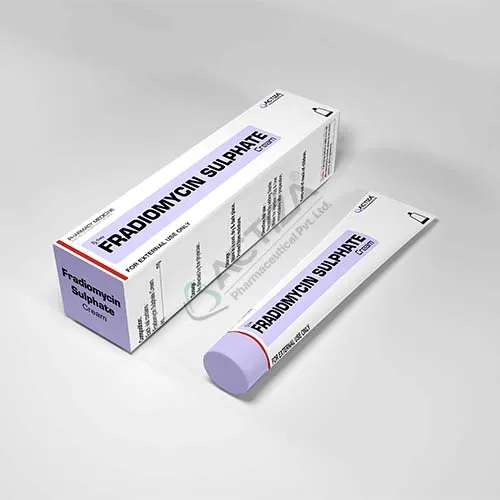
Fradiomycin Sulphate
| Product/Composition:- | Fradiomycin Sulphate |
|---|---|
| Strength:- | 5 mg |
| Form:- | Cream |
| Packaging:- | 30 gm in 1 tube |
| Therapeutic use:- | bacterial infections of the skin, eyes, and ears |
| Package Insert/Leaflet:- | Available upon request |
Introduction
Actiza Pharmaceutical is a WHO-GMP certified pharmaceutical exporter supplying Fradiomycin Sulphate the Japanese Accepted Name for the substance known internationally as neomycin sulphate as a finished dosage formulation rather than as an API.
Fradiomycin is an aminoglycoside antibacterial derived from Streptomyces fradiae, from which its name comes.
It is supplied in oral, topical, ophthalmic and otic presentations, frequently in combination with a corticosteroid, and the safety profile differs materially by route.
Complete CTD, ACTD and eCTD dossiers, CoPP, FSC and ICH Zone IVb stability are supplied for MOH registration, prepared under the substance name that your destination authority recognises.
Substance Overview
| Field | Details |
| Product Name | Fradiomycin Sulphate (Neomycin Sulphate) |
| Name:- Japan (JAN) | Fradiomycin sulfate the name used in Japanese Pharmacopoeia markets |
| Name:- INN / USAN | Neomycin sulphate the name used in USP, BP and most other markets |
| Note | Do NOT confuse with Framycetin sulphate a separate entity consisting mainly of neomycin B |
| Therapeutic Class | Aminoglycoside antibacterial |
| Source | Obtained from the metabolic products of the actinomycete Streptomyces fradiae |
| Dosage Forms | Oral tablets; topical ointment and cream; ophthalmic and otic preparations most commonly in combination with a corticosteroid |
| Oral Strength | Tablets 500 mg neomycin sulphate, equivalent to 350 mg neomycin base |
| Oral Boxed Warnings | Nephrotoxicity, ototoxicity and neuromuscular blockade. Small amounts of orally administered neomycin are absorbed through intact intestinal mucosa, and there are many literature reports of nephrotoxicity and ototoxicity with oral use. |
| Topical Key Issue | Allergic contact dermatitis is well documented, particularly with periocular application of combination ointments |
| Cross-Allergenicity | Demonstrated among aminoglycosides a patient sensitised to one may react to others |
| Neuromuscular Caution | Use with caution in myasthenia gravis or parkinsonism; aminoglycosides may aggravate muscle weakness through a curare-like effect at the neuromuscular junction |
| Pharmacopoeial Standard | USP / BP as Neomycin Sulphate; JP as Fradiomycin Sulfate |
| API Quality | Manufactured using DMF-grade material |
| Manufacturing Facility | WHO-GMP certified block depends on the dosage form selected |
| Dossier Available | Yes, CTD / ACTD / eCTD format |
Presentations
Oral Tablets Neomycin Sulphate 500 mg
Supplied as 500 mg tablets equivalent to 350 mg of neomycin base, used for gastrointestinal indications where poor oral absorption is the therapeutic point rather than a limitation.
This is the presentation carrying boxed warnings, and it is the one with the heaviest labelling burden.
Registered almost universally under the neomycin name rather than the fradiomycin name.
Topical Ointment and Cream
The presentation most often requested under the fradiomycin name, and most often supplied in combination with a corticosteroid.
Combination topical products carry their own registration pathway a fixed-dose combination dossier rather than a single-agent one and their own dominant safety issue, which is allergic contact dermatitis rather than systemic aminoglycoside toxicity.
Combination partners commonly seen in these markets include corticosteroids such as betamethasone and methylprednisolone.
Ophthalmic and Otic Preparations
Ophthalmic and otic presentations, again commonly combined with a corticosteroid, are established in Japan-influenced markets for ophthalmic inflammation associated with infection and for external ear conditions.
These are sterile products, which changes the manufacturing requirement entirely.
The periocular contact dermatitis issue is documented specifically in relation to combination ophthalmic ointments containing this substance.
Regulatory & Dossier Support
Dossier Availability
CTD (Common Technical Document) ICH-aligned, for regulated and semi-regulated markets.
ACTD (ASEAN Common Technical Dossier) for Philippines, Vietnam, Myanmar, Indonesia, Cambodia. eCTD for authorities mandating electronic submission.
Dossiers are prepared under the substance name the destination authority recognises fradiomycin sulfate for Japanese Pharmacopoeia markets, neomycin sulphate elsewhere.
Module 3 content depends on the dosage form; combination products require fixed-dose combination justification.
Stability data includes real-time and accelerated under ICH Zone IVb (30°C / 75% RH).
Bioequivalence Route Determines Everything
Combination products add a further layer the contribution of each component must be justified, and the comparison is against the registered combination reference, not against the single agents.
Drug Master File (DMF)
Drug Master File (DMF) reference available for cross-referencing in your registration dossier.
API is sourced from a qualified vendor with full impurity, potency, and component-ratio characterisation
neomycin is a multi-component aminoglycoside, and the component profile is part of the specification. CDSCO / Indian DMF reference accepted by a large number of importing authorities.
Manufacturing Compliance
WHO-GMP certified manufacturing facility, audit-ready, with inspection reports shared on an NDA basis. Site Master File (SMF) available for regulatory submissions.
The applicable block depends on the form. Oral solids run in a general non-beta-lactam oral solid block; topical products in a dedicated semisolid block; ophthalmic and otic preparations in a sterile block with Grade A filling under Grade B background.
Fradiomycin is an aminoglycoside but not a beta-lactam, so no penicillin block applies however, segregation from beta-lactam operations and validated cleaning between products remain standard.
Complete Documentation Package (Per Shipment)
| Document | Purpose |
| Certificate of Analysis (CoA) | Issued under the substance name recognised in the destination market |
| Certificate of Pharmaceutical Product (CoPP / CPP) | Required for MOH registration in most importing countries |
| Free Sale Certificate (FSC) | Confirms the product is freely sold in the country of manufacture |
| Method of Analysis (MOA) | Analytical methodology mandatory dossier component |
| GMP Certificate | Confirms manufacturing site compliance for the applicable block |
| Stability Data | Real-time and accelerated ICH Zone IVb |
| Nomenclature Equivalence Statement | Confirms fradiomycin sulfate and neomycin sulphate are the same substance |
| Component Profile / Potency Data | Neomycin is multi-component; potency expressed in the units the destination monograph requires |
| BE or Biowaiver Justification | Form-dependent |
| Excipient Declarations | For all inactive ingredients |
The Nomenclature Problem Why It Matters
Fradiomycin sulfate and neomycin sulphate are the same aminoglycoside under two official names fradiomycin is the Japanese Accepted Name, neomycin the INN and USAN.
A dossier, artwork set, or certificate of analysis issued under the name the destination authority does not use will be queried, and in the worst case will be treated as a different substance.
| Name | Status | Where It Is Used |
| Neomycin sulphate | INN / USAN. Same substance as fradiomycin sulfate. | USP, BP and the majority of export markets |
| Fradiomycin sulfate | Japanese Accepted Name. Same substance as neomycin sulphate. | Japanese Pharmacopoeia markets and Japan-influenced Asian markets |
| Framycetin sulphate | A SEPARATE named entity, consisting mainly of neomycin B. | Recognised separately in some markets do NOT treat as interchangeable |
Ask which name the destination authority uses before the dossier is compiled, not after the first query letter arrives.
Artwork, CoA, CoPP and the MOH application must all use the same name, and it must be the one the authority recognises.
We supply a nomenclature equivalence statement with the documentation package, confirming that fradiomycin sulfate and neomycin sulphate are the same substance, which pre-empts the most frequent query on this molecule.
Framycetin is the trap. It is related but separately named, consisting mainly of neomycin B, and it is recognised as its own entity in some markets.
Potency units matter alongside the name aminoglycoside potency is expressed differently across monographs, and a specification that states milligrams where the authority expects units is another avoidable query.
Clinical & Safety Information
Fradiomycin is an aminoglycoside antibacterial obtained from the metabolic products of Streptomyces fradiae.
Its clinical profile is dominated by the class toxicities of aminoglycosides, moderated by the fact that it is very poorly absorbed which is why it survives as an oral gut agent and a topical agent while having no place in systemic therapy.
Oral Route the Boxed Warning Territory
Reference labelling for oral tablets carries boxed warnings covering nephrotoxicity, ototoxicity and neuromuscular blockade, and these must appear in full in the leaflet and artwork.
Poor absorption is not zero absorption. Small amounts of orally administered neomycin are absorbed through intact intestinal mucosa, and there are many literature reports of nephrotoxicity and ototoxicity with oral use.
Additive toxicity is a real prescribing risk. Concurrent or sequential use with other aminoglycosides, or with other nephrotoxic or neurotoxic agents, should be avoided.
Advanced age and dehydration increase risk, and concurrent use with potent diuretics should be avoided.
Absorption interference is extensive. Oral neomycin inhibits gastrointestinal absorption of several other medicines and may enhance the effect of coumarin anticoagulants by reducing vitamin K availability.
High oral doses produce a malabsorption syndrome affecting a wide range of nutrients.
The interaction section of the leaflet is unusually consequential and must not be trimmed.
Topical and Ophthalmic Route a Different Dominant Risk
Allergic contact dermatitis is the defining issue. It is well documented with topical preparations containing this substance, and specifically with combination ophthalmic ointments applied to the periocular region.
Cross-allergenicity among aminoglycosides has been demonstrated, so a patient sensitised through topical exposure may subsequently react to other members of the class including systemically administered ones.
That is a consequence patients and prescribers rarely connect, and it belongs in the leaflet.
Application to large or broken skin surfaces raises systemic absorption, and with it the oral-route toxicities.
Local labelling should state the area and duration limits from the approved reference.
Target Export Markets
Markets Using the Neomycin Name (USP / BP nomenclature)
Markets Using or Recognising the Fradiomycin Name
Japan and Japan-influenced Asian markets, where Japanese Pharmacopoeia nomenclature is used.
Combination topical, ophthalmic and otic presentations have a long-established position in these markets.
Registration requirements differ substantially from the ACTD and CTD routes used elsewhere.
Southeast Asia Check Nomenclature Per Country
Active markets: Philippines, Vietnam, Myanmar, Cambodia, Indonesia, Thailand, Bangladesh.
ACTD dossier format supplied as standard—mandatory for ASEAN registrations.
This region is where nomenclature is least predictable: some authorities follow USP or BP naming, others have historical Japanese influence.
Confirm per country rather than assuming regional consistency.
Export Packaging & Supply
Packaging by Dosage Form
| If the form is… | Then packaging follows… |
| Oral tablets | Alu-Alu blister or HDPE bottle; artwork must carry the full boxed warning set |
| Topical ointment or cream | Internally lacquered aluminium or laminated tube; carton must carry the contact-sensitisation caution and area/duration limits |
| Ophthalmic or otic | LDPE dropper bottle or ophthalmic tube from a sterile block; single-patient use and in-use discard period required on artwork |
| Any combination product | Both actives named on every carton face, with the corticosteroid component and its own cautions carried in full |
Labelling: What Applies Regardless of Form
The substance name must match the destination authority’s nomenclature on carton, leaflet, foil or tube, and CoA. This is non-negotiable on this product.
Private label manufacturing available, subject to unchanged regulatory content. Multilingual labelling: English, French, Spanish, Portuguese, Arabic, Russian, Japanese.
Cross-allergenicity caution belongs on topical artwork, not only in the leaflet a patient sensitised topically may later react to a systemic aminoglycoside, and the connection is not obvious to them.
Logistics & Supply
Incoterms: FOB, CIF, CFR, EXW as per buyer requirement.
Cold chain requirement depends on form; none of the candidate presentations normally requires it.
Why Source From Us?
We Get the Name Right Before the Dossier Is Built Fradiomycin sulfate and neomycin sulphate are the same substance under two official names, and framycetin is a third and separate one.
We establish which your authority recognises first, and supply a nomenclature equivalence statement that pre-empts the most common query on this molecule.
We Ask Which Dosage Form Before We Quote Oral, topical, ophthalmic and otic presentations have different warnings, different manufacturing blocks, different dossiers and different bioequivalence routes.
Route-Appropriate Safety Labelling Boxed warnings for the oral form; contact sensitisation and cross-allergenicity for the topical. We do not blend the two into a generic warning set.
Combination Product Capability Corticosteroid combinations are a fixed-dose combination submission, not a single-agent one, and we handle them as such.
Complete Dossier in CTD, ACTD and eCTD Pre-compiled with regulatory query response support and country-specific customisation.
WHO-GMP Certified Manufacturing With the block appropriate to the form supplied. GMP certificate and Site Master File (SMF) shared on request.
Frequently Asked Questions
Q1. Is fradiomycin sulphate the same as neomycin sulphate?
Yes. Fradiomycin sulphate is the Japanese Accepted Name for the substance known internationally as neomycin sulphate the same aminoglycoside, obtained from Streptomyces fradiae.
The name appears on your dossier; artwork and CoA must match what your destination authority recognises, and we supply a nomenclature equivalence statement to pre-empt queries.
Q2. Is framycetin the same thing too?
No, and this is the trap on this molecule. Framycetin sulphate is a separately named entity consisting mainly of neomycin B, and it is recognised as its own substance in some markets.
If a buyer asks for framycetin, we ask them to confirm what their registered reference product actually is.
Q3. Which dosage form do you supply?
Please tell us which you need, because the answer changes almost everything.
Oral tablets, topical ointments and creams, and ophthalmic and otic preparations have different warnings, require different manufacturing blocks, follow different bioequivalence routes, and need different dossiers.
Combination products with a corticosteroid are a further category.
Q4. What are the main safety warnings?
They differ by route and should never be merged.
Oral tablets carry boxed warnings for nephrotoxicity, ototoxicity, and neuromuscular blockade poor absorption is not zero absorption.
Topical preparations are dominated instead by allergic contact dermatitis, documented particularly with combination ophthalmic ointments in the periocular region.
Q5. Why does cross-allergenicity matter to a distributor?
Because it extends beyond the product you are selling.
Cross-allergenicity among aminoglycosides has been demonstrated, so a patient sensitised through topical exposure may later react to a systemically administered aminoglycoside.
Patients do not make that connection themselves, which is why we carry the caution on topical artwork.
Q6. Do you provide a dossier?
Yes, in CTD, ACTD, and eCTD formats, prepared under the substance name your destination authority recognises.
Module 3 content and the bioequivalence section depend on the dosage form, and combination products require fixed-dose combination justification.
Q7. Can you supply combination products with a corticosteroid?
Corticosteroid combinations are long established in the markets that use the fradiomycin name, particularly in topical and ophthalmic presentations.
Note that a combination is registered as a fixed-dose combination against the registered combination reference, not against the single agents.
Q8. What is the MOQ and lead time?
Both depend on the dosage form and on whether a combination is involved.
Contact our export team with your destination market, the substance name your authority uses, and the presentation you need, and we will respond with a specification and a quotation built for the right product.
Enquiring about Fradiomycin Sulphate (Neomycin Sulphate)?
Tell us three things, and we can quote accurately: your destination market, which substance name that authority recognises, and which dosage form you require oral, topical, ophthalmic or otic, single agent or corticosteroid combination.
Our regulatory team will confirm the applicable pharmacopoeial standard, dossier format, and bioequivalence route before pricing is discussed.