

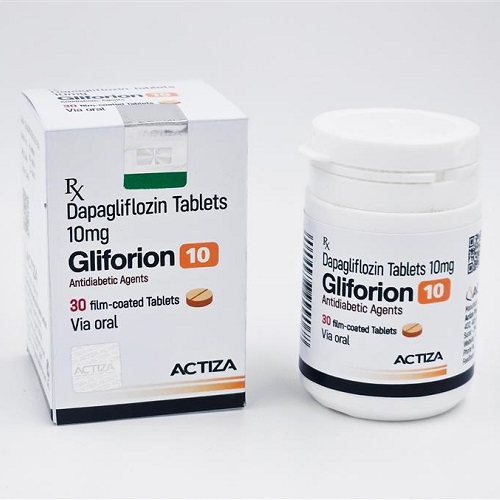

Dapagliflozin Tablet
| Product/Composition:- | Dapagliflozin Tablet |
|---|---|
| Strength:- | 10mg, 5mg |
| Form:- | Tablets |
| Production Capacity:- | 10 Million Tablets/Month |
| Packaging:- | 1 X 30 Tablets / Bottle |
| Therapeutic use:- | Type 2 diabetes |
| Package Insert/Leaflet:- | Available upon request |
Introduction
Actiza Pharmaceutical is a WHO-GMP certified pharmaceutical exporter supplying Dapagliflozin Tablets as a finished dosage formulation not API in 5 mg and 10 mg film-coated presentations.
Dapagliflozin is a sodium-glucose co-transporter 2 (SGLT2) inhibitor, now used across type 2 diabetes, heart failure and chronic kidney disease rather than in diabetes alone.
Every consignment is supported by a complete CTD dossier, also available in ACTD and eCTD format, with in-vivo bioequivalence data, CoPP, FSC and ICH Zone IVb stability.
Because the compound patent lapsed only recently while secondary patents remain live in many jurisdictions, we confirm freedom to operate for your specific market including the solid form we supply before quoting.
Product Overview
| Field | Details |
| Product Name | Dapagliflozin Tablets |
| INN / Generic Name | Dapagliflozin (supplied as dapagliflozin propanediol monohydrate) |
| Therapeutic Class | Sodium-glucose co-transporter 2 (SGLT2) inhibitor |
| Mechanism | Inhibits SGLT2 in the proximal renal tubule, reducing glucose reabsorption and increasing urinary glucose and sodium excretion. Action is insulin-independent. |
| Indications | Type 2 diabetes mellitus; heart failure; chronic kidney disease per approved local labelling. NOT indicated for type 1 diabetes. |
| API Quality | Manufactured using DMF-grade Dapagliflozin |
| Pharmacopoeial Standard | USP |
| Available Strengths | 5 mg and 10 mg film-coated tablets |
| Key Safety Issue | Diabetic ketoacidosis, including cases presenting with blood glucose below the level usually associated with DKA |
| Other Notable Warnings | Genital mycotic infections; urinary tract infections; necrotising fasciitis of the perineum (Fournier’s gangrene); volume depletion and hypotension |
| Perioperative | Reference labelling directs temporary interruption before scheduled surgery |
| Solid Form Note | The specific crystalline form is both a quality attribute and a patent-relevant question |
| Patent Status | Compound patent recently lapsed in major markets; secondary patents subsist. Freedom to operate must be confirmed per market. |
| Shelf Life | 36 Months |
| Storage | Store at 20-25°C; excursions permitted 15–30°C |
| Manufacturing Facility | WHO-GMP certified general oral solid dosage block, segregated from beta-lactam operations |
| Dossier Available | Yes CTD / ACTD / eCTD format |
Strengths, Presentation & Specification
Dapagliflozin Tablets 10 mg
The principal strength and the one that carries most of the volume, used across the glycaemic, cardiac and renal indications.
The expansion of this molecule beyond diabetes has changed who prescribes it: cardiology and nephrology now account for a substantial share of prescribing in developed markets, and that shift is spreading into the markets this page targets.
Target buyers: diabetes and cardiology distributors, hospital and retail chains, MOH tender procurement in eligible markets.
Dapagliflozin Tablets 5 mg
The lower strength, used where a reduced dose is appropriate under local labelling and in patients being initiated cautiously.
Volumes are smaller than the 10 mg strength but the two are normally tendered together.
Fixed-Dose Combinations A Separate Question Entirely
If your portfolio includes dapagliflozin fixed-dose combinations with metformin, or with a DPP-4 inhibitor do NOT append them to this page.
Reporting indicates combination formulation patents running materially longer than monotherapy formulation patents, to around 2030.
A combination product therefore has a different and later freedom-to-operate position than the monotherapy tablet, and each combination needs its own page and its own freedom-to-operate analysis.
Specification & Testing
Solid form is specified and controlled explicitly.
Dapagliflozin is supplied as a co-crystallised or solvated form rather than as a simple free molecule, and the form affects dissolution, stability and the patent position
Assay, content uniformity, dissolution and related substances against the declared specification
Discriminatory dissolution method validated across the physiological pH range
Moisture control across shelf life, supporting the packing specified
Regulatory, Dossier & IP Position
Dossier Availability
CTD (Common Technical Document) ICH-aligned, for regulated and semi-regulated markets.
ACTD (ASEAN Common Technical Dossier) for Philippines, Vietnam, Myanmar, Indonesia, Cambodia.
eCTD for authorities mandating electronic submission.
Module 3 quality documentation includes solid form characterisation, process validation, dissolution method validation and moisture control strategy.
Stability data includes real-time and accelerated under ICH Zone IVb (30°C / 75% RH), with solid-form stability confirming no conversion across shelf life.
Bioequivalence Position
In-vivo bioequivalence (BE) data against the reference product is the standard route for registration of dapagliflozin tablets.
Whether a BCS-based biowaiver is available in a given jurisdiction depends on the solubility and permeability data recorded in your own dossier rather than on a classification that can be assumed from the literature.
BE study data available
Strength-to-strength biowaiver may be accepted between 5 mg and 10 mg where proportional similarity and comparable dissolution profiles are demonstrated, subject to the individual authority
Comparative dissolution profiles held throughout shelf life, with the solid form verified as unchanged
Drug Master File (DMF)
Drug Master File (DMF) reference for the Dapagliflozin API is available for cross-referencing in your registration dossier.
API is sourced against a qualified vendor with impurity, residual solvent, particle size and critically solid form and polymorph characterisation.
The API solid form is a patent-relevant specification on this molecule, not only a quality one.
Manufacturing Compliance
WHO-GMP certified manufacturing facility, audit-ready, with inspection reports shared on an NDA basis.
Dapagliflozin is neither a beta-lactam nor a cytotoxic and is not subject to international drug control conventions.
Production runs in a general oral solid dosage block physically segregated from beta-lactam operations, with validated cleaning between products.
Solid-form integrity is protected through processing granulation and drying conditions are controlled so that the crystalline form specified in the dossier is the form present in the finished tablet.
Complete Documentation Package (Per Shipment)
| Document | Purpose |
| Certificate of Analysis (CoA) | Confirms batch quality against the agreed specification |
| Certificate of Pharmaceutical Product (CoPP / CPP) | Required for MOH registration in most importing countries |
| Free Sale Certificate (FSC) | Confirms the product is freely sold in the country of manufacture |
| Method of Analysis (MOA) | Analytical methodology mandatory dossier component |
| GMP Certificate | Confirms manufacturing site compliance |
| Stability Data | Real-time and accelerated ICH Zone IVb, plus solid-form stability |
| BE Study Report or Biowaiver Justification | States explicitly which route was taken and on which strength |
| Solid Form / Polymorph Characterisation | Both a quality attribute and a patent-relevant specification |
| Dissolution Profile Report | Discriminatory method across the physiological pH range |
| Freedom-to-Operate Confirmation | Written confirmation of the IP position assessed for the destination market |
| Content Uniformity Data | Batch-level |
| Excipient Declarations | For all inactive ingredients |
Safety Points That Belong in Every Leaflet
Ketoacidosis can occur without the blood glucose level that usually signals it.
Leaflet and prescriber information must describe the symptoms nausea, vomiting, abdominal pain, malaise, breathlessness rather than relying on a glucose threshold.
Perioperative interruption is a real-world failure point.
Reference labelling directs temporary discontinuation before scheduled surgery.
A plain-language instruction on the carton and in the leaflet does more for this than anything in the prescribing information.
Genital and urinary infections are the most common reason patients stop.
Forewarning materially improves persistence.
Necrotising fasciitis of the perineum has been reported.
The leaflet must direct urgent medical attention for perineal pain, tenderness, redness or swelling accompanied by fever or malaise.
Volume depletion warrants a specific caution in elderly patients, those on diuretics and those with impaired renal function.
Not indicated for type 1 diabetesthis must be explicit in local artwork.
We supply the full warning set translated for the destination market and will not abbreviate the ketoacidosis or perineal infection sections.
Freedom to Operate Why “The Patent Expired” Is Not the Answer Here
Public reporting indicates the compound patent expired in the United States in early April 2026, with key European patents estimated to expire at the end of June 2026.
Those dates describe the compound only.
Reporting also indicates formulation patents running to around 2028 for the monotherapy product and to around 2030 for combinations, alongside polymorph and crystalline-solvate patents, within an estate reported at over four hundred patent family members across more than fifty countries.
The solid form is a patent question, not only a quality one.
Patents in this estate cover crystalline solvates of the molecule.
Which crystalline form your API supplier uses may therefore determine whether your finished product infringes in a given market, even where the compound patent has lapsed.
Your API supplier’s freedom-to-operate position becomes yours.
Ask the question of them directly rather than assuming a DMF reference settles it.
Formulation patents can block a specific tablet, not the molecule.
A different excipient system may be clear where yours is not, and vice versa.
Combinations run later than monotherapy. If a buyer asks about dapagliflozin plus metformin on the strength of a monotherapy clearance, the answer is a separate analysis.
Our process: we obtain written confirmation of the destination market IP position, covering compound, formulation and solid form, before quoting.
MANDATORY VERIFICATION: Patent dates are drawn from public reporting current at drafting and were changing rapidly through 2026.
Verify the current position for every destination market at the time of each transaction, through IP counsel, and never from a stored list.
Clinical Indications & Therapeutic Information
Dapagliflozin is a sodium-glucose co-transporter 2 inhibitor.
It reduces reabsorption of filtered glucose in the proximal renal tubule and increases urinary glucose and sodium excretion.
Its action is independent of insulin secretion and insulin sensitivity, which is why it functions across a patient population far wider than the one it was originally developed for.
Approved indications per local labelling span type 2 diabetes mellitus, heart failure and chronic kidney disease.
Do not import indications from another market’s label registration scope varies significantly by country.
The indication expansion is the commercial story on this molecule.
It began as a diabetes agent and is now prescribed by cardiologists and nephrologists as well as diabetologists.
Not indicated for type 1 diabetes, and this must be explicit in local artwork.
Ketoacidosis, including presentations without markedly elevated blood glucose, is the class safety issue that most often delays diagnosis.
Genital mycotic infections, urinary tract infections, necrotising fasciitis of the perineum, and volume depletion with hypotension are documented in reference labelling and must carry through in full.
Market structure: type 2 diabetes, heart failure and chronic kidney disease are all rising steeply across the markets this page targets, and the recent compound patent expiry has opened a large volume opportunity.
Market Eligibility & Target Markets
The Screening Sequence In This Order
Regions Where Enquiries Are Actively Handled
Africa, Southeast Asia, Latin America, the Middle East and the CIS subject in every case to the screening sequence above.
Registration support available for NAFDAC (Nigeria), PPB (Kenya), FDA Philippines, INVIMA (Colombia) and comparable authorities.
ACTD dossier format supplied as standard for ASEAN registrations. Multi-lingual labelling in English, French, Spanish, Portuguese, Arabic, Russian.
ICH Zone IVb stability data supplied as standard for tropical and subtropical destinations.
Export Packaging & Supply Chain
Primary Packaging Options
| Presentation | Packaging Options |
| Dapagliflozin Tablets 10 mg | Alu-Alu blister 10×10, 3×10 and 2×14; HDPE bottle of 30 / 90 with induction seal and desiccant |
| Dapagliflozin Tablets 5 mg | Alu-Alu blister 10×10 and 2×14; HDPE bottle of 30 |
| Chronic-therapy packs | 28-day or calendar blister presentations, suited to indefinite once-daily therapy |
This is lifelong once-daily therapy across all three indications, so packs are opened daily and stored in domestic conditions for years.
Alu-Alu is the default recommendation for Zone IVb markets.
Calendar formats are worth specifying: adherence matters clinically here, and a pack that makes a missed dose visible is a low-cost intervention.
Labelling & Customisation
Private label manufacturing with your brand name and artwork, subject to unchanged regulatory content. Multi-lingual labelling in English, French, Spanish, Portuguese, Arabic, Russian.
Mandatory artwork content: the ketoacidosis symptom warning in plain language, the perioperative interruption instruction, the perineal infection urgent-attention direction, the not-for-type-1-diabetes statement, storage statement and country-specific registration fields.
Private label artwork must not adopt trade dress, colour scheme, tablet shape or embossing resembling the originator product.
On a molecule whose secondary patent estate is live and litigated, this is a trademark and passing-off exposure.
Logistics & Supply
Incoterms: FOB, CIF, CFR, EXW as per buyer requirement.
No cold chain required; protect from moisture and sustained heat in transit.
Chronic indefinite therapy across three indications: we plan against committed annual forecasts rather than reactive ordering.
Why Source Dapagliflozin Tablets From Us?
We Clear the Full Patent Estate, Not Just the Compound Compound, formulation and solid form assessed in writing for your destination market before we quote.
Solid Form Specified and Controlled The crystalline form is both a quality attribute and a patent-relevant specification. We control it through granulation and drying, and document it in the dossier.
Leaflet Built Around the Two Issues That Actually Cause Harm Ketoacidosis that presents without the expected glucose reading, and perioperative interruption that patients forget to mention.
Complete Dossier in CTD, ACTD and eCTD Pre-compiled with regulatory query response support, for markets that clear the eligibility screen.
Adherence-Oriented Pack Options Calendar formats make a missed dose visible, which matters more here than the packaging cost difference.
WHO-GMP Certified Manufacturing Segregated general oral solid facility with validated cleaning.
Frequently Asked Questions
Q1. The dapagliflozin patent has expired can you supply my market now?
That depends on which patent. Public reporting indicates the compound patent lapsed in the United States in April 2026 and key European patents were estimated to expire in June 2026.
But formulation patents are reported to run to around 2028 for monotherapy and 2030 for combinations, alongside polymorph and crystalline-solvate patents.
We assess compound, formulation and solid form for your market before quoting.
Q2. Why does the crystalline form matter?
Because patents in this estate cover crystalline solvates of the molecule, not only the molecule itself.
Which solid form your API supplier uses can determine whether a finished product infringes in a given market even after the compound patent has lapsed.
It is also a quality attribute affecting dissolution and stability. Ask your API supplier about their own freedom-to-operate position directly.
Q3. Do you provide a dossier for Dapagliflozin Tablets?
Yes, for markets that clear the eligibility screen. We provide complete dossiers in CTD, ACTD and eCTD formats covering both strengths, including Module 3 quality documentation with solid form characterisation, process validation, dissolution method validation, ICH Zone IVb stability with solid-form stability, and the bioequivalence study report.
Q4. What about dapagliflozin plus metformin?
A separate question with a later answer. Reporting indicates combination formulation patents running materially longer than monotherapy formulation patents, to around 2030.
A clearance on the monotherapy tablet says nothing about the combination, and we handle each as its own freedom-to-operate analysis.
Q5. What are the safety points you build into labelling?
Two in particular. Ketoacidosis in this class can present without the markedly elevated blood glucose that usually signals it, so the leaflet describes symptoms rather than relying on a glucose threshold.
And reference labelling directs temporary interruption before scheduled surgery an instruction patients routinely fail to mention, which is why we put it in plain language on the carton.
Q6. Is a bioequivalence study required?
In-vivo bioequivalence against the reference product is the standard route and our submissions carry it.
Whether a BCS-based biowaiver is available in a given jurisdiction depends on the solubility and permeability data in your own dossier.
A strength biowaiver between 5 mg and 10 mg may be accepted subject to the authority.
Q7. Can you supply under our private label?
Yes, for eligible markets, with the usual safety-labelling limits plus one specific to this molecule.
Artwork must not adopt trade dress, colour scheme, tablet shape or embossing resembling the originator.
On a product whose secondary patent estate is live and litigated, that is a trademark exposure separate from the patent position.
Q8. What is the MOQ and lead time?
MOQ varies by strength and pack configuration, and the two strengths are normally quoted as a pair.
We do not quote until freedom to operate for the destination market is confirmed in writing, so the first step is to tell us your target market and intended launch date rather than your volume.
Enquiring about Dapagliflozin Tablets?
Tell us your destination market and intended launch date first, and our regulatory team will assess the freedom-to-operate position across compound, formulation and solid form, and confirm the bioequivalence route that authority requires.
Where the position is clear, we will follow with specification, dossier format, pack options, lead time and pricing.
Dossier extracts and quality documentation are released under confidentiality once eligibility is confirmed.