

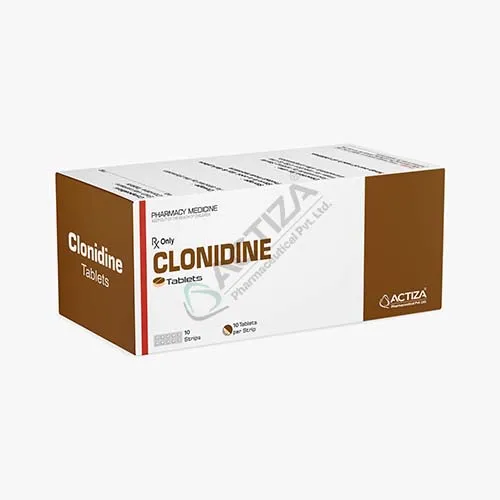
Clonidine Tablet
| Product/Composition:- | Clonidine Tablet |
|---|---|
| Strength:- | 100mg |
| Form:- | Tablet |
| Production Capacity:- | 10 Million Tablets/Month |
| Packaging:- | 10 X 10 Tablets / Box |
| Therapeutic use:- | High blood pressure |
| Package Insert/Leaflet:- | Available upon request |
Introduction
Clonidine is a centrally acting alpha-2 adrenergic agonist used in hypertension.
Because abrupt discontinuation can cause rebound hypertension, we plan supply on this molecule against committed forecasts and buffer stock rather than reactive ordering a stockout here has clinical consequences, not merely commercial ones.
Complete CTD, ACTD and eCTD dossiers, bioequivalence data, CoPP, FSC and ICH Zone IVb stability are supplied for MOH registration.
Product Overview
| Field | Details |
| Product Name | Clonidine Tablets |
| INN / Generic Name | Clonidine hydrochloride |
| Therapeutic Class | Centrally acting alpha-2 adrenergic agonist antihypertensive |
| Mechanism (brief) | Stimulates presynaptic alpha-2 receptors in the brainstem, suppressing sympathetic outflow and reducing peripheral vascular resistance |
| Indication | Hypertension, per approved local labelling |
| API Quality | Manufactured using DMF-grade Clonidine Hydrochloride |
| Pharmacopoeial Standard | USP Clonidine Hydrochloride Tablets USP; BP available [CONFIRM per SKU] |
| Available Strengths | 0.1 mg, 0.2 mg and 0.3 mg tablets |
| CRITICAL WARNING | Do not discontinue abruptly. Sudden cessation can cause rebound hypertension, with rapid blood pressure rise beginning 8 to 24 hours after the last dose. |
| Discontinuation | Taper gradually over 2 to 4 days minimum. Patients on therapy longer than four weeks may require slower reduction. |
| Beta-Blocker Sequencing | Where a beta-blocker is co-prescribed, it should be withdrawn first, several days before beginning the clonidine taper |
| Substitution Warning | Immediate-release and extended-release clonidine products must NOT be substituted on a milligram-per-milligram basis, because pharmacokinetic profiles differ |
| Governing Quality Attribute | Content uniformity at 0.1 mg this is a genuinely low-dose product |
| Solubility Position | Clonidine hydrochloride is freely water-soluble and the dose is very low, which supports a strong BCS-based biowaiver argument [CONFIRM formal classification] |
| Shelf Life | 36 Months [CONFIRM against stability data] |
| Storage | Store at 20–25°C, protect from light and moisture [CONFIRM against your stability data] |
| Manufacturing Facility | WHO-GMP certified general oral solid dosage block, segregated from beta-lactam operations |
| Dossier Available | Yes, CTD / ACTD / eCTD format |
Strengths, Presentation & Specification
Clonidine Tablets 0.1 mg
The foundation strength and the one that does the most work.
It serves as the usual starting dose, as the increment for upward titration, and most importantly as the step that makes a controlled taper possible.
Because clonidine must be withdrawn gradually, a range without the 0.1 mg strength leaves prescribers unable to taper safely.
At 0.1 mg this is also a genuinely low-dose tablet, making content uniformity the governing quality risk.
Target buyers include cardiology and general medicine distributors, hospital and retail chains, MOH tender procurement.
Clonidine Tablets 0.2 mg
The common maintenance strength for established patients, reducing tablet burden.
Typically tendered alongside the 0.1 mg strength rather than separately, since a patient on 0.2 mg who needs to stop will require 0.1 mg tablets to taper safely.
Clonidine Tablets 0.3 mg
The higher maintenance strength, used in patients requiring larger daily doses.
Withdrawal reactions have been associated particularly with previous administration of high oral doses, so patients on this strength are the group for whom taper availability matters most another reason to stock the full range.
Specification & Testing
Regulatory & Dossier Support
Dossier Availability
CTD (Common Technical Document) ICH-aligned for regulated markets; ACTD for Philippines, Vietnam, Myanmar, Indonesia, Cambodia; eCTD for authorities requiring electronic submission.
Module 3 quality documentation includes blend and content uniformity data, process validation, dissolution method validation and photostability.
Stability data includes real-time and accelerated under ICH Zone IVb (30°C / 75% RH).
Module 1 labelling carries the discontinuation warning, taper instruction and non-substitution statement in full.
Bioequivalence & Biowaiver Position
Clonidine hydrochloride is freely soluble in water and the therapeutic dose is very small, so absorption is not solubility-limited.
That makes a BCS-based biowaiver a realistic and often straightforward route for immediate-release tablets where authorities accept it.
Where a biowaiver is pursued, the argument rests on demonstrated high solubility across the physiological pH range plus rapid and comparable dissolution for both test and reference product.
In-vivo BE study data is available; strength-to-strength biowaiver may be accepted across 0.1 mg, 0.2 mg and 0.3 mg where proportional similarity and comparable dissolution profiles are demonstrated.
NOTE: This biowaiver discussion applies to immediate-release tablets only.
Extended-release clonidine has a different pharmacokinetic profile and must not be substituted on a milligram-per-milligram basis.
Drug Master File (DMF)
Drug Master File reference for Clonidine Hydrochloride API is available for cross-referencing in your registration dossier.
API is sourced against a qualified vendor with impurity, residual solvent, elemental impurity and particle size characterisation.
Particle size matters for blend uniformity at this dose.
CDSCO / Indian DMF reference is accepted by large number of importing authorities.
Manufacturing Compliance
WHO-GMP certified manufacturing facility, audit-ready, with inspection reports shared on NDA basis.
Site Master File (SMF) is available for regulatory submissions.
Clonidine is not a beta-lactam or cytotoxic and is not subject to international drug control conventions.
Production runs in general oral solid dosage block physically segregated from beta-lactam operations, with validated cleaning between products.
Low-dose blending controls are the substantive manufacturing question.
At 0.1 mg per tablet, blend homogeneity, API particle size and segregation control during compression govern content uniformity, and we document these as controlled process parameters rather than as release testing outcomes.
Compliant with NAFDAC (Nigeria), PPB (Kenya), FDA Philippines, DRAP (Pakistan) and INVIMA (Colombia).
Complete Documentation Package (Per Shipment)
| Document | Purpose |
| Certificate of Analysis (CoA) | Confirms batch quality against the agreed specification |
| Certificate of Pharmaceutical Product (CoPP / CPP) | Required for MOH registration in most importing countries |
| Free Sale Certificate (FSC) | Confirms the product is freely sold in the country of manufacture |
| Method of Analysis (MOA) | Analytical methodology mandatory dossier component |
| GMP Certificate | Confirms manufacturing site compliance |
| Stability Data | Real-time and accelerated ICH Zone IVb, plus photostability |
| BE Study Report or Biowaiver Justification | States explicitly which route was taken and on which strength |
| Content Uniformity Data | Batch-level the governing quality attribute at 0.1 mg |
| Blend Uniformity Data | Through granulation and compression, not only at release |
| Dissolution Profile Report | Across the physiological pH range |
| Supply Continuity Undertaking | Forecast-based scheduling and buffer stock agreement see Section 5F |
| Excipient Declarations | For all inactive ingredients |
Why Continuity of Supply Is a Safety Control on This Molecule
On almost every other product in this portfolio, a stockout means a patient switches brand or waits.
On clonidine, an interrupted supply is pharmacologically identical to abrupt discontinuation and abrupt discontinuation is the recognised mechanism of rebound hypertension.
Blood pressure may begin rising 8 to 24 hours after the last dose.
Missing even a few doses can precipitate it.
That means buffer stock on this molecule is not inventory prudence; it is the control that prevents the harm.
Sudden withdrawal of immediate-release clonidine has produced nervousness, agitation, headache and tremor, accompanied or followed by a rapid rise in blood pressure and elevated plasma catecholamine concentrations.
In rare instances, hypertensive encephalopathy, cerebrovascular accidents and death have been reported.
The reaction is more pronounced after cessation of long-term therapy and has been associated particularly with previous high oral doses and with continued beta-blocker therapy.
Clinical Indications & Therapeutic Information
Clonidine is a centrally acting alpha-2 adrenergic agonist.
It stimulates presynaptic alpha-2 receptors in the brainstem, suppressing sympathetic outflow from the central nervous system and reducing peripheral vascular resistance, heart rate and blood pressure.
Approved indication: hypertension, per approved local labelling. Where a market’s registration covers additional indications, local labelling governs.
Discontinuation warning: sudden cessation of immediate-release clonidine has resulted in nervousness, agitation, headache and tremor, accompanied or followed by a rapid rise in blood pressure.
Rare reports include hypertensive encephalopathy, cerebrovascular accidents and death.
Dose should be reduced gradually over 2 to 4 days minimum, with slower reduction for patients treated longer than four weeks.
Beta-blocker interaction on withdrawal: where a beta-blocker is co-administered, the rebound reaction is amplified, and the beta-blocker should be withdrawn first, several days before beginning the clonidine taper.
Non-substitution: immediate-release and extended-release clonidine products have differing pharmacokinetic profiles and must not be substituted on a milligram-per-milligram basis.
This must be explicit in local labelling wherever both presentations are available.
Hypotension, bradycardia and syncope are recognised effects; titration should be gradual and vital signs monitored in patients at risk.
Target Export Markets
Africa: Nigeria, Kenya, Ghana, Egypt, Tanzania, Uganda, Ethiopia, Zambia, Côte d’Ivoire. Registration support through NAFDAC, PPB, FDA Ghana, TFDA. Hypertension prevalence is among the largest chronic disease burdens in the region. English and French labelling available.
Southeast Asia: Philippines, Vietnam, Myanmar, Cambodia, Indonesia, Bangladesh, Thailand. ACTD dossier format supplied as standard. ICH Zone IVb stability data is prerequisite.
Latin America: Colombia, Peru, Ecuador, Bolivia, Guatemala, Dominican Republic. USP pharmacopoeial standard preferred. Spanish and Portuguese labelling available. CTD format with local regulatory adaptation.
Middle East & CIS: Iraq, Jordan, Yemen, Uzbekistan, Kazakhstan, Azerbaijan. GMP Certificate and CoPP are primary registration requirements. Arabic and Russian labelling available.
Export Packaging & Supply Chain
Primary Packaging Options
| Presentation | Packaging Options |
| Clonidine Tablets 0.1 mg | Alu-Alu blister 10×10 and 3×10; HDPE bottle of 30 / 100 with induction seal and child-resistant closure |
| Clonidine Tablets 0.2 mg | Alu-Alu blister 10×10 and 3×10; HDPE bottle of 30 / 100 |
| Clonidine Tablets 0.3 mg | Alu-Alu blister 10×10; HDPE bottle of 30 |
| Chronic-therapy packs | 28-day or calendar blister presentations, which support adherence and make a missed dose visible [TBC] |
Calendar or 28-day blister formats carry real weight on this molecule, because a patient who cannot see that they have missed doses is at risk of unintended partial withdrawal.
Clonidine is pharmacologically potent at very low doses and the tablets are small; where bottle presentations are supplied, child-resistant closures should be specified rather than treated as optional.
Labelling & Customisation
Private label manufacturing available with your brand name and artwork, subject to unchanged regulatory content.
Multi-lingual labelling available in English, French, Spanish, Portuguese, Arabic, Russian.
Mandatory artwork content: the do-not-stop-suddenly instruction in plain language, the taper direction, the beta-blocker sequencing note, the non-substitution statement where an extended-release product exists in the market, storage statement and country-specific registration fields.
Private label flexibility does not extend to safety labelling.
The specific non-negotiable is the discontinuation warning on the carton face.
Patients stop antihypertensives on their own judgement far more often than prescribers do, and a warning buried in a folded leaflet does not reach the person making that decision.
Logistics & Supply
Incoterms: FOB, CIF, CFR, EXW as per buyer requirement.
No cold chain required; protect from light, moisture and sustained heat.
Supply planning is a stated commitment on this product.
We schedule against committed annual forecasts and recommend buffer stock sized to taper duration rather than to reorder lead time.
Why Source Clonidine Tablets From Us?
• Continuity Treated as a Safety Obligation An interrupted supply is pharmacologically identical to abrupt discontinuation. We plan against committed forecasts and recommend buffer stock sized to taper duration.
• Full Strength Range 0.1, 0.2 and 0.3 mg. The 0.1 mg strength makes a controlled taper possible. We encourage buyers to register the full range.
• Low-Dose Uniformity Controlled at Source Blend homogeneity and API particle size govern content uniformity. We document these as controlled process parameters.
• Favourable Biowaiver Position Clonidine hydrochloride is freely water-soluble at a very low dose, supporting a straightforward BCS-based biowaiver argument.
• Discontinuation Warning on the Carton Face Not buried in the leaflet. Patients stop antihypertensives on their own judgement.
• WHO-GMP Certified Manufacturing Segregated general oral solid facility with validated cleaning. GMP certificate and SMF shared on request.
Frequently Asked Questions
Q1. Do you provide a dossier for Clonidine Tablets?
Yes. We provide complete dossiers in CTD, ACTD and eCTD formats across all three strengths.
Module 3 includes blend and content uniformity data, process validation, dissolution method validation, ICH Zone IVb stability with photostability, and bioequivalence or biowaiver justification.
Module 1 labelling carries the discontinuation warning and taper instruction in full.
Q2. Why do you make an issue of supply continuity on this product?
Because an interrupted supply is pharmacologically identical to abrupt discontinuation, and abrupt discontinuation of clonidine causes rebound hypertension.
Sudden cessation has produced nervousness, agitation, headache and tremor followed by a rapid rise in blood pressure.
Blood pressure may begin rising 8 to 24 hours after the last dose, and missing even a few doses can precipitate it.
Q3. Should we register all three strengths or just the fastest-moving one?
All three, and the 0.1 mg strength in particular. Clonidine must be withdrawn by gradual dose reduction over at least 2 to 4 days, and longer for patients on therapy more than four weeks.
A market stocking only 0.2 mg and 0.3 mg leaves prescribers without a taper step.
Q4. Is a bioequivalence study required, or is a biowaiver available?
The position here is more favourable than on most molecules.
Clonidine hydrochloride is freely soluble in water and the dose is very small, so absorption is not solubility-limited and a BCS-based biowaiver is a realistic route where the authority accepts it. Note that this applies to immediate-release tablets only.
Q5. What is the main manufacturing risk on this product?
Content uniformity. At 0.1 mg per tablet this is genuinely a low-dose product, so blend homogeneity, API particle size and segregation control during compression govern the outcome.
We document these as controlled process parameters.
Q6. Can you supply Clonidine Tablets under our private label?
Yes, with one firm exception. We offer private label manufacturing across all three strengths.
The discontinuation warning must remain on the carton face in plain language patients stop antihypertensives on their own judgement far more often than prescribers do.
Q7. Do you recommend any particular pack format?
Calendar or 28-day blister formats where the market allows, because a patient who can see a missed dose is less likely to drift into unintended partial withdrawal.
Where bottles are supplied, child-resistant closures should be specified rather than treated as optional.
Q8. What is the MOQ and lead time?
MOQ varies by strength and pack configuration. The three strengths are normally quoted as a set.
On this product we would also rather agree an annual forecast than take reactive orders, so please share your expected annual volume and we will build buffer stock into the schedule.
Ready to Source Clonidine Tablets FDF?
Share your target market, required strengths and expected annual volume, and our export team will respond with applicable specification, the bioequivalence route that authority requires, dossier format, pack options and a supply schedule that includes buffer stock.
If you are at technical evaluation stage, request the content uniformity and dissolution summaries and a sample CoA.