

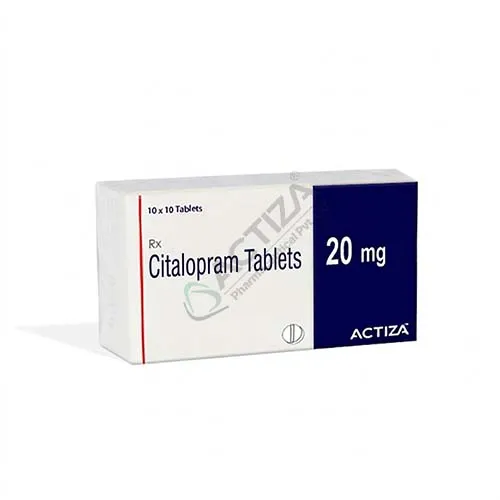
Citalopram Tablet
| Product/Composition:- | Citalopram Tablet |
|---|---|
| Strength:- | 20mg |
| Form:- | Tablets |
| Production Capacity:- | 10 Million Tablets/Month |
| Packaging:- | 10 X 10 Tablets / Box |
| Therapeutic use:- | treat panic disorder |
| Package Insert/Leaflet:- | Available upon request |
Introduction
Actiza Pharmaceutical is a WHO-GMP certified pharmaceutical exporter supplying Citalopram Tablets as a finished dosage formulation, not an API, in 10 mg, 20 mg, and 40 mg film-coated presentations, to importers, distributors, and mental health programme procurement across Africa, Southeast Asia, Latin America, and the Middle East.
Citalopram is a selective serotonin reuptake inhibitor and a WHO Essential Medicine for depressive disorders.
Our labelling reflects the current restricted dosing position of a maximum of 40 mg daily, and 20 mg daily in defined patient groups following the dose-dependent QT findings that led regulators to revise this molecule’s dosing.
Complete CTD, ACTD and eCTD dossiers, CoPP, FSC and ICH Zone IVb stability data are supplied for MOH registration.
Product Overview
| Field | Details |
| Product Name | Citalopram Tablets |
| INN / Generic Name | Citalopram (as citalopram hydrobromide) |
| Therapeutic Class | Selective serotonin reuptake inhibitor (SSRI) antidepressant |
| Mechanism (brief) | Potentiates serotonergic activity in the central nervous system through selective inhibition of serotonin reuptake, with minimal effect on noradrenaline and dopamine reuptake |
| Indication | Treatment of depression in adults, per approved local labelling. NOT approved for paediatric use. |
| API Quality | Manufactured using DMF-grade Citalopram Hydrobromide |
| Pharmacopoeial Standard | USP / BP Citalopram Tablets [CONFIRM applicability per SKU] |
| Available Strengths | 10 mg; 20 mg (scored); 40 mg (scored) film-coated tablets |
| Maximum Dose Adults | 40 mg daily. Doses above 40 mg daily are not recommended due to dose-dependent QT prolongation. |
| Maximum Dose Defined Groups | 20 mg daily for patients over 60 years, hepatic impairment, CYP2C19 poor metabolisers, and those taking a CYP2C19 inhibitor |
| Key Contraindications | MAOIs, or within 14 days of stopping an MAOI; pimozide; known hypersensitivity |
| Cardiac Warning | Dose-dependent QTc prolongation, torsade de pointes, ventricular tachycardia and sudden death have occurred |
| Discontinuation | Reduce dosage gradually abrupt cessation is not appropriate |
| Solubility Position | Freely water-soluble and well absorbed supports a BCS-based biowaiver argument, see Section 5B |
| Shelf Life | 36 Months [CONFIRM against stability data] |
| Storage | Store at 20-25°C; excursions permitted 15-30°C |
| Manufacturing Facility | WHO-GMP certified general oral solid dosage block, segregated from beta-lactam operations |
| Safety Labelling | Antidepressant class boxed warning suicidal thoughts and behaviours in children, adolescents and young adults |
| Dossier Available | Yes, CTD / ACTD / eCTD format |
Strengths, Presentation & Specification
Citalopram Tablets 20 mg (Scored)
The workhorse strength and, since the dosing restriction, the single most important SKU.
It serves as the usual API is sourced from a qualified vendor withstarting dose, maintenance dose, and absolute daily maximum for patients over 60 years, with hepatic impairment, who are CYP2C19 poor metabolisers, or who take a CYP2C19 inhibitor.
The tablet is scored, supporting 10 mg titration increments.
Target buyers include mental health programmes, hospital and retail distributors, and MOH tender procurement.
Citalopram Tablets 10 mg
The initiation and titration strength, used where a lower starting dose is indicated and for gradual dose adjustment in 10 mg increments.
Because citalopram must be discontinued by gradual dose reduction rather than stopped abruptly, the 10 mg tablet makes a controlled taper practical.
Buyers who stock only 20 mg and 40 mg leave prescribers without a taper step.
Citalopram Tablets 40 mg (Scored)
The maximum permitted daily dose for adults under 60 without risk factors.
Since the dosing restriction, this strength’s addressable population is narrower than historically.
Forecast this SKU on the basis of the current restricted population rather than on historic ratios.
Specification & Testing
Assay, content uniformity, dissolution and related substances against declared monograph
Comparative dissolution profiles at pH 1.2, 4.5 and 6.8 maintained on file to support biowaiver submissions
Score-line functionality assessed for 20 mg and 40 mg presentations
Moisture control across shelf life, supporting packing specified
Regulatory & Dossier Support
Dossier Availability
CTD (Common Technical Document) ICH-aligned for regulated markets; ACTD (ASEAN Common Technical Dossier) for Philippines, Vietnam, Myanmar, Indonesia, Cambodia; eCTD for authorities requiring electronic submission.
Module 3 quality documentation includes process validation, content uniformity, dissolution method validation, and score-line functionality data.
Stability data includes real-time and accelerated under ICH Zone IVb (30°C / 75% RH).
Module 1 labelling is built to the current restricted dosing position not carried over from a pre-restriction reference.
Bioequivalence & Biowaiver Position
Citalopram hydrobromide is freely soluble in water and well absorbed after oral administration, making a BCS-based biowaiver a realistic route for immediate-release tablets where authorities accept it.
The argument rests on demonstrated high solubility across the physiological pH range together with rapid and comparable dissolution for both test and reference products.
BE study data is available; discriminatory dissolution method is documented and validated with profiles at pH 1.2, 4.5 and 6.8 held throughout shelf life.
Strength-to-strength biowaiver may be accepted across 10 mg, 20 mg and 40 mg where proportional similarity and comparable dissolution profiles are demonstrated, subject to the individual authority.
Drug Master File (DMF)
Drug Master File reference for Citalopram Hydrobromide API is available for cross-referencing in your registration dossier.
API is sourced from a qualified vendor with full impurity, residual solvent, and elemental impurity characterisation.
CDSCO / Indian DMF reference is accepted by a large number of importing authorities.
Manufacturing Compliance
WHO-GMP certified manufacturing facility, audit-ready, with inspection reports shared on an NDA basis.
Site Master File (SMF) is available for regulatory submissions.
Citalopram is not a beta-lactam or cytotoxic and is not subject to international drug control conventions, so no dedicated block is required.
Production runs in a general oral solid dosage block physically segregated from beta-lactam operations, with validated cleaning between products.
Cleaning validation includes swab and rinse recovery data.
Compliant with NAFDAC (Nigeria), PPB (Kenya), FDA Philippines, DRAP (Pakistan) and INVIMA (Colombia).
Complete Documentation Package (Per Shipment)
| Document | Purpose |
| Certificate of Analysis (CoA) | Confirms batch quality against the agreed specification |
| Certificate of Pharmaceutical Product (CoPP / CPP) | Required for MOH registration in most importing countries |
| Free Sale Certificate (FSC) | Confirms the product is freely sold in the country of manufacture |
| Method of Analysis (MOA) | Analytical methodology mandatory dossier component |
| GMP Certificate | Confirms manufacturing site compliance |
| Stability Data | Real-time and accelerated ICH Zone IVb |
| BE Study Report or Biowaiver Justification | States explicitly which route was taken and on which strength |
| Dissolution Profile Report | pH 1.2, 4.5 and 6.8 supports the biowaiver route |
| Content Uniformity Data | Batch-level, relevant at the 10 mg strength |
| Score-Line Functionality Data | For the scored presentations supports 10 mg titration steps |
| Current-Labelling Confirmation | Written confirmation that leaflet dosing reflects the restricted position see Section 5F |
| Excipient Declarations | For all inactive ingredients |
Labelling Currency, The Issue Specific to This Molecule
Citalopram was originally used at higher daily doses. Following a QT study demonstrating dose-dependent QTc prolongation, regulators restricted the maximum dose and capped defined patient groups lower.
A large number of registrations and printed artworks in emerging markets predate that revision and still carry older, higher dosing.
If a buyer holds a legacy registration, they may be importing a product whose leaflet contradicts current safety guidance.
The revised position, which our Module 1 labelling reflects:
Adults: maximum 40 mg daily. Doses above 40 mg are not recommended because QT prolongation is dose-dependent. The thorough QT study found mean QTc prolongation of approximately 8.5 ms at 20 mg and 18.5 ms at 60 mg, with 40 mg estimated at around 12.6 ms
Maximum 20 mg daily for patients over 60 years, patients with hepatic impairment, CYP2C19 poor metabolisers, and patients taking cimetidine or another CYP2C19 inhibitor
Avoid in congenital long QT syndrome, bradycardia, hypokalaemia or hypomagnesaemia, recent acute myocardial infarction, uncompensated heart failure, and in patients taking other QTc-prolonging medicines
Contraindicated with MAOIs or within 14 days of stopping one, and with pimozide
Discontinue by gradual dose reduction rather than abruptly
Where a buyer holds an existing registration, we flag on request whether the approved leaflet appears to predate the dosing revision, and we support a labelling variation rather than shipping against outdated artwork.
Clinical Indications & Therapeutic Information
Citalopram hydrobromide is a selective serotonin reuptake inhibitor.
It potentiates serotonergic activity in the central nervous system through selective inhibition of serotonin reuptake, with minimal effect on noradrenaline and dopamine reuptake.
It is metabolised principally by CYP2C19 and CYP3A4.
Citalopram is listed on the WHO Model List of Essential Medicines for depressive disorders.
Approved indication: treatment of depression in adults, per local labelling. The product is NOT approved for paediatric use, and this must be explicit in local artwork.
Boxed warning: antidepressants increased the risk of suicidal thoughts and behaviours in children, adolescents and young adults in short-term studies.
Patients started on therapy should be monitored appropriately. This warning must carry through to leaflet and artwork in full.
Cardiac safety is the defining labelling issue for this molecule: dose-dependent QTc prolongation, torsade de pointes, ventricular tachycardia and sudden death have been reported.
The dose caps exist for this reason and are not conservative guidance.
Class considerations include serotonin syndrome, hyponatraemia, increased bleeding risk with concomitant NSAIDs or antiplatelet agents, and discontinuation symptoms on abrupt cessation.
Target Export Markets
Africa: Nigeria, Kenya, Ghana, Tanzania, Uganda, Ethiopia, Egypt, Zambia, Côte d’Ivoire.
Registration support through NAFDAC (Nigeria), PPB (Kenya), FDA Ghana, TFDA (Tanzania).
Mental health service expansion is driving formulary inclusion; tenders increasingly specify the full strength range. English and French artwork available.
Southeast Asia: Philippines, Vietnam, Myanmar, Cambodia, Indonesia, Bangladesh, Thailand.
ACTD dossier format supplied as standard for ASEAN registrations. ICH Zone IVb stability data is a prerequisite.
Latin America: Colombia, Peru, Ecuador, Bolivia, Guatemala, Dominican Republic. USP pharmacopoeial standard preferred.
Spanish and Portuguese labelling available. CTD format with local regulatory adaptation.
Middle East & CIS: Iraq, Jordan, Yemen, Uzbekistan, Kazakhstan, Azerbaijan.
GMP Certificate and CoPP are primary registration requirements. Arabic and Russian labelling available.
Export Packaging & Supply Chain
Primary Packaging Options
| Presentation | Packaging Options |
| Citalopram Tablets 20 mg | Alu-Alu blister 10×10, 3×10 and 2×14; HDPE bottle of 30 / 100 with induction seal |
| Citalopram Tablets 10 mg | Alu-Alu blister 10×10 and 2×14; HDPE bottle of 30 / 100 |
| Citalopram Tablets 40 mg | Alu-Alu blister 10×10 and 3×10; HDPE bottle of 30 |
| Chronic-therapy packs | 28-day or calendar blister presentations, which suit a therapy taken continuously for months [TBC] |
Antidepressant therapy runs for months and longer, so packs are opened daily and stored in domestic conditions.
Alu-Alu is recommended for Zone IVb markets on that basis.
Labelling & Customisation
Private label manufacturing available with your brand name and artwork, subject to unchanged regulatory content. Multi-lingual labelling available in English, French, Spanish, Portuguese, Arabic, Russian.
Mandatory artwork content: the boxed warning, the not-for-paediatric-use statement, the maximum dose statements including the 20 mg cap for defined groups, the QT and MAOI/pimozide contraindications, the gradual-discontinuation instruction, and country-specific registration fields.
Private label flexibility does not extend to safety labelling. If a buyer supplies artwork based on an existing legacy registration carrying pre-restriction dosing, we route it to regulatory and treat it as a labelling variation, not as customer artwork instruction.
Logistics & Supply
Incoterms: FOB, CIF, CFR, EXW as per buyer requirement. No cold chain required; protect from moisture and sustained heat.
Because discontinuation must be gradual and unplanned interruption is clinically undesirable, continuity matters more for this product.
We plan against committed annual forecasts rather than reactive ordering.
Why Source Citalopram Tablets From Us?
Frequently Asked Questions
Q1. Do you provide a dossier for Citalopram Tablets?
Yes. We provide complete dossiers in CTD, ACTD, and eCTD formats across all three strengths.
Module 1 labelling is built to the current restricted dosing position rather than carried over from an older reference.
Q2. What is the maximum dose your labelling supports, and why does it matter?
Adults: 40 mg daily. For patients over 60 years, those with hepatic impairment, CYP2C19 poor metabolizers, and patients taking a CYP2C19 inhibitor, the maximum is 20 mg daily.
It matters because many legacy registrations in emerging markets still carry higher pre-restriction dosing.
Q3. Our existing registration has older dosing in the leaflet. What should we do?
Raise it with us before supply. We will review whether your approved leaflet predates the dosing revision and support a labelling variation.
We will not print artwork carrying pre-restriction dosing.
Q4. Is a bioequivalence study required, or is a biowaiver available?
Both routes are in play depending on the authority. Citalopram hydrobromide is freely water-soluble and well absorbed, which supports a BCS-based biowaiver argument where the authority accepts it.
Tell us your market, and we will confirm which route applies.
Q5. Why do you emphasise the 10 mg strength?
Because citalopram must be discontinued by gradual dose reduction rather than stopped abruptly, and titration proceeds in 10 mg increments.
A range consisting only of 20 mg and 40 mg leaves prescribers without a practical taper step.
Q6. Can you supply Citalopram Tablets under our private label?
Yes, across all three strengths. Safety content is fixed the boxed warning, not-for-paediatric-use statement, maximum dose statements, QT and contraindication warnings and gradual-discontinuation instruction cannot be reduced or relocated.
Q7. Is citalopram a controlled substance?
No. Citalopram is prescription-only but is not subject to international drug control conventions, so no narcotic or psychotropic import authorisation applies.
Standard prescription-medicine requirements govern supply.
Q8. What is the MOQ and lead time?
MOQ varies by strength and pack configuration. The three strengths are normally quoted as a set.
Contact our export team with your target market, required strengths, and estimated annual volume.
Ready to Source Citalopram Tablets FDF?
Share your target market, required strengths, and volume, and our export team will respond with applicable specifications, the bioequivalence route that the authority requires, dossier format, pack options, and pricing.
If you hold an existing registration, send us the approved leaflet, and we will check the dosing text against the current restricted position before anything is printed.