

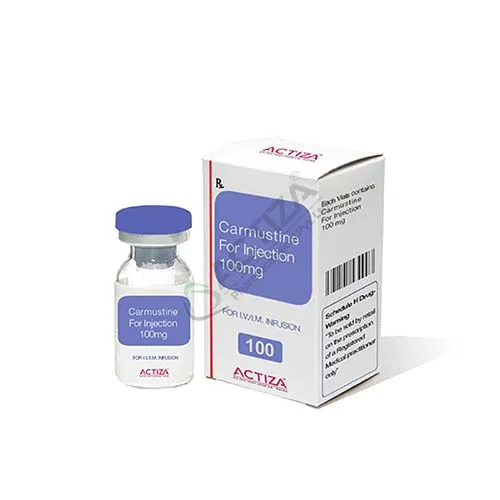
Carmustine Injection
| Product/Composition:- | Carmustine Injection |
|---|---|
| Strength:- | 100mg |
| Form:- | Injection |
| Production Capacity:- | 1 Million Injection/Month |
| Therapeutic use:- | Anti Cancer |
| Package Insert/Leaflet:- | Available upon request |
Introduction
Actiza Pharmaceutical is a WHO-GMP certified pharmaceutical exporter supplying Carmustine for Injection 100 mg as a sterile finished dosage formulation not API to importers, oncology distributors and cancer centre procurement in markets with functioning oncology services.
Each pack contains a lyophilised 100 mg carmustine vial together with a co-packaged 3 mL vial of sterile diluent.
Production takes place in a dedicated cytotoxic sterile block with aseptic lyophilisation, because carmustine cannot be terminally sterilised.
The product requires cold chain storage at 2–8°C, and we supply validated shipping, temperature monitoring and receipt-inspection guidance with every consignment.
Complete CTD, ACTD and eCTD dossiers, CoPP and FSC are provided for MOH registration.
Product Overview
| Field | Details |
| Product Name | Carmustine for Injection |
| INN / Generic Name | Carmustine (BCNU) |
| Chemical Class | Nitrosourea 1,3-bis(2-chloroethyl)-1-nitrosourea; molecular weight 214.06 |
| Therapeutic Class | Cytotoxic antineoplastic alkylating agent, cell-cycle non-specific |
| Mechanism (brief) | Alkylation and carbamoylation of nucleic acids and proteins, forming DNA-DNA and DNA-protein crosslinks |
| Indications | Brain tumours (glioblastoma, brainstem glioma, medulloblastoma, astrocytoma, ependymoma); multiple myeloma; Hodgkin and non-Hodgkin lymphomas as per approved local labelling |
| API Quality | Manufactured using DMF-grade Carmustine |
| Pharmacopoeial Standard | USP Carmustine for Injection USP [CONFIRM applicability per SKU] |
| Presentation | 100 mg lyophilised powder in single-dose vial, co-packaged with 3 mL sterile diluent (Dehydrated Alcohol Injection USP) |
| Physical Description | Sterile lyophilised pale yellow flakes or congealed mass |
| Solubility | Highly soluble in alcohol and lipids; poorly soluble in water hence the alcohol diluent |
| Preservative | None single-dose vial, not for multiple use |
| Sterilisation Method | Aseptic processing with lyophilisation terminal sterilisation is NOT possible (see Section 4) |
| Storage | Refrigerate at 2–8°C. Protect from light. Critical see Section 5F. |
| Shelf Life | Up to 36 months for unopened vials under correct refrigeration [CONFIRM against your stability data] |
| Container Compatibility | Glass or PVC-free, DEHP-free polypropylene only the IV solution is unstable in PVC |
| Manufacturing Facility | WHO-GMP certified DEDICATED cytotoxic sterile block with lyophilisation capability |
| Safety Labelling | Boxed warnings delayed myelosuppression and pulmonary toxicity; specialist prescriber statement |
| Dossier Available | Yes, CTD / ACTD / eCTD format |
Product Presentation & Sterility Assurance
Carmustine for Injection 100 mg + 3 mL Diluent
The single global presentation. Carmustine is highly soluble in alcohol and lipids but poorly soluble in water, which is why the lyophilised powder is supplied with a co-packaged vial of dehydrated alcohol as the reconstitution diluent rather than with water.
The reconstituted concentrate is then further diluted for intravenous infusion in accordance with approved labelling. The product contains no preservative and the vial is single-dose only.
Target buyers include cancer centres, neuro-oncology units, MOH oncology programmes, and specialist hospital distributors.
Why This Product Cannot Be Terminally Sterilised
Carmustine has a low melting point of approximately 30.5-32.0°C.
A drug substance that melts slightly above room temperature cannot be autoclaved.
Aseptic processing is therefore not a shortcut, it is the only scientifically available route.
Release Testing
Regulatory & Dossier Support
Dossier Availability
We provide dossiers in CTD (Common Technical Document) ICH-aligned for regulated markets, ACTD (ASEAN Common Technical Dossier) for Philippines, Vietnam, Myanmar, Indonesia, Cambodia, and eCTD for markets requiring electronic submissions.
Module 3 quality documentation includes lyophilisation cycle validation, aseptic process validation and media fill data, container closure system qualification, residual moisture control and diluent specification.
Stability data includes real-time under refrigerated conditions with defined temperature excursion studies, photostability, and in-use stability for reconstituted and further-diluted solution.
Bioequivalence
Carmustine is administered by intravenous infusion, so the drug enters systemic circulation directly and absorption is not a variable.
FDA regulation treats bioequivalence as self-evident for a parenteral solution intended solely for administration by injection that contains the same active and inactive ingredients in the same concentration as the approved reference product.
The condition to satisfy is Q1/Q2 sameness and for this product it extends to the co-packaged diluent.
The reconstituted and further-diluted solution must match the reference in composition and concentration, and the diluent is part of that comparison, not an accessory.
Comparative characterisation of the reconstituted solution is supplied to support the waiver argument, including appearance, pH, osmolality, assay, degradation profile and reconstitution behaviour.
Because the lyophile is reconstituted before use, the dossier documents reconstitution time and absence of degradation across the in-use period.
Drug Master File (DMF)
Drug Master File reference for Carmustine API is available for cross-referencing in your registration dossier.
API is sourced from a qualified vendor with full impurity, degradation product, residual solvent and thermal characterisation.
CDSCO / Indian DMF reference is accepted by a large number of importing authorities and shortens query cycles.
Manufacturing Compliance
WHO-GMP certified manufacturing facility, audit-ready, with inspection reports shared on NDA basis.
Site Master File (SMF) is available for regulatory submissions.
Manufactured in a dedicated cytotoxic sterile block with lyophilisation capability dedicated premises, equipment and air handling under controlled pressure regime.
Combining cytotoxic containment with aseptic processing is genuinely uncommon.
Containment and aseptic requirements pull in opposite directions containment wants negative pressure, sterility wants positive pressure and facility design resolves this through cascaded airlocks.
Water for Injection system is qualified and monitored.
Cytotoxic waste and effluent management is documented, with operator protection controls.
Cleaning validation is performed against a toxicologist-authored HBEL / Permitted Daily Exposure.
Complete Documentation Package (Per Shipment)
| Document | Purpose |
| Certificate of Analysis (CoA) | Confirms batch quality against the agreed specification |
| Certificate of Pharmaceutical Product (CoPP / CPP) | Required for MOH registration in most importing countries |
| Free Sale Certificate (FSC) | Confirms the product is freely sold in the country of manufacture |
| Method of Analysis (MOA) | Analytical methodology mandatory dossier component |
| GMP Certificate | Confirms site compliance, including the dedicated cytotoxic sterile block |
| Stability Data | Real-time refrigerated, excursion, photostability and in-use reconstituted stability |
| Sterility Test Report | USP <71> product-critical, with no terminal sterilisation step in the process |
| Bacterial Endotoxin Report | USP <85> LAL against the calculated endotoxin limit |
| Media Fill Validation Summary | Aseptic process assurance the substitute for a terminal lethality value |
| Lyophilisation Cycle Validation | Including product temperature control and residual moisture data |
| Container Closure Integrity Test (CCIT) | Vial and stopper seal integrity across shelf life |
| Cold Chain Validation & Shipper Qualification | Route-specific thermal validation with temperature logger data |
| Biowaiver Justification (Q1/Q2) | Composition comparison covering drug product and co-packaged diluent |
| HBEL / PDE Assessment | Toxicologist-authored exposure limit underpinning cleaning acceptance criteria |
| Cytotoxic Handling Guidance | For destination pharmacy PPE, spillage response, waste segregation |
Cold Chain, Thermal Integrity & Receipt Inspection
Carmustine has a low melting point of approximately 30.5-32.0°C.
If the product is exposed to that temperature or above, the lyophilised powder liquefies and appears as an oil film in the vial a sign of decomposition, and affected vials must be discarded.
Storage: Both drug vial and diluent vial are stored refrigerated at 2–8°C, protected from light.
Unopened vials remain stable for up to three years.
Receipt inspection is a field test the buyer can run.
Hold the vial to a bright light and inspect: dry flakes or a dry congealed mass indicate the product is suitable and should be refrigerated immediately; an oily film indicates decomposition and the vial must be discarded.
We supply this inspection guidance in consignment documentation in the destination language.
Validated shipping uses qualified thermal shippers with route-specific validation and temperature data loggers, plus a documented excursion protocol so that a borderline shipment is assessed against data rather than assumed to be either fine or ruined.
Container compatibility must reach the ward, not just the pharmacy.
The intravenous solution is unstable in PVC administration must use glass or PVC-free, DEHP-free polypropylene containers and sets.
This instruction is carried in our leaflet and artwork.
Dermal exposure: impervious gloves are required at every handling stage; accidental skin contact with reconstituted product has been associated with transient hyperpigmentation.
Clinical Indications & Therapeutic Information
Carmustine is a nitrosourea alkylating agent and is cell-cycle non-specific.
It carries two chloroethyl groups that alkylate nucleic acids and cell proteins, forming DNA-DNA and DNA-protein crosslinks.
Isocyanates formed during decomposition additionally carbamoylate protein residues, and both mechanisms contribute to its activity.
Blood-brain barrier penetration is the defining clinical property.
Carmustine is highly lipid soluble and relatively un-ionised at physiological pH, so it crosses the blood-brain barrier effectively the basis of its central role in brain tumour protocols and the reason demand concentrates in neuro-oncology units.
Indications per reference labelling: brain tumours including glioblastoma, brainstem glioma, medulloblastoma, astrocytoma and ependymoma; multiple myeloma; and Hodgkin and non-Hodgkin lymphomas, as a single agent or in established combination therapy.
Reference labelling characterises this use as palliative therapy this framing must be reproduced accurately in local labelling.
Boxed warnings cover delayed bone marrow suppression and pulmonary toxicity, with the requirement that the product be administered under supervision of a physician experienced in cancer chemotherapy.
Delayed myelosuppression is the reason dosing intervals in reference labelling are unusually long.
Market structure: brain tumour protocols are delivered in a small number of specialist centres per country, so volumes per market are modest but concentrated, and procurement decisions sit with neuro-oncology pharmacy.
Target Export Markets
Market qualification requires BOTH functioning neuro-oncology or haemato-oncology services AND a reliable 2-8°C distribution chain to the hospital pharmacy. Cold chain is the binding constraint.
Southeast Asia: Philippines, Vietnam, Thailand, Malaysia, Indonesia. ACTD dossier format supplied as standard.
Ambient temperatures sit above carmustine melting threshold for much of the year, making shipper qualification and last-mile handling the deciding technical factor.
Middle East & North Africa: Egypt, Iraq, Jordan, Gulf states. Established cancer centres with specialist pharmacy capability.
GMP Certificate and CoPP are primary registration requirements. Arabic labelling available.
Latin America: Colombia, Peru, Ecuador, Dominican Republic. USP pharmacopoeial standard preferred.
Spanish and Portuguese labelling available. CTD format with local regulatory adaptation.
CIS & Selected African Markets: Uzbekistan, Kazakhstan, Azerbaijan; established cancer centres in Egypt, Nigeria, Kenya, South Africa.
Russian and French labelling available. Cold chain integrity to receiving pharmacy is the constraint.
Export Packaging & Cold Chain Supply
Packaging Configuration
| Component | Specification |
| Drug product vial | 100 mg carmustine as sterile lyophilised powder, Type I glass single-dose vial with elastomeric stopper and flip-off seal |
| Diluent vial | 3 mL sterile diluent (Dehydrated Alcohol Injection USP), co-packaged in the same carton |
| Carton | Individual carton per pack with leaflet, cytotoxic identification and cold chain storage statement |
| Shipper | Qualified insulated thermal shipper with coolant configuration and temperature data logger |
Both vials in the pack are stored refrigerated.
Carton design carries cold chain statement, cytotoxic identification and light-protection requirement.
Each carton is individually inspectable so pharmacy can check vials without breaking down entire consignment.
Labelling & Customisation
Private label manufacturing available with your brand name and artwork, subject to unchanged regulatory, cytotoxic and cold chain content.
Multi-lingual labelling available in English, French, Spanish, Portuguese, Arabic, Russian.
Mandatory artwork content includes 2-8°C storage statement, protect-from-light instruction, cytotoxic identification, specialist prescriber statement, PVC incompatibility warning, single-dose and no-preservative statement, and country-specific registration number fields.
Why Source Carmustine Injection From Us?
Frequently Asked Questions
Q1. Do you provide a dossier for Carmustine Injection?
Yes. We provide complete dossiers in CTD, ACTD and eCTD formats.
The dossier includes Module 3 quality documentation, lyophilisation cycle validation, aseptic process and media fill data, container closure qualification, residual moisture control, refrigerated and excursion stability, in-use reconstituted stability and administration system compatibility data.
Country-specific customisation and regulatory query support are included.
Q2. Why is this product not terminally sterilised?
Because it physically cannot be. Carmustine has a low melting point of approximately 30.5-32.0°C, so a heat sterilisation cycle would destroy the product.
Manufacture is therefore by aseptic processing with validated lyophilisation, and sterility assurance rests on media fill validation, sterilising-grade filtration validation and environmental monitoring.
Q3. Does Carmustine Injection require a bioequivalence study?
Generally not. The product is administered intravenously, so absorption is not a variable, and regulators treat bioequivalence as self-evident for parenteral products containing the same active and inactive ingredients at same concentration as the reference.
The condition is Q1/Q2 sameness including the co-packaged diluent.
Q4. What happens if the cold chain is broken in transit?
It is visible. Carmustine melts at approximately 30.5-32.0°C, and above that the powder liquefies into an oil film in the vial a sign of decomposition.
Those vials must be discarded.
Hold the vial to a bright light: dry flakes or congealed mass indicate suitability; oily film indicates decomposition. We supply inspection guidance with every consignment.
Q5. Why can this product not be given in a PVC infusion bag?
The intravenous solution is unstable in polyvinyl chloride.
Carmustine in dextrose solution degrades rapidly in PVC containers.
Administration must use glass or PVC-free, DEHP-free polypropylene containers and sets.
This is a bedside failure mode that manufacturing quality cannot protect against.
Q6. Is your Carmustine manufactured in a dedicated cytotoxic facility?
Yes, dedicated, and additionally sterile.
Production runs in dedicated cytotoxic sterile block with lyophilisation capability, its own premises, equipment and air handling.
Containment and aseptic requirements conflict by design; our facility resolves this through cascaded airlocks, documented in Site Master File.
Q7. What is the MOQ and lead time for Carmustine Injection?
MOQ varies by pack and shipper configuration.
Production runs in scheduled campaigns within dedicated cytotoxic sterile block; cold chain shipping is qualified per route.
MOQ and lead time are quoted against confirmed destination. Contact our export team with target market and annual forecast.
Q8. Which markets can you supply?
Markets that have both functioning oncology services and a reliable 2–8°C chain to the hospital pharmacy.
We assess these two together, because a market with excellent cancer centres but unreliable cold chain will experience product losses reflecting distribution rather than quality.
Our team reviews your route and last-mile handling before confirming supply.
Ready to Source Carmustine for Injection FDF?
Tell us your destination market, route and annual forecast, and our export team will respond with applicable specification, registration route, cold chain configuration, shipper qualification status and pricing.
If you are at technical evaluation stage, request media fill validation summary, cold chain qualification data, cytotoxic containment section of SMF and sample CoA.