


Why 2026 Will Be a Critical Year for API Manufacturers
The year 2026 will be very important for API manufacturers worldwide.
Regulators are stepping up checks on API quality, safety, and traceability.
Companies must show clear records and strong quality systems.
Demand for GMP-certified manufacturers is rising in both regulated and semi-regulated markets.
This trend is pushing firms to improve their standards and processes.
Global rules are becoming more aligned through ICH, PIC/S, and WHO frameworks.
Manufacturers must meet shared standards. This is necessary to sell APIs in other countries.
This 2026 checklist helps companies improve compliance, digital tracking, and export readiness.
It keeps them competitive, trusted, and ready for future global supply needs.
Understanding Global GMP Requirements for APIs
Global GMP rules guide API manufacturing and quality.
They help companies use safe, clear, and trusted production practices all over the world.
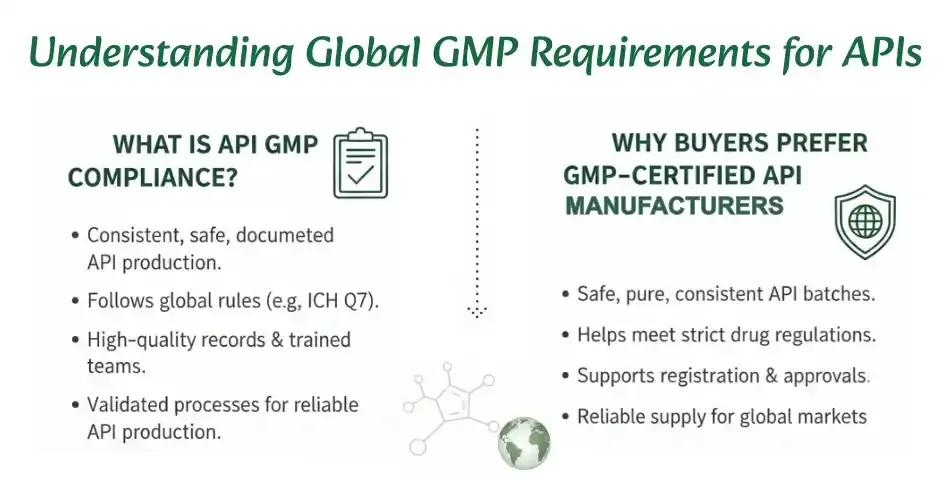
What is API GMP Compliance?
API GMP compliance means APIs are produced and controlled in a consistent, safe, and documented way.
It follows global rules, such as ICH Q7. These guidelines help manufacturers maintain high quality.
They ensure proper records, trained teams, and validated processes for reliable API production.
Why Buyers Prefer GMP-Certified API Manufacturers
Buyers pick GMP-certified manufacturers. They do this because these manufacturers provide safe, pure, and consistent API batches.
This helps finished drug makers meet strict rules.
GMP suppliers help with registration dossiers, approvals, and reliable manufacturing.
They support global markets and regulated product supply chains.
Key Global Regulatory Bodies & Their 2026 Requirements
Global regulators are strengthening rules on quality, data, and safety.
This aims to provide safer medicines and devices. It also promotes clear supply chains globally.
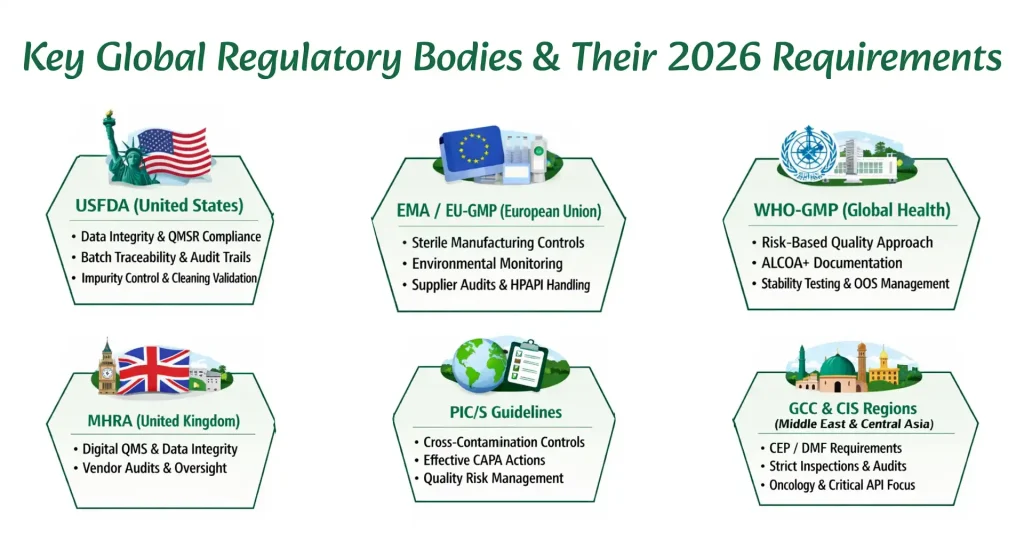
USFDA (United States)
In 2026, the US FDA focused on data integrity. It also highlights clear supply chains and stronger quality systems.
Companies need to follow QMSR rules. They should improve traceability, keep digital records secure, and meet strict impurity and cleaning standards.
This ensures safe and reliable products for global markets.
Updated expectations around:
Regulators now want clearer systems, stronger controls, and complete digital records.
This will help ensure safe, compliant production.
EMA / EU-GMP (European Union)
Recent updates to EU-GMP Annex 1 set stricter rules for sterile API sites.
Facilities should create strong contamination control strategies.
They must also use better barriers and regularly review their processes.
The revisions affect both new and existing plants.
They back quality management that focuses on risk. They also promote safer sterile production systems.
Enhanced expectations:
EU regulators now want deeper controls and constant monitoring.
They want stronger checks on suppliers. This will help keep the production environment safe.
WHO-GMP (Global Public Health Supply)
WHO-GMP certification is important. It helps with global tenders and public health programs.
Many NGOs and agencies across Africa, Asia, and Latin America require it.
It helps give safe, quality medicines. This is important for large groups and government buying.
2026 update focuses on:
The 2026 WHO-GMP updates focus on stronger quality systems.
They also emphasize clearer records and improved science-based controls.
These changes apply to the entire product lifecycle.
MHRA (UK)
In 2026, the MHRA focuses strongly on data integrity and digital quality systems.
Companies must use secure electronic QMS, validated systems, and clear audit trails.
The agency also expects strict audits of vendors and suppliers.
It wants strong oversight of partners, records, and supply chains to ensure safe and reliable manufacturing.
PIC/S Guidelines
PIC/S guidelines are shaping global GMP standards.
By 2026, more countries are adopting these rules to align inspections and build trust.
Following PIC/S helps manufacturers meet global standards.
It also makes it easier to enter new regulated markets.
GCC (Middle East) & SFDA Regulations
In 2026, GCC and SFDA rules demand strong documentation and strict inspections.
Many markets prefer CEP or DMF-backed APIs for approvals.
Regulators now carry out stricter audits, especially for oncology and critical-care APIs.
This ensures a safe supply, clear traceability, and reliable manufacturing quality.
CIS Region (Uzbekistan, Kazakhstan, Tajikistan)
By 2026, CIS markets will follow EAEU-aligned rules for medicine and API registration.
Companies need to submit CTD-style dossiers and provide solid stability data.
Regulators check GMP equivalence closely.
They make sure that manufacturing quality meets global standards.
This happens before products are approved for these expanding markets.
2026 Global API GMP Checklist: What Every Manufacturer Must Comply With
In 2026, API makers must stick to strict global GMP rules. This ensures safe products, clean data, and strong quality systems.
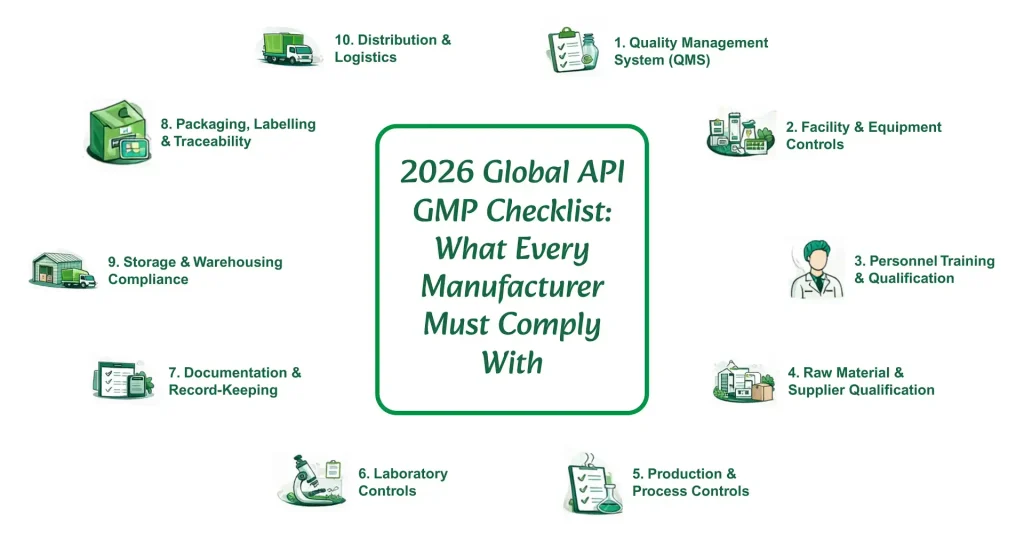
Quality Management System (QMS)
A strong QMS keeps processes controlled, records clear, and risks managed.
Regulators expect systems to be active. They should improve the quality and watch for issues.
They must also support daily operations in manufacturing and supply chains.
Facility & Equipment Controls
Modern API facilities must keep equipment reliable. They also need to ensure it is clean and well-controlled.
This helps protect product quality and patient safety. Regulators want validated systems and precise instruments.
They also look for controlled environments and effective change tracking. This ensures a steady state of control.
Validated Equipment
All critical machines must be qualified and tested. They should perform reliably during regular production.
Calibration Programs
Measuring instruments need regular calibration. They should also connect to approved national or global standards.
Environmental Controls
Facilities must manage temperature. They also need to control humidity, pressure, and cleanliness.
They can do this with monitored HVAC and cleanroom systems.
Change Control
Any change in equipment or processes must be reviewed. It also requires approval, documentation, and a quality risk check.
Personnel Training & Qualification
Trained staff help keep products safe, clean, and compliant. Regulators expect solid evidence that workers grasp GMP rules.
GMP Training Records
Companies must keep clear records of both induction and refresher training. They must also track staff understanding of GMP practices.
Role Qualification Matrix
Critical roles must have a skills matrix showing who is trained and approved for each task.
Hygiene & Gowning
Staff must follow hygiene rules. They should wear proper gowns and prevent contamination in production areas.
Raw Material & Supplier Qualification
Safe raw materials and trusted suppliers help ensure strong product quality.
Regulators want thorough vendor checks and proper handling.
Production & Process Controls
Production controls keep processes stable. They also make them safe and consistent.
Effective monitoring stops errors. It keeps impurities and contaminants out of the manufacturing process.
Process Validation
Companies must check processes with ICH Q8 and Q10. This keeps quality steady and operations in check.
In-Process Testing
Regular checks during production are important. They must ensure that pH, temperature, and yield stay within limits.
Impurity Profiling
Firms need to check and control impurities as per ICH M7. This helps ensure product safety and compliance.
Cross-Contamination Control
Facilities should stop product mix-ups. They can do this with cleaning validation, segregation, and controlled production areas.
Laboratory Controls
Laboratory controls help ensure test results are accurate. They also keep results traceable and reliable. Strong lab systems protect product quality and patient safety.
Method Validation
Analytical methods must be validated. This proves they provide accurate, consistent, and reliable test results.
Stability Studies
Labs must run stability studies to confirm shelf life and storage conditions for APIs.
Reference Standards
Standards need to be stored, labelled, and used correctly. This ensures accurate testing and comparisons.
OOS Procedure
There should be clear steps to investigate out-of-specification results. This will help prevent repeated testing without a valid reason.
Documentation & Record-Keeping
Clear records prove that every step was done correctly. Good documentation supports inspections, traceability, and product quality.
Packaging, Labelling & Traceability
In 2026, packaging carries safety data, protects quality, and supports global tracking across supply chains.
Storage & Warehousing Compliance
Proper storage keeps APIs safe, stable, and traceable. Warehouses must follow strict controls to protect material quality.
Distribution & Logistics
In 2026, distribution will become part of manufacturing. There will be strict controls to keep APIs safe during transport.
DMF, CEP, and Regulatory Documentation Requirements in 2026
Drug Master File (DMF) Best Practices
In 2026, DMFs must be clear, up to date, and easy to review.
Regulators expect real-time updates, strong controls, and full lifecycle tracking.
Key best practices for preparing and maintaining a Drug Master File include:
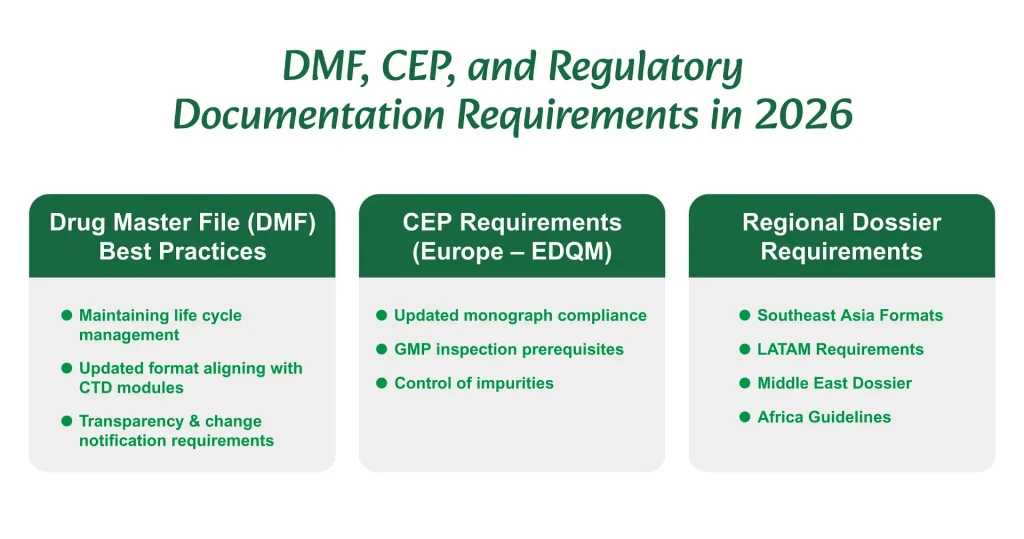
CEP Requirements (Europe – EDQM)
CEP shows that an API meets European Pharmacopoeia quality standards.
It also shows that the API follows strict EDQM review and inspection rules.
This section explains the main CEP requirements:
Regional Dossier Requirements
Different regions need specific dossier formats and documents.
Companies must adjust core files to match local authority rules.
LATAM Requirements
Follow COFEPRIS and ANMAT rules.
Submit CTD dossiers.
Provide GMP proof.
Maintain local regulatory contacts.
Africa Guidelines
Meet PPB, NDA, and NAFDAC expectations.
Use CTD format.
Submit required approvals and quality documents.
Southeast Asia Formats
Align with Thai FDA, NPRA, and BPOM formats.
Include ACTD structure, stability data, and forms specific to each country.
Middle East Dossier
Follow the GCC unified template.
Submit e-CTD documents.
Make sure all files meet Gulf authority review and approval standards.
Special Requirements for HPAPI & Oncology APIs
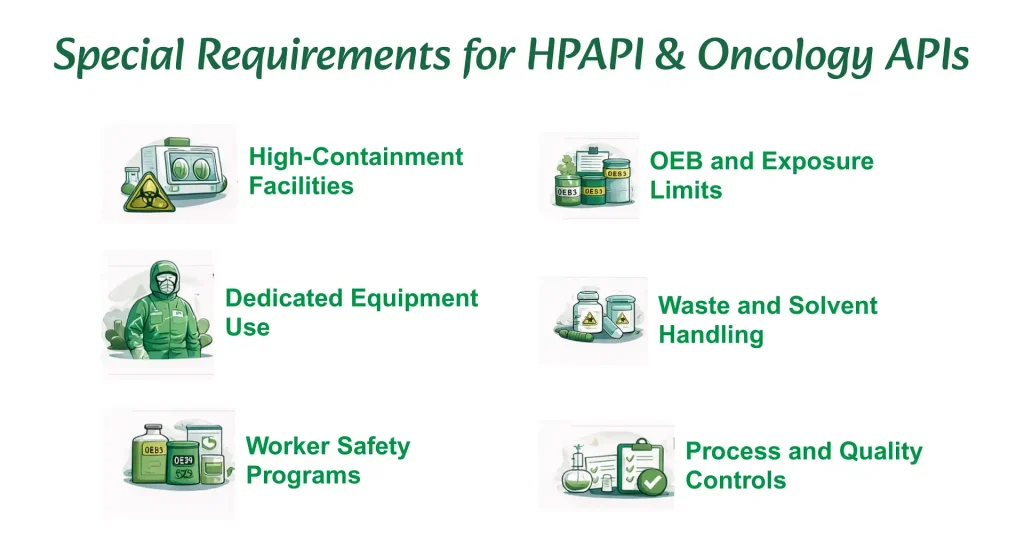
Oncology APIs that are highly potent require more precautions.
Trained staff and strong safety measures are vital for keeping people and products safe.
High-Containment Facilities
Manufacturing must use closed isolators. It also needs airlocks and negative-pressure rooms.
These controls keep harmful particles from escaping. They also protect nearby areas and workers from exposure risks.
Dedicated Equipment Use
Use dedicated reactors, dryers, and sampling tools for oncology APIs.
Shared equipment can only be used after it has been cleaned to very low, non-detectable contamination levels.
Worker Safety Programs
Staff must stick to safety rules, wear protective gear, and finish health checks.
Regular air and surface testing ensure exposure levels stay below safe limits.
OEB and Exposure Limits
Classify APIs into exposure bands and set safe limits for each band.
Check air quality and ensure that handling processes keep exposure within safe work limits.
Waste and Solvent Handling
Treat all waste from potent APIs carefully. Dispose of waste safely, recover solvents carefully, and conduct thorough cleaning checks.
This helps stop environmental harm and prevents contamination between products.
Process and Quality Controls
Follow strong development and control strategies. Define critical quality points and monitor impurities.
Check processes to ensure quality and safe manufacturing.
ESG, Green Chemistry & Sustainability Expectations

In 2026, API makers must follow strong environmental and safety rules.
Buyers want clean processes and less pollution.
They want safer chemicals and regular checks on sustainability.
Sustainability is now a key buying factor. Many global buyers choose API makers that hold solid environmental certifications.
They also look for companies that use green manufacturing.
Technology & Digital Transformation in GMP
Digital tools make it easier to follow Good Manufacturing Practice (GMP) rules.
These tools let teams work faster, safer, and more accurately.

AI-driven quality monitoring
AI systems study batch data and sensor signals to find patterns and risks.
They spot issues early, improve process control, and help teams solve problems before they fail.
This cuts waste, boosts yield, and helps make steady quality choices.
Electronic Batch Records (EBR)
EBR replaces paper records with digital forms and real-time data capture.
Systems link to equipment and automatically save values.
Built-in checks prevent missed steps and errors. Review-by-exception makes product releases faster.
It also ensures that data integrity remains strong.
QMS software (Trackwise, MasterControl)
Modern QMS platforms link documents, training, deviations, and audits in one place.
Tools like Trackwise and MasterControl help teams keep track of issues.
They manage CAPA and ensure compliance. Digital workflows cut down on manual tasks and boost visibility across sites.
IoT-enabled warehouse monitoring
IoT sensors check temperature, humidity, and storage conditions all day long.
Alerts are sent if limits are crossed, so teams act quickly.
Real-time monitoring keeps materials safe and helps with cold chain control.
It also ensures proper storage across warehouses and transport.
Blockchain for supply chain transparency
Blockchain makes records safe. They are tamper-proof and trackable in the supply chain.
Each step is logged and cannot be changed later. This improves traceability and lowers the risk of fake materials.
It also helps to build trust between suppliers, manufacturers, and regulators.
Common Mistakes API Manufacturers Must Avoid in 2026
Strong data integrity and updated systems are now key for GMP.
By avoiding simple mistakes, we can strengthen global compliance and build trust.
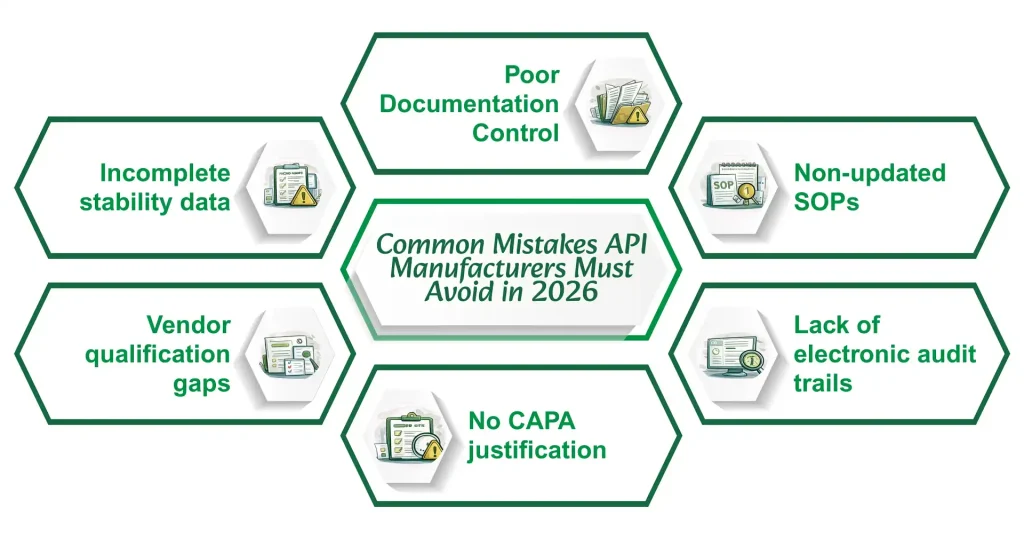
Poor documentation control
Using loose papers, unofficial notes, or late data entry can cause big data integrity risks.
Uncontrolled documents can cause problems. They can cause inspection problems.
They may lead to batch rejections or delays in certification.
Incomplete stability data
Submitting files without full stability studies can stop product approvals.
Many regions need real-time and zone-specific data.
Dossiers lack long-term results or shipping simulations. This weakens files and delays registrations in global markets.
Vendor qualification gaps
Relying only on supplier certificates without audits or testing is risky.
Hidden impurities or quality issues may go unnoticed.
Bad vendor checks can lead to recalls and compliance issues.
They can also cause problems in the supply chain during inspections.
Non-updated SOPs
Old SOPs that do not match current practices create compliance gaps.
If procedures are outdated, staff may follow incorrect steps. Regular reviews and updates are necessary.
They help show new guidelines, equipment, and regulatory expectations.
Lack of electronic audit trails
Systems lacking secure audit trails cast doubt on data reliability.
Shared logins or turned-off tracking can seem suspicious in audits.
Regulators require traceable electronic records.
These should show who made the changes and when they occurred.
No CAPA justification
Closing CAPA without a proper root cause analysis is a common mistake.
Simple retraining is not enough. Every CAPA must have a clear investigation, action steps, and checks for effectiveness.
This helps stop repeated issues and inspection alerts.
2026 Audit-Ready Checklist for API Manufacturers
Before any inspection, API manufacturers should review key records and systems.
This checklist ensures you’re ready for global audits.
It also lowers the chance of major or critical findings. Here’s a ready-to-use summary list:
Conclusion: Staying Globally Competitive as a GMP-Compliant API Manufacturer
API manufacturers meet global GMP and regulatory standards.
This helps them build strong systems and keep clear records.
This ensures steady quality, full compliance, and smooth market access in 2026.
It also forms long-term partnerships with buyers, regulators, and global pharma companies.
These goals apply to both regulated and semi-regulated markets.
Actiza Pharma is prepared for the 2026 global standards with strong quality systems, updated documents, and dependable supply practices.
This commitment builds trust with importers and distributors.
It supports approvals in many areas and helps create stable, long-term global business relationships.
