


Introduction: The Global Diabetes Epidemic
Diabetes is rising fast across the world. More than 540 million adults are living with diabetes today, according to IDF 2024.
Approximately 1 in 9 adults has the disease, and many are unaware of it yet.
By 2050, about 853 million people could be affected.
This is mostly due to rising Type 2 diabetes tied to urban living, ageing, obesity, and low physical activity.
The demand for treatment is also increasing. The global antidiabetic drugs market is expected to cross USD 95 billion by 2030.
APIs are key to making affordable oral tablets, insulin analogs, and metabolic medicines.
India has a strong API manufacturing base. It plays a key role in supplying diabetes and metabolic APIs globally.
This ensures steady and affordable access for many countries.
Understanding Diabetes & Metabolic APIs
Diabetes and metabolic APIs are essential parts of today’s medicine.
Here are their types, uses, and major drug classes, explained simply.

What Are Diabetes APIs?
Diabetes APIs are key components in medicines. They help manage blood sugar, lower insulin resistance, and boost fat metabolism.
They are used in tablets and injections for the treatment of type 2 diabetes.
These include biguanides like metformin, DPP-4 inhibitors, SGLT2 inhibitors, sulfonylureas, thiazolidinediones, GLP-1 receptor agonists, and insulin APIs.
Each class helps manage glucose levels and reduce health risks in its own way.
What Are Metabolic APIs?
Metabolic APIs are active ingredients used to treat various metabolic conditions.
These include obesity, high cholesterol (hyperlipidemia), and metabolic syndrome.
They help improve insulin sensitivity, reduce fat levels, and lower heart risks.
These APIs focus on obesity medications. They also cover statins, cholesterol-lowering drugs, and insulin sensitisers.
They are typically used in combination with antidiabetic medications.
This improves metabolic control and supports better long-term health.
Market Overview: Diabetes & Metabolic API Demand
The diabetes and metabolic API market is growing fast worldwide.
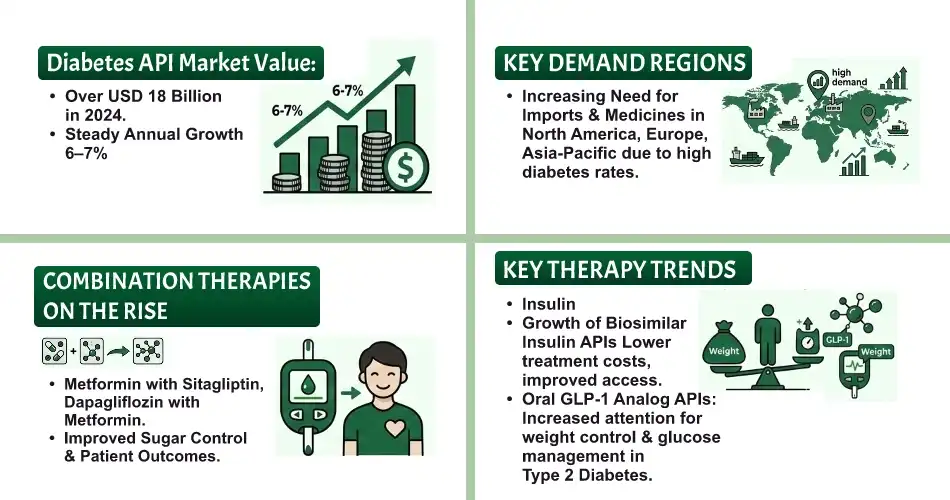
Here is the review of market size, growth rate, key regions, and therapy trends:
India’s Role in the Global Diabetes API Supply Chain
India plays a major part in the global diabetes API network. Here are the manufacturing strengths, export reach, and quality standards.

India as a Key API Manufacturing Hub
India is one of the world’s top API producers and a trusted supplier of diabetes APIs. India is a key API manufacturing hub as:
Competitive Advantages of Indian Manufacturers
Indian API manufacturers are known for their ability to keep costs low and for their technical knowledge.
Here are the competitive advantages of Indian manufacturers over others:
Strong Integration
Indian companies handle their supply chain. They make the raw materials in-house.
This keeps costs low, cuts imports, and makes supply chains stable and affordable for all.
It also builds stronger local networks.
Advanced Synthesis
Manufacturers are skilled in chiral chemistry. They understand complex processes inside and out.
They are experts in making high-quality molecules. This includes Sitagliptin and Canagliflozin.
These have clear structures and meet strict purity standards, ensuring reliability.
Regulatory Strength
Indian firms keep their documents up to date. This includes DMF, CoA, MSDS, and stability data.
They ensure everything is consistent. This helps global buyers meet some pretty tough regulations without a hitch.
Commonly Exported Diabetes & Metabolic APIs from India
India exports a wide range of diabetes and metabolic APIs worldwide.
Here are the major APIs, their applications, and key export markets.
| API Name | Therapeutic Class | Application | Export Markets |
|---|---|---|---|
| Metformin Hydrochloride | Biguanide | Oral antidiabetic | Africa, Asia, EU |
| Sitagliptin Phosphate Monohydrate | DPP-4 Inhibitor | Type 2 diabetes | LATAM, CIS |
| Dapagliflozin Propanediol Monohydrate | SGLT2 Inhibitor | Type 2 diabetes | EU, Middle East |
| Pioglitazone Hydrochloride | Thiazolidinedione | Insulin sensitizer | Africa, Asia |
| Glimepiride | Sulfonylurea | Oral insulin secretagogue | LATAM, Africa |
| Canagliflozin | SGLT2 Inhibitor | Oral antidiabetic | EU, Asia |
| Rosuvastatin Calcium | Lipid Regulator | Metabolic syndrome | Global |
| Orlistat | Lipase Inhibitor | Anti-obesity agent | Asia, LATAM |
Key Market Trends Shaping the API Landscape
The API market is changing fast with new science and higher demand.
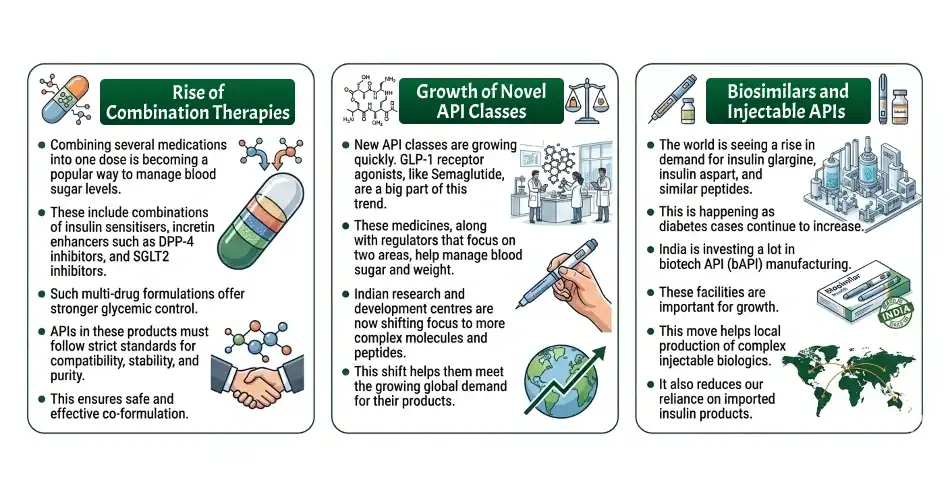
Here are the key market trends shaping the API landscape:
Rise of Combination Therapies
Combining several medications into one dose is becoming a popular way to manage blood sugar levels.
These include combinations of insulin sensitisers, incretin enhancers such as DPP-4 inhibitors, and SGLT2 inhibitors.
Such multi-drug formulations offer stronger glycemic control.
APIs in these products must follow strict standards for compatibility, stability, and purity.
This ensures safe and effective co-formulation.
Growth of Novel API Classes
New API classes are growing quickly. GLP-1 receptor agonists, like Semaglutide, are a big part of this trend.
These medicines, along with regulators that focus on two areas, help manage blood sugar and weight.
Indian research and development centres are now shifting focus to more complex molecules and peptides.
This shift helps them meet the growing global demand for their products.
Biosimilars and Injectable APIs
The world is seeing a rise in demand for insulin glargine, insulin aspart, and similar peptides.
This is happening as diabetes cases continue to increase.
India is investing a lot in biotech API (bAPI) manufacturing. These facilities are important for growth.
This move helps local production of complex injectable biologics.
It also reduces our reliance on imported insulin products.
R&D & Manufacturing Innovation in Indian Pharma
Indian pharma is moving from cost-based production to innovation for growth.
Below are the R&D & Manufacturing Innovations in Indian Pharma:
Green Chemistry
Companies are focusing more on greener methods.
They use green chemistry and enzymatic synthesis to reduce waste and impurities in their processes.
Cleaner solvents, biocatalysts, and eco-friendly methods boost efficiency and safety.
They also make API production more sustainable in the long run.
Continuous Manufacturing
Many firms are now using continuous manufacturing and Quality by Design systems.
These methods make batch consistency better. They also cut errors and let you monitor in real time.
This maintains quality stability and helps comply with global rules.
Solubility Enhancement
Micronization techniques help APIs dissolve better and work more effectively.
They do this by increasing the surface area. It’s crucial to carefully manage the crystal form.
This makes drugs more stable. It also helps with absorption and performance.
This is key to getting the best therapeutic results.
Global Collaborations
Indian companies often team up with contracting firms.
They also partner with development firms for global research and manufacturing projects.
These partnerships speed up development. They help make complex molecules and also meet global quality and regulatory standards.
Regulatory & Compliance Standards

Strict rules ensure that APIs comply with quality and safety standards.
This helps them gain global acceptance. Below are the required regulatory and compliance standards:
Global Guidelines
Manufacturers follow ICH Q7 rules for good manufacturing practices of APIs.
They also meet WHO-GMP requirements. Many also follow ISO 9001:2015 quality systems.
This keeps production steady. It also ensures strong process control.
Documentation Strength
Companies offer full regulatory documents. This includes Type II DMF filings, Certificates of Analysis (CoA), MSDS, and detailed stability data.
Traceability reports track raw materials. They also track intermediates and finished APIs.
This happens throughout the supply chain.
Audit Transparency
Factories are transparent during inspections by importers and government agencies.
They keep accurate records, do regular quality reviews, and protect their data with secure systems.
This approach makes audits much easier and helps build trust with customers globally.
Supply Chain & Export Excellence
India ensures safe and timely API exports worldwide. Below is how to maintain the supply chain and Export Excellence.

Temperature Control
APIs are delivered using either cold-chain or ambient logistics.
This choice depends on what the product needs. Temperature-sensitive APIs must be shipped under controlled conditions.
This ensures they remain stable, safe, and effective during transport.
Major Ports
India’s main export centres are ports such as Mumbai, Chennai, Mundra, and Visakhapatnam.
These ports manage a large part of the country’s export trade.
These ports handle large pharmaceutical shipments.
They also have a strong infrastructure for global trade.
Smart Tracking
ERP-enabled systems enable real-time tracking of shipments.
This results in on-time deliveries, easier coordination, and better reliability with global partners.
Regulatory Support
Manufacturers and their logistics partners assist with import licenses.
They also help with registration documents. This support makes it easy for buyers to manage paperwork.
It also helps them follow rules in different countries.
Future Outlook: The Next Generation of Diabetes & Metabolic APIs

The diabetes API sector is shifting toward smarter, friendlier solutions for patients.
Below is the Future Outlook:
Oral & Weekly Innovations
Research is advancing oral insulin to reduce injection burden.
Once-weekly GLP-1 APIs are in high demand.
They help patients, support sticking to treatment, and improve long-term glucose control.
Fixed-Dose Focus
Companies are developing more fixed-dose combos.
This makes it easier for people to follow their treatment plans.
These combine several diabetes drugs into one dose.
This helps patients manage blood sugar with fewer tablets.
It also helps them stick to their routine better.
AI Integration
Artificial intelligence and predictive analytics are being used to improve API processes.
These tools help check quality, boost yield, reduce errors, and accelerate the development of safer, better molecules.
Sustainable Manufacturing
There’s a growing demand for sustainable, low-emission API production.
Companies are working to reduce their environmental impact.
They’re using better processes, cutting waste, and investing in systems that help the planet.
This helps them meet the global environmental standards.
Conclusion
Diabetes is on the rise at an alarming rate.
Today, over 540 million adults are affected, and that number is projected to skyrocket to 853 million by 2050.
The global antidiabetic drugs market may cross USD 95 billion by 2030.
India’s diabetes and metabolic API makers are boosting global access to vital therapies.
They do this through innovation, scale, and strong regulatory practices.
As chronic lifestyle disorders rise, a steady API supply is more crucial than ever.
Indian exporters like Actiza Pharmaceutical Pvt. Ltd. play a critical role in providing top-notch, affordable APIs to countries worldwide.
They help countries improve access to treatment and better manage diabetes and metabolic diseases.


