


The world for Active Pharmaceutical Ingredient suppliers’ global market has reached a critical inflection point.
Competing on price is no longer a competitive advantage; it is now a liability.
The global market for APIs is estimated at USD 270.53 billion in 2025, with a CAGR of 5.55% until 2033.
While the market is growing, a significant gap persists, especially for suppliers who prioritize quality over price.
Purchasers, regulatory affairs managers and formulation companies face an unusual challenge.
We try to understand how to interpret signals of quality from suppliers, API price-negotiation strategies without risking non-compliance, and identify the various risks associated with different global markets.

The Real Problem Facing API Buyers Today: Price Wars Are Hiding Quality Failures
The market is now more competitive than ever. This competition has increased competition in the API market.
Suppliers not only need better business strategies but also the right documents to pass this hurdle.
Indian, Chinese, Eastern European, South Korean, and Brazilian suppliers are facing intense price competition.
For active pharmaceutical ingredient suppliers (global market), this scenario presents buyer leverage.
The Global API Market Has Never Been More Competitive or More Deceptive
The world of API suppliers is crowded with companies coming from India, China, Eastern Europe, and lately South Korea and Brazil.
Small-scale generics manufacturers under intense margin pressure from their respective health ministry officials and insurers who require lower prices, cannot help but consider the lowest bid offer seriously.
Unfortunately, it is a structural issue. The lowest bid supplier operates with a thin budget of quality measures in the areas of sourcing of materials, in-process testing, and environmental controls.
The result is deadly in many instances. As per the WHO Fact Sheet on Substandard and Falsified Medical Products, one out of ten medications produced in low- and middle-income countries is either substandard or falsified, citing poor manufacturing and quality control practices among the top three root causes.
It is worth noting that the issue of quality control is further backed by regulatory data, as per the FDA’s FY2024 Report on the State of Pharmaceutical Quality, where a staggering 39% of all issued import alerts are related to facilities in China.
While 13% relate to India numbers substantially exceeding the average 10% for other regions.
Indian manufacturers had the highest percentage (13%) of severe CGMP violations among all facilities examined for Senator Jim Banks’ letter to the FDA Commissioner in October 2025.
What does ‘Competitive Price’ Actually Mean When You Buy Pharmaceutical API Quality Price
For understanding the API cost vs quality tradeoff, it is important to pay attention to the ‘three-price problem’.
What is the Three-Price Problem?
The Three Price Problem represents the following:
To understand it better, let’s take an example:
A Bangladeshi formulator’s switch in Metformin HCl API supplier resulted in a cost saving of US$ 2/kg.
This was followed by an out-of-specification (OOS) result on dissolution testing within two production cycles.
The total cost of the batch write-off, retesting, and the regulatory deviation report exceeded six months of the cost savings.
According to IQVIA’s analysis of generic manufacturing costs, the average cost of a batch failure is estimated to be USD 500,000 to over USD 2 million.
Comparison between different problems:
| Cost Layer | Budget Supplier (Tier 3) | Mid-Range Supplier (Tier 2) | Premium Supplier (Tier 1) |
|---|---|---|---|
| Ex-Works Price | Lowest (baseline) | +10-20% vs. Tier 3 | +25-40% vs. Tier 3 |
| Landed Price | Low | Moderate | Highest |
| Batch Failure Probability | High (1 in 5-8 batches) | Moderate (1 in 15-20) | Low (1 in 50+) |
| Regulatory Delay Risk | High (6-18 months) | Moderate (2-6 months) | Low (<1 month) |
| True Total Cost of Compliance | Highest | Moderate | Lowest to Moderate |
The Documentation Gap No One Talks About
Many GMP-certified API suppliers from non-ICH countries (who can be priced competitively) typically lack most essential documentation needed for regulated market submissions.
These documents include complete DMF filing API supplier records, a current CEP certificate of suitability, and a WHO-PQ compliant API sourcing listing.
As per the EMA’s published EDMF assessment reports, the primary reason for assessment delays is the incomplete Module 3 documentation.
The gap is clearly visible to the buyers not only during the supplier selection but also during the regulatory submission.
The FDA, TGA (Australia), and Health Canada have been working since 2020 on introducing more stringent bulk API import regulations.
Summary:
As it is known that disparity comes with a high cost, this makes the API cost vs quality tradeoff a real deal. When documents are absent, the three-price problem develops.
After understanding the central issue in a clear way, it’s time to pay attention to the related risks that are the outcome when the price is prioritized.
The Hidden Risks Buyers Accept When They Prioritize Price Over Process
When procurement chooses to buy the cheapest quote possible instead of considering the best quote in terms of the supplier’s process quality, the pharmaceutical supply chain risk starts with one batch, and could even go beyond one batch.
Suppliers with questionable quality systems fail to sell their offerings.
It is also understandable that there are large gaps between what supposedly exists in the quality systems and the documentation presentation for so-called GMP-certified API suppliers.
Such gaps are the most underestimated risk in the process of buying pharmaceutical API quality prices.
It is not a misconception that the cost of API is directly proportional to the quality of the accompanying documentation.

Supplier Qualification Failures Are the #1 Cause of API-Related Regulatory Action
Failure to qualify API suppliers is neither anecdotal nor infrequent; it is well-documented, common, and increasing.
In two of the main regulatory databases, it is evident for any buyer willing to check.
To begin with, in the US FDA context, the FY2024 Report on the State of Pharmaceutical Quality listed 105 warning letters in total, marking the highest number in the last five years with 25% of quality-related import alert additions being aimed specifically at API manufacturers.
However, more tellingly, within the last five years, FDA enforcement activities against API sites resulted in 72% of such measures being directed against facilities supplying compounding pharmacies.
Even though these facilities accounted for merely 18% of API manufacturers in the Site Catalog, 51% of violative sites resided in China and 30% in India.
Next, in the EU context, the EMA EudraGMDP database openly reports on GMP non-compliance statements issued to API manufacturers around the world.
Once one of the EU authorities posts a non-compliance statement, the effect will be immediate throughout the whole territory of all 30 EEA member states.
In other words, a single discovery of a critical deficiency will mean an automatic ban on sales of APIs into the whole European market.
Nevertheless, many mid-sized API buyers continue qualifying API suppliers through the examination of their current WHO-GMP certificates without checking if their processes comply with the ICH Q7 API standard.
The WHO-GMP certificate ensures that the facility has passed the minimum inspection; however, no data integrity, no impurities, and no robust change control management will be certified.
Additionally, the ANDA drug master file containing the process description and facility information is essential when it comes to confirming the quality of an API, but many buyers do not bother looking.
This means that qualification red flags are real and cannot be overlooked in any supplier audit program.
Supply Disruption Risk Is Built Into Low-Cost API Supply Chains
From 2020 to 2022, pharmaceutical supply shortages were exacerbated by the global market’s reliance on India or China as the sole low-cost active pharmaceutical ingredient suppliers globally.
From 2020 to 2023, the US Food and Drug Administration (FDA) Drug Shortage database identified disruption of the supply of APIs as one of the main reasons for the drug shortages.
Buyers who used dual sourcing were able to avoid supply disruptions and maintain supply continuity.
Country-Wise Regulatory and Market Risk Snapshot
For WHO-PQ compliant API sourcing and GMP-certified API suppliers, there are risk profiles for each region.
Risk Matrix: Countrywise API Sourcing
| Country | Approx. API Export Volume | Key Regulatory Body | GMP Standard | Known Risk Factors |
|---|---|---|---|---|
| India | ~USD 25-27B annually (Pharmexcil) | CDSCO | WHO-GMP, EU-GMP | High FDA warning letter volume; variable EDMF quality |
| China | ~USD 40-45B annually (CPIA data) | NMPA | NMPA-GMP | Geopolitical risk; limited EDMF filings; IP concerns |
| Italy / EU | Significant intra-EU volumes (EMA) | EMA member agencies | EU-GMP, ICH Q7 | Higher cost; strong CEP (Certificate of Suitability) availability |
| USA | Limited export volumes (FDA) | FDA | cGMP (21 CFR Part 211) | Very high cost; limited captive API export |
| South Korea | Growing capacity (MFDS) | MFDS | ICH Q7, KGMP | Expanding track record; limited global DMF history |
| Israel | Niche volumes (MOH Israel) | MOH Israel | EU-GMP aligned | Strong documentation culture; niche categories |
The ICH Q7 Compliance Gap in Emerging Market Suppliers
ICH Q7 encompasses the rules governing the highest-tiered pharmaceuticals manufacturing, widely regarded as the benchmark for GMP.
Guidelines include quality management, change control, deviation management, stability testing, validated testing methodologies, and testing conducted by qualified personnel.
The main issue affecting the developing markets is a self-proclaimed adherence to ICH Q7 guidelines API.
What is expected from suppliers under ICH Q7 guidelines? API is actually highly non-compliant:
For purchasers, the main problem is that, by accepting self-declarations of compliance with ICH Q7 without any auditing, they are taking on all the unknown risks.
Summary:
Price-based sourcing conceals risk in three dimensions: qualification failures that threaten overall systemic risk, blockages in the supply chain caused by reliance on a single source, and the regional risk profile that demands market-specific due diligence.
After analysing the risk, let’s look at the supply chain in further detail.
Inside the API Supply Chain: What Buyers Must Audit Before Signing a Contract
An area of pharma procurement best practices remains unexamined by almost all experienced regulatory affairs teams.
Audits focus singularly on the facilities of API manufacturers.
The CoA is verified. And the contract is signed with almost zero visibility to the processes that occur upstream of the manufacturer’s reactor and the downstream processes of the cold chain and port clearance.
The buyers achieving the best prices on high-quality APIs are not negotiating hardest on ex-works prices.
Rather, they’re the buyers who’ve redesigned the qualification and commercial frameworks to make quality a pricing advantage.

API Sourcing: From Starting Material to Finished API
Most audits for qualifying API vendor qualification processes solely focus on finished API manufacturers.
ICH Q11 stipulates that the qualification of starting materials (SM) must be referenced in the API’s Drug Master File.
Upstream supply chain red flags include:
Cold Chain, Humidity Sensitivity, and Climate Zone Considerations
According to ICH Q1A(R2), climatic zones determine stability testing requirements.
Zone IVb (30 C/75 RH) applies to Southeast Asia, sub-Saharan Africa, and parts of Latin America.
One of the most common mismatches is when an Indian supplier provides Zone II stability data to a Malaysian formulator who is operating in Zone IVb conditions.
This is a non-compliance issue, and it is not merely a technicality.
When buying temperature-sensitive APIs, customers must request Zone IVb stability data, validated cold chain SOPs, and temperature excursion response plans.
Customs, Port Clearance, and Last-Mile Reality
Bulk API import regulations are not consistent. Australia (TGA), Brazil (ANVISA) and Saudi Arabia (SFDA) require the API source to be approved prior to import.
According to the World Bank Logistics Performance Index, the level of port efficiency varies greatly in the pharmaceutical-importing countries.
A 72-hour delay without cold chain storage can lead to the complete loss of temperature-sensitive API shipments.
Pharma procurement best practices are to insist on the complete export documentation pack (including the CoA, Certificate of Origin, MSDS, packaging declaration, and GMP self-certification) prior to the shipment of the first consignment.
Now that supply chain risks are understood, let’s look at how smart buyers win on both quality and price.
How Smart API Buyers Are Winning on Both Quality and Price
The API vendor qualification process is merely a compliance procedure to check, and it provides no strategic value to the buyer.
Market reactive buyers are only concerned with the consequences when an API seller’s offering leads to batch failure, regulatory infractions, or disruptions to their supply.
They bear the consequences of their decisions and merely repeat the process.
The proactive buyer recognizes the API cost vs quality tradeoff.
These buyers understand the value of the offering and are largely unaffected by the compliance, supply, and total cost of ownership, risk, and resilience components.
Reactive buyers generally lack an appreciation of the pharma procurement best practices.
Which is largely attributable to sophisticated multinational conglomerates with integrated supplier quality management systems and highly sophisticated procurement mechanisms.
The Supplier Qualification Framework That Eliminates Surprises
Define five successive steps to qualify for new GMP-certified API suppliers:
A wise API buyer doesn’t gamble and learn about the supplier’s shortcomings only when faced with an unsuccessful batch.
Instead, they take the necessary risk assessment upfront as part of the qualification process.
The five successive steps to qualify for new GMP-certified API suppliers:
No system reduces risks entirely. However, those who follow these five stages have fewer problems with OOS failures and regulatory holds, and greater bargaining power over price.
API Supplier Qualification Checklist: 20 Point Framework
| S-No | Document / Activity | Classification |
|---|---|---|
| 1 | Current GMP Certificate | Required |
| 2 | FDA, EMA DMF or EDMF Number | Required |
| 3 | CEP from EDQM | Required (EU) / Preferred (others) |
| 4 | WHO-PQ Listing | Required (donor programs) |
| 5 | Quality Manual | Required |
| 6 | Change Control SOP | Required |
| 7 | Deviation Management SOP | Required |
| 8 | Multi-Batch CoA (min. 3 batches) | Required |
| 9 | Certificate of Re-test Date | Required |
| 10 | ICH Q3A Impurity Profile | Required |
| 11 | Stability Data (market-relevant zone) | Required |
| 12 | Validation Master Plan | Required |
| 13 | Starting Material Supplier Details (ICH Q11) | Required |
| 14 | Analytical Method Validation Reports | Required |
| 15 | Site Master File | Preferred |
| 16 | Prior Inspection History | Preferred |
| 17 | Environmental Monitoring Data | Preferred |
| 18 | Water System Qualification | Preferred |
| 19 | Supply Capacity Confirmation | Preferred |
| 20 | Financial Stability Indicators | Optional |
Price Negotiation Without Compromising Quality: A Practical Playbook
To secure lower pricing, it is imperative to have API price negotiation strategies without compromising quality:
Buyers can lock in price stability for 24 months at an estimated 8-12% discount off spot market pricing with a commitment to minimum annual volume.
This works to the supplier’s advantage for predictable revenue.
A price reduction of 5-7% is achieved just by saying you’re turning to another source with most vendors.
This is one of the easy partnerships; In terms of pricing, when a supplier lacks a good freight network, CIF pricing may be more economical when you consider the total land cost than FOB pricing plus the buyer’s qualified cold chain forwarder.
Buyers who obtain published inspection results from PIC/S, Pharmaceutical Inspection Co-operation Scheme, the 55 GMP Inspection data sharing governing bodies, including FDA and EMA, experience reduced audit costs while retaining access to the results.
Building a Multi-Region Sourcing Strategy for Resilience
Pharma procurement best practices for different regions:
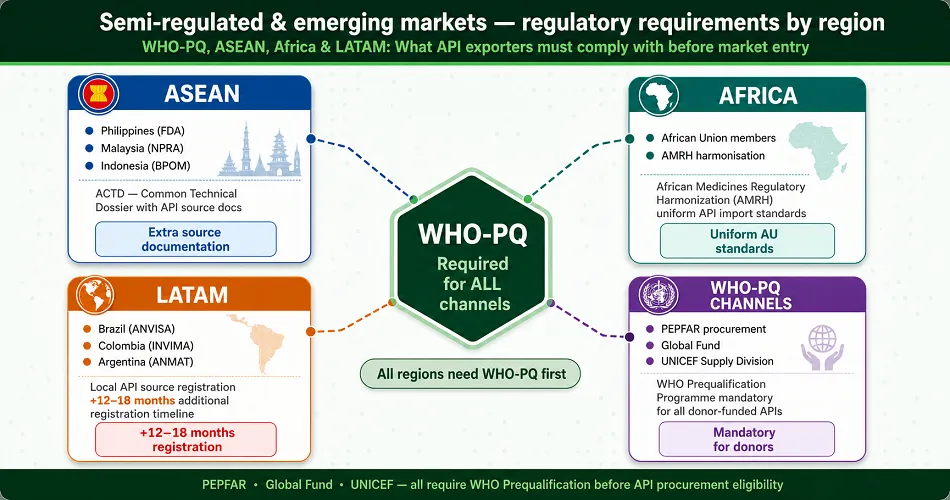
For emerging market procurement, suppliers that are listed in the WHO-PQ listed suppliers facilitate less risky submissions for tenders linked to the PEPFAR, Global Fund, and UNICEF Supply Division.
As per IQVIA’s analysis of top generic manufacturers, leading global generic manufacturers have generally increased dual sourcing since 2021.
Summary
The buyer uses the structured API vendor qualification to get the commercial contracts.
This results in both flexible and resilient supply with negotiating power.
Now, when the solution framework is established, we can pinpoint buyer-specific compliance requirements.
Compliance Requirements Every API Buyer Must Satisfy by Market
It is essential to remove misconceptions around the cost of buynig pharmaceutical API at a quality price.
Supplier qualification processes typically include confirmation of FDA compliance, DMF filing, API supplier status with CDER, and no active Import Alerts.
Regulated Markets (US, EU, Australia, Canada, Japan)
An ANDA (Abbreviated New Drug Application) drug master file is a submission to the FDA that provides confidential information about an API’s manufacturing processes and control facilities.
Key bulk API import regulations:
Comparison for Regulated Market API Compliance
| Requirement | USA (FDA) | EU (EMA) | Australia (TGA) | Canada | Japan (PMDA) |
|---|---|---|---|---|---|
| Dossier Route | DMF Type II | CEP or EDMF | Embedded in product dossier | Embedded in ANDS | Embedded in submission |
| GMP Standard | 21 CFR Part 211 | EU-GMP (EudraLex Vol. 4) | TGA GMP clearance | Division 2 F&D Regs | JGMP (ICH Q7 aligned) |
| Import Alert Risk | Yes | No formal system | Hold orders possible | GMP non-compliance blocks approval | Equivalent controls |
| Local Agent Required | No | No | No | No | Yes (typically) |
Semi-Regulated and Emerging Markets (Southeast Asia, Africa, LATAM)
Global API Market Forecast 2025 – 2030: Where the Opportunities and Pressures Are Heading
In the period 2025-2030, Pharma procurement best practices will be guided by three key factors: the direction of market growth, supply base structural constraints, and the risk scenarios buyers will need to navigate.
As per Grand View Research and Mordor Intelligence, the global API market is expected to reach USD 310-330 billion by 2030, growing at a rate of about 6.0-6.5%.
The fastest-growing segments include oncology and biosimilar APIs.
Market Size, CAGR, and Demand Drivers
Captive vs. Merchant API Supply: The Shift and Its Relevance
The structural change that has arguably been the most profound in the world of APIs is the trend of innovator pharmaceutical firms’ increasing abandonment of captive API manufacturing.
With pipeline focus moving towards the development of highly potent drugs, complex biologics, and outsourced product development, many large innovator pharmaceuticals are leaving behind in-house API manufacturing in favor of contract research organizations and other third-party manufacturers.
The merchant API segment is predicted to witness the largest growth in terms of market value during the forecast period, with the rising costs of captive production pushing companies to move out of captive production in order to cut down on expenses related to purchasing costly equipment.
This trend is reflected by the fact that the merchant segment accounted for a 48.27% share of the global API market in 2025 and is expected to grow further at a CAGR of 9.82% during the forecast period.
This structural change has enormous effects on both formulation companies and procurement professionals.
It indicates that reliance on third-party API providers is increasing, and that the need for vendor evaluations, regulatory compliance, and supply chain diversification is also growing.
The global active pharmaceutical ingredient (API) suppliers market is expected to be influenced by the following over the next 5 to 6 years:
Far-reaching increases in chronic illnesses paired with an aging population and unhealthy lifestyles have been noted in wealthy economies.
Governments in developing countries are investing in the availability of medicine countrywide.
Hosting affordable healthcare improves and enhances the requests of imperative medication.
The biosimilars indicate the end of monopoly for the influential bodies, hence enabling affordability.
The primary increase in demand for the APIs is the cytotoxic and monoclonal antibodies, which have been bound and justified within the growing global burden of cancer.
Risk-Adjusted Scenarios for API Buyers
India-EU GMP convergence improves the supplier’s quality and the symbiotic aspect concerning the regulatory convergence.
Dual sourcing minimizes dependency risks and keeps buyers satisfied. Within this hypothesis, the expectation is that after 2026, API prices will stay almost the same.
The prices of API will rise at a rate of about 3-5% of the total value due to the increase in the prices of energy and raw materials used.
The number of rules will increase, and the suppliers with a good structure to deal with documentation and rules will manage the new risks with a good level of efficiency.
Geopolitical risks, with the US-China tensions and a possible restraint of exports from India, will also result in a Global API supply chain disruption.
In this case, the buyers will have to deal with a huge increase in the global API spot market with prices rising.
Frequently Asked Questions
Q1: What is the difference between WHO-GMP and WHO-PQ for API suppliers?
WHO-GMP is a generic site-level verification of the WHO GMP standard, while WHO-PQ compliant API sourcing is both product-level and site-process verification of a particular API at a particular site, which is compliant with WHO quality standards and is a prerequisite for international procurement initiatives such as PEPFAR and the Global Fund.
Q2: How do I verify if an API supplier has an active FDA Import Alert?
The FDA Import Alert database can be searched by company name, product, or country of origin.
Q3: What documents should I always receive before the first API shipment?
As a minimum, the shipment should include: CoA for the specified batch, Certificate of Origin, MSDS/SDS, packaging declaration, and GMP self-certification. If the shipment is to a regulated market, the supplier should also reference the applicable DMF filing API supplier or CEP certificate of suitability.
Q4: Is a lower ex-works price always a red flag for API quality?
Not necessarily, but it does require the most robust evaluation through the API vendor qualification process. Any price that deviates more than 20-25% from the mean quotation is likely to have compromised quality, so sufficient documentation and audit outcomes will determine whether or not the API is acceptable.
Q5: What is ICH Q7, and why does it matter to API buyers, not just manufacturers?
ICH Q7 is an international set of guidelines for GMPs in API manufacturing.
The ICH Q7 guidelines API for manufacturers acts as a guide in production, while the buyers will utilize the same as a criterion for qualification. They will audit the suppliers against the stipulations contained herein before procuring even a kilogram of product. It also constitutes part of the framework for your paper audit checklist while conducting audits for the pharma procurement best practices.
Q6: Can I use a single API supplier for both the US and EU market submissions?
Yes, if the supplier has a valid FDA DMF Type II and a CEP certificate of suitability or a valid EDMF. However, relying on a single supplier creates an unnecessary risk for the pharmaceutical supply chain. A dual-source supply solution of one FDA-qualified supplier and one EU-qualified supplier ensures both compliance and supply chain resilience.
Q7: How do Incoterms affect the true cost of buying APIs internationally?
Incoterms specify the extent to which risk and costs are transferred from the seller to the buyer. For example, the CIF payment term with an unqualified cold chain supplier would put temperature-sensitive APIs at risk for exceeding the required temperature range (excursions). On the other hand, the FOB payment term coupled with a qualified cold chain forwarder from the buyer would likely ensure better temperature compliance at a lower total cost. This is a vital element of API price negotiation strategies.
Conclusion
There is global API market competition in the pharma market, and buyers who maintain quality discipline will be rewarded, and to maximize value, they adopt a quality management approach to procurement that goes beyond cost saving.
The structure of this guide outlines the operational basis: understanding the API cost vs quality tradeoff, the structured API vendor qualification process, the mapping of bulk API import regulations to your target markets, and the construction of a multi-region WHO-PQ compliant API sourcing strategy that is resilient to supply, regulatory and geopolitical disruptions.
The buyers who regularly buy pharmaceutical API quality price advantages do so not because of the most aggressive negotiation, but because of the most rigorous application of pharma procurement best practices, the most intelligent structuring of commercial relationships, and the most collaborative relationship with suppliers to sustain elevated standards.
Are you prepared for the upcoming compliance and supply challenges with your API sourcing strategy?
Reach out to us to talk about your qualification requirements, or check out our selection of GMP-certified API suppliers for those who cannot compromise on quality and price.
