


If you are responsible for sourcing, regulatory affairs, or business development for a pharmaceutical manufacturer, the next 5 years will reward the former and punish the latter for good reason.
Africa and Latin America are two of the world’s most dynamic regions regarding API export, and three phenomena in this regard are: growing demand and imports, a newly structured global freight system, and increasing regulatory compliance.
Exporters who consider these markets to be static, require little paperwork, and are commodity-based will lose tenders. This is the practice draft for those who will not.
Two Import-Hungry Regions and an API Market in Transition
The global active pharmaceutical ingredient market is extensive and expanding.
India monopolizes the supply, while Africa and LATAM are strongly import-reliant; thus, the opportunity is real.
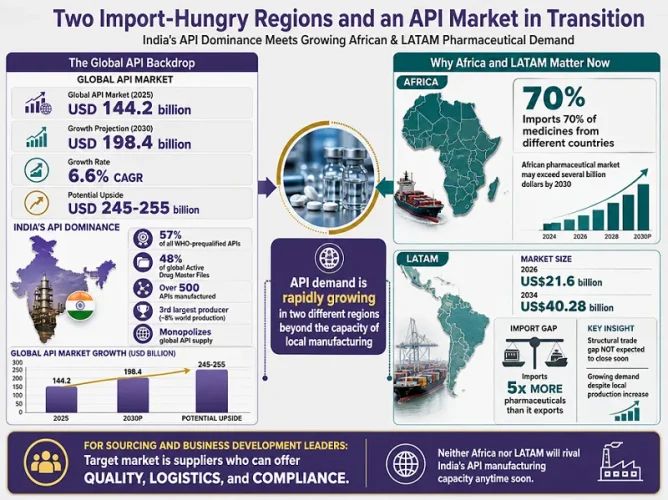
The Global API Backdrop
The API market is expected to reach a valuation of approximately US$198.4 billion[1] by 2030, with a CAGR of 6.6% from a USD 144.2 billion valuation in 2025.
The fastest-growing region in the API market is the Asia-Pacific region. Some analysts expect that the broader API market could reach USD 245-255 billion.[2]
India has manufacturing capabilities for over 500 APIs, produces approximately 57% of all WHO-prequalified APIs,[3] is the third-largest producer in the world (~8% of the world production), and holds about 48% of global Active Drug Master Files.
This provides the basis of India’s export options with Africa and LATAM.
Why Africa and LATAM matter now
Africa imports 70% of its medicines[4] from different countries. The African pharmaceutical market may exceed several billion dollars by 2030.
Latin America’s pharmaceutical market estimates for 2026 suggest a US$21.6 billion market,[5] growing to US$40.28 billion in 2034 .
Within LATAM, it imports five times more pharmaceuticals than it exports. This is a structural trade gap that is not expected to close anytime soon.
As both regions are producing more finished dose medicines locally, demand for API imports paradoxically continues to increase.
Neither region will rival India’s and China’s capacity for API manufacturing anytime soon.
API demand is rapidly growing in two different regions beyond the capacity of local manufacturing.
For sourcing and business development leaders, that is the target market, but these are only the suppliers who can offer quality, logistics, and compliance. Price is excluded as a competitive factor.
We have now analyzed both regions and the growing relationship of import dependence.
We will now analyze the reasons why the export strategies used by suppliers for the past ten years are beginning to fail.
Why the Old Export Playbook Is Breaking
API exporter is being impacted by three concurrent, simultaneous shifts: regulatory, freight, and competitive. Each of these corresponds to a pillar discussed in the remainder of the article.
Buyers no longer rely on the same strategies: ship on price, register per country, and hope the freight remains stable. The scene is changing on three levels:
In 2023, Chinese manufacturers continued to supply around 80% of the world’s generics and APIs, despite the post-COVID “China-plus-one” Indian procurement policy.
The Cost of Standing Still
The following data indicate the magnitude of the problem for exporters unable to adapt to compliance costs, freight shocks, and margin compression.
A rising, consolidating quality bar
Increased GMP compliance, nitrosamine testing integration, GMP harmonization, along with increased expectations for ICH Q12 and Schedule M, increase costs and favor bigger, better-capitalized suppliers (Source: Mordor Intelligence).
A freight environment that punishes time-sensitive cargo
Due to disruptions to regular air routes, the cost of transporting pharmaceuticals from India overseas has been greatly impacted, and Indian pharma transport charges have doubled.
Estimates suggest an additional cost of $4,000-$8,000 per shipment.[6] Approximately $600 million of exports are at risk.
The longer and more congested alternate routes are increasing the risk of the items in the cold chain deteriorating.
34 Margin compression and sharper competition
In India, aggressive tenders and price pressures impacted commodity molecules. Current exporters need to have resilience to fluctuations in freight costs and be ready for higher standards of quality.
Those that are still relying on low prices to sell their products are in direct competition with those that have the above attributes.
We have established the costs of doing nothing; now, we will look to the solutions where the real demand is distributed across the respective regions.
Pillar 1 – Opportunities: Where the Demand Is, Region by Region
Africa’s demand is based on the need for anti-infectives and a manufacturing and trade reset. Demand in Latin America is based on generics, chronic-disease molecules, and a structural trade deficit.
Africa: import reliance plus a manufacturing-and-trade reset
The African Continental Free Trade Area (AfCFTA) and the Pharmaceutical Manufacturing Plan for Africa (PMPA) strive to encourage the production of locally manufactured finished-dose medicines.
There is still dependence on imported Active Pharmaceutical Ingredients (APIs) from India and China.
One drawback to the increased manufacturing of finished-dose medicines is the potential increase in API demand.
Africa’s biggest pull, therapeutically, is in medicines to treat infections. This is in line with the WHO-PQ expectations.
Africa also has an increasing demand for therapeutic molecules to treat non-communicable diseases (NCDs).
The AfCFTA, AMA, and PMPA build synergies and link local production with harmonized regulation, pooled procurement, and trade facilitation.
They are intended to reduce the barriers for producers in Africa’s continental market.
LATAM: a generics-heavy, import-dependent, fast-growing market
Brazil is the region’s leading example of a generics-based system: generics make up over 65% of its pharmaceutical sales[7] and eight out of ten of the drugs are produced there.

As seen in Mexico and Argentina, the combination of a solid generics base and a large pharmaceutical trade deficit creates a sustained API demand in Brazil, especially for pain relief, antibiotics, and chronic disease.
Currency volatility, especially in Argentina, affects the price of imported APIs and provides opportunities for a good and stable supply.
For API manufacturing, Latin America is one of the fastest-growing regions in the world. Latin America is very reliant on the importation of APIs.
Latin American pharma CMO market, projected to reach US$37.2 billion by 2033.[8]
For an API exporter, the implication is that Africa and Latin America are not interchangeable markets served by one go-to-market plan of a patented API.
In Africa, go-to-market strategies based on WHO-PQ-grade API supply and fluency in donor procurement are well rewarded, while Latin America values price margins protected from currency fluctuations, as well as depth of the marketing authorization application and local registration discipline.
Africa vs. LATAM Opportunity Snapshot
| Dimension | Africa | Latin America (LATAM) |
| Market Size & Growth | By the 2030s, Africa’s pharmaceutical market is expected to exceed US$50 billion; most of the medicines are imported. | In 2025, Brazil’s pharmaceutical imports were about USD 14.8 billion, compared to USD 1.3 billion in exports, resulting in a 12:1 import-to export ratio. Brazil continues to be a net importer of pharmaceuticals. |
| Largest Markets | South Africa, Nigeria, Egypt, Kenya, Ghana | Brazil (largest), Mexico, Argentina, Colombia |
| Most Sought-After APIs | WHO prequalified (WHO-PQ) anti-infectives, antimalarials, and a growing demand for non-communicable disease (NCD) APIs | Pain management APIs, antibiotics, cardiovascular APIs, and anti-diabetic APIs |
| Key Structural Element | Efforts to reduce finished dosage formulation (FDF) costs continue to increase API import demand rather than reduce it. | Generics-dominated market (Brazil accounts for nearly 70% of pharmaceutical sales); significant pharmaceutical trade deficit. |
| Most Dominant Buyers / Channels | Public tenders, donor-funded procurement agencies, and local pharmaceutical formulators | Public healthcare systems (e.g., Brazil’s SUS), local pharmaceutical laboratories, and contract manufacturing organizations (CMOs) |
After mapping actual demand locations, we can now examine the second pillar: developing an adaptive freight and logistics strategy.
Pillar 2 – Freight & Logistics: Building a Resilient API Supply Chain
The Cape of Good Hope route is an industry standard that increases costs and cold-chain risks.
However, the established mitigation strategies keep our time-sensitive API shipments on time.
The new normal: Cape routing, premiums, and cold-chain risk
With transits through the Red Sea having decreased significantly, routing via the Cape of Good Hope has become the new norm.
This adds 10 to 14 days to transit times. Asia to Europe freight has remained 25 to 35% more expensive than freight rates prior to the crisis.

The situation for India has become more difficult, increasing the risk for all of the chokepoints in the Suez, Bab-al-Mandab, and Hormuz regions.
Air cargo capacity was reduced by 22%. In certain trade lanes, freight costs increased by 70%.[9]
Because of these costs, increasing numbers of pharmaceutical shippers began to air-freight more goods, even though the cost was still considerably higher.
The resilience playbook for API exporters
To prevent disruption from delays in transport, maintain a buffer stock in regional hubs and warehouses that are nearer to buyers in Africa and LATAM.
For different transport methods and paths, use air freight more selectively, and only for APIs that are high-value and time-sensitive. Keep an eye on new transport pathways (IMEC and INSTC) while they develop.
Design the cold chain and the ambient chain to Good Distribution Practice (GDP) standards, which include investment in Qualified (GxP-Compliant) Packaging, Continuous Temperature Monitoring, and Reefer-Liner Capacity to address Container Imbalances.
Create contractual buffers to build your own buffers. These should include longer lead times and freight surcharges, and contracts with two different shipping lines.
Freight Disruption Impact and Mitigation
| Disruption Impact | What It Means for API Cargo | Mitigation |
| Cape of Good Hope Rerouting | Longer transit times increase shipment exposure and create greater delivery uncertainty for API cargo. | Maintain higher buffer stocks at regional hubs and advance reorder points to offset extended lead times. |
| Freight & Surcharge Inflation | Air cargo capacity dropped around 22%, and rates on trade lanes increased 70%. This caused many pharmaceutical shippers to opt for air cargo shipment, despite the costs, for the timely shipping of critical cargo. | Include surcharge clauses in contracts, adopt a dual-carrier strategy, and maximize shipment consolidation wherever possible. |
| Cold-Chain & Reefer Imbalance | Extended transit durations increase the risk of temperature excursions and API spoilage. | Improve reefer planning, implement continuous temperature monitoring (CTM), and use GDP-compliant packaging. |
| Air-Freight Cost Spikes | Air freight rates on the India–Middle East route have risen by 30%, significantly increasing logistics costs. | Reserve air freight only for the most critical, high-value, and time-sensitive API shipments. |
| Chokepoint Concentration Risk | Dependence on the Suez Canal, Bab al-Mandab Strait, and the Strait of Hormuz increases the risk of geopolitical disruptions to India–West trade. | Diversify logistics corridors, including IMEC and INSTC, and strengthen regional warehousing to improve supply chain resilience. |
The way freight works has changed. For those exporting APIs to Africa or Latin America, longer trade routes, increased surcharges, and greater risk of congestion at distribution centers have become permanent factors to be considered when planning freight.
Exporters who incorporate these factors into their contracts and inventory planning today will be the first to provide lead time estimates.
Other exporters will be forced to answer to demanding buyers who cannot tolerate a stock-out of critical medications. These exporters will be left explaining missed delivery time estimates.
After covering freight resilience, we will now approach the third pillar.
This pillar relates to the proactive response to the restructuring of both regions’ regulatory harmonization.
Pillar 3 – Regulatory Compliance: Getting Ahead of Harmonisation
A universal compliance toolkit, plus early positioning for Africa’s continental regulator and LATAM’s reliance pathways, is what separates harmonisation-ready exporters from the rest.
The universal API compliance toolkit
Global regulatory compliance credentials include a baseline of WHO-GMP.
WHO prequalification to address donor and African demand.
Drug Master File (DMF) and DMF-equivalent markets.
Certificate of Suitability (CEP) for EU Pharmacopoeia; and, for each country, a CTD dossier, Certificate of Analysis, and stability/impurity data.
India’s breadth in these credentials (approximately 57% of WHO-PQ APIs and ~48% of global active DMFs) forms the export base.
Africa: a continental regulator takes shape
The African Medicines Agency (AMA), which has had its treaty in force since November 2021 and is headquartered in Kigali, with its first Director General in place from June 2025, will be in charge of coordinated joint inspections of API manufacturing sites and joint dossier reviews.
The AMRH continental procedure has already registered its first five medicinal products (Source: AUDA-NEPAD/Wikipedia).
While 55 separate systems are progressively integrated into a single continental system with a single, more stringent standard, harmonization also means faster access across continents.
For the time being, exporters must deal with the national authorities (e.g., NAFDAC) as well as the emerging continental authorities at the same time.
LATAM: from country silos toward reliance
Brazil’s ANVISA approved foreign-authority dossiers and, as of March 2025, will have mutual-recognition agreements with the EU and Australia.
COFEPRIS is expanding cross-border dossier harmonisation with the US FDA.
Still, ANVISA, COFEPRIS, and ANMAT have different requirements for inspections and dossiers. (Source: Mordor Intelligence/Market Data Forecast)
Regulatory Landscape Africa vs. LATAM
| Dimension | Africa | Latin America (LATAM) |
| Key Authorities | National regulatory authorities (e.g., NAFDAC, SAHPRA) alongside the emerging African Medicines Agency (AMA). | ANVISA (Brazil), COFEPRIS (México), ANMAT (Argentina), and INVIMA (Colombia). |
| Direction of Travel | Advancing continental regulatory harmonisation through the AMA and AfCFTA, including joint API site inspections. | Increasing adoption of reliance pathways, foreign dossier acceptance, ICH alignment, and Mutual Recognition Agreements (MRAs). |
| Decisive Credential | WHO-GMP certification and WHO Prequalification (WHO-PQ), particularly for anti-infectives and donor-funded procurement. | CTD dossier with local registration requirements; CEP and DMF documentation strengthen regulatory submissions. |
| Current Friction | Only 31 of 55 African countries have ratified the AMA Treaty, limiting full regulatory harmonisation. | Inspection timelines and dossier requirements continue to vary across national regulatory agencies. |
| Exporter Takeaway | Prepare for joint continental reviews while keeping individual national registrations current. | Leverage reliance pathways where available and localize regulatory documentation for each target country. |
While the methods are different, the core reasoning is the same for Africa and LATAM.
For both, this means that instead of dozens of inconsistent national processes, there will be fewer, more reliable regulatory pathways.
Exporters that put effort into WHO-PQ, DMFs, and more are already ahead of that wave and are better prepared for the future than others.
We have discussed all three pillars. Now, we can look at what India and Actiza Pharma specifically bring to the table.
The India Advantage and How Actiza Is Positioned
Indian manufacturers with good credentials can sustainably cater to Africa and LATAM, thanks to self-reliance on APIs, as driven by India’s PLI, and the scale of India’s exports.
By March 2025, India’s Production Related Incentive (PLI) program, will have localized 38 of the critical APIs that were previously imported in large quantities, including Penicillin G, Clavulanic Acid, Atorvastatin, and Metformin.
India still remains the “Pharmacy of the World”. Total pharma exports reached nearly US$ 30 billion, with exports going to more than 200 countries and markets.
APIs and bulk drugs constitute a significant percentage of these exports.
A WHO-GMP API manufacturer with a resilient posture for logistics and with a portfolio of anti-infectives and anti-malarials for Africa, and pain, antibiotic, and cardiovascular/anti-diabetic molecules for LATAM, is exactly the Market this article is describing.
Having explained India’s advantage, we will now take a look at the future and the probable developments in the next five years in the area of this three-tier system.
India’s PLI-driven API self-reliance, combined with its export scale, positions well-credentialled Indian manufacturers to serve both Africa and LATAM sustainably.
The Five-Year Outlook: What Comes Next
Regulators, logistics, and supply bases show a trend toward consolidation and resilience. The early movers on regulatory compliance and freight logistics will become frontrunners.

Exporters who approach compliance, logistics, and quality as strategy, and not as formalities, will find opportunities that are increasingly real in Africa and LATAM.
FAQ
Q1. Will the African Medicines Agency make it easier to export APIs to Africa?
Yes, the AMA hopes to eliminate 55 national approvals in favor of a single continental review and inspection system. However, in 2026, only 31 of the 55 countries approved the treaty. So in the near future, exporters will still need national registrations (e.g., NAFDAC) in addition to the newly established continental pathways.
Q2. How has the Red Sea crisis affected API shipments from India?
Most shipping from India to Europe and Africa has taken the longer Cape of Good Hope route at additional freight costs of 25-35% and a 10-14 day longer transit time. Emergency surcharges of $2,000-$8,000 per shipment were implemented, and cold-chain risks are higher on these longer routes.
Q3. What regulatory documents do API exporters need for Brazil and Mexico?
Usually, exporters have to present CTD-format dossiers, local registrations, and a Certificate of Analysis, supplemented with a Drug Master File (DMF) or Certificate of Suitability (CEP). At the moment, Brazil’s ANVISA recognizes certain foreign authority dossiers, and Mexico’s COFEPRIS is implementing further reliance channels to the US FDA.
Q4. Why are Africa and LATAM considered the future of API exports?
Both regions are characterized by large structural dependence on imports -for example, Africa imports about 60 percent of the medicines it uses, LATAM imports roughly five times more than it exports and is experiencing rapid growth in the pharma market and a rising production of finished doses locally, which boosts rather than decreases the demand for imported APIs.
Q5. How is India reducing its own dependence on Chinese APIs?
With the Production-Linked Incentive (PLI) scheme, India has localised 38 important APIs, comprising penicillin G as well as Metformin, since the scheme began, which has cut down its roughly 65-70% dependence on Chinese API imports and boosted its own export capabilities.
Conclusion & Next Steps
Future API exports towards Africa as well as Latin America will not be achieved solely by the price. Demand is growing, and the dependence on imports is a structural issue; however, the influence of a continental regulator is altering Africa, and reliance pathways are shaping LATAM, and a new freight map is changing the way APIs with a time-sensitive design are able to move.
The exporters who succeed take all three shifts as strategies for harmonisation, ready regulatory compliance, as well as a reliable logistics system that can withstand freight and high-quality products that the market can trust.
For buyers and partners, this combination makes an important distinction between a single shipment and a reliable long-term supply contract.
Check out Actiza’s certifications, API portfolio, and export-desk contact for regional regions for a robust supply-partnership that is compliant with Africa and Latin America.
Explore Actiza’s certifications, API portfolio, and regional export-desk contacts to discuss a resilient, compliance-ready supply partnership for Africa and LATAM.
1. https://www.marketsandmarkets.com/Market-Reports/API-Market-263.html
2. https://www.researchnester.com/reports/active-pharmaceutical-ingredient-api-market/4214
3. https://www.researchandmarkets.com/report/india-active-pharmaceutical-ingredient-market?srsltid=AfmBOoqQsiUy3a-IbiBSIcqY6fD2bb69ibUuMw_PBN_3S-EdvH7n1ME0
4. https://www.gitexfuturehealth.com/pharma-reinvented-localisation-regulation-and-innovation-in-africas-new-health-economy
5. https://www.thereportcubes.com/report-store/pharmaceutical-services-market-latin-america
6. https://pharma.economictimes.indiatimes.com/news/supply-chain-and-logistics/west-asia-crisis-disrupts-pharma-exports-potential-5000-cr-loss-looms/129126952
7. https://bricscompetition.org/news/domestic-drugmakers-lead-brazils-retail-pharmaceutical-sales
8. https://www.grandviewresearch.com/industry-analysis/latin-america-pharmaceutical-contract-manufacturing-services-market
9. https://www.reuters.com/world/middle-east/air-freight-rates-soar-middle-east-conflict-blocks-trade-routes-2026-03-13/
