


Introduction: India’s Transformation into a Global API Powerhouse
Global pharmaceutical companies are increasingly diversifying their supply chains beyond China and India is emerging as one of the biggest beneficiaries.
But what does this shift really mean for API exports to Africa and LATAM?
This change could bring many new chances for working together and growing.
Pharma exports reached $30.47 billion in FY24-25. This shows strong global trust.
India is moving away from basic generics. It is now focusing on high-value APIs and KSMs.
The sector is moving fast, thanks to solid R&D, over 500 locally made APIs, and approvals from around the world.
Data from IBEF and Pharmexcil for 2025-26 shows India’s focus on innovation. India is also aiming for scale and global leadership.
Overview of India’s API Ecosystem (The 2026 Context)
India’s API ecosystem is growing fast. There’s a big increase in both size and exports.
We can see its capacity, policy effects, and global footprint by looking at the 2026 figures.
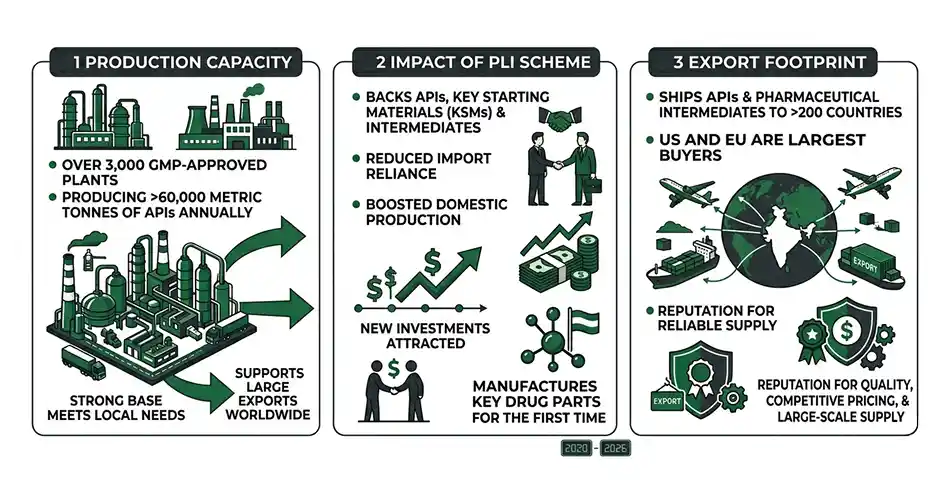
Production Capacity
India’s got more than 3,000 GMP-approved plants. They produce over 60,000 metric tonnes of APIs each year.
This strong base meets local needs and supports large exports worldwide.
Impact of PLI Scheme
The PLI scheme has been a big help to local manufacturing. It backs APIs, KSMs, and intermediates, which is a good thing.
Reliance on imports has gone down. This is due to new investments attracting attention, which have helped increase domestic production.
It’s also helping to make key drug parts for the first time.
Export Footprint
India ships out APIs and pharmaceutical intermediates to more than 200 countries.
The US and EU are its largest buyers. This shows India has built a reputation for being trustworthy.
It offers a mix that’s tough to match: quality, low prices, and dependable large-scale supply.
Strategic Importance of Africa & LATAM Markets
Africa and LATAM are important growth areas for pharma exports.

Below are the demand trends, import reliance, and trade links driving India’s role.
Demographic Dividends
Places like Nigeria, Brazil, and Mexico have populations that are growing quickly. They’re also getting a boost in their middle classes.
People are earning more and learning more. This is driving up healthcare spending. So, there’s a greater need for affordable APIs and medicines.
Import-Driven Resilience
About 70-80% of APIs in these regions come from outside. Because they don’t make many locally, they need to buy from global suppliers.
That’s why there’s a steady demand for Indian pharmaceutical exports that are reliable and good value.
Economic Synergy
India holds about 14% of pharma exports in Africa. It is also expanding in LATAM, with a share of 5-6%.
The country has strong trade links. Its pricing advantages will help long-term growth in these areas.
Deep Dive: Key Regional Drivers & Therapeutic Trends
Things are moving quickly in Africa and LATAM markets. Changes in policy and demand are behind this shift.

Here are the key countries, regulations, and therapy trends shaping API demand.
Africa’s Growth Engines
Nigeria is gaining from the African Continental Free Trade Area. It’s giving a boost to trade and making it easier to access markets.
South Africa is trying to grow its local pharma industry. They want to make it stronger and more competitive.
Meanwhile, Ethiopia is turning into a major healthcare market with a lot of growing demand.
LATAM’s High-Value Markets
Brazil follows strict ANVISA rules, so its imports are of high quality.
Mexico’s COFEPRIS is speeding up its approval process. It is partnering with companies all over the world.
Chile supports open trade, which is allowing Indian APIs to gain a presence and expand in the country.
High-Demand Segments (2026 Trend)
Demand is going up because of long-term and infectious diseases everywhere. Below are key therapy areas driving API consumption growth.
Emerging Opportunities for Indian Manufacturers
Indian pharma companies are exploring new ways to expand globally.

They’re finding new ways to succeed around the world. Below are the key opportunities:
Biosimilars & Biologics
Biosimilars represent a growing opportunity for Indian API manufacturers.
The active ingredients for these complex biological drugs are in high demand across Africa and LATAM, where healthcare systems seek affordable biologic treatments.
Indian companies with capabilities in biosimilar APIs and high-potency biologics are well-positioned to meet this rising demand.
Local Partnerships
Indian companies supply the ingredients, called APIs. African firms then use these to produce final medicines in their own countries.
This cuts costs, builds trust, and supports local jobs. So, it makes partnerships stronger and long-lasting.
Sustainability (Green APIs)
Latin American buyers like products made in an eco-friendly way.
Many companies now ask suppliers for ESG information. This marks a big shift in how they do business.
Indian firms that use green methods can win more contracts and stay competitive worldwide.
Regulatory Navigation: The Path to Market Access
Getting medicines approved in various markets can be tough.

However, things are getting better. Good systems make sure safe, quality medicines get to people quickly.
African Medicines Agency (AMA)
The African Medicines Agency is working to make rules the same across different countries.
It reduces duplicate reviews, supports team decisions, and speeds up approvals.
This improves access to vital medicines.
Regulatory Reliance
Countries trust approvals from the USFDA and EMA because of regulatory reliance.
This speeds up the review process for ANVISA and SAHPRA.
It reduces their workload and helps get medicines to patients faster.
Digital Compliance
Switching to eCTD turns submissions into digital and structured files. This makes reviews much easier.
It boosts accuracy and speeds up communication. This helps regulators approve drugs more quickly.
It’s due to better data handling.
Key Challenges & Risk Mitigation
Global expansion has risks. So, it’s important to plan ahead.
Knowing what these risks are can help companies cut down on delays, keep costs in check, and stay ahead of the game in new markets.

Logistical Hurdles
Shipping routes are getting held up because of the Red Sea crisis.
This means longer routes are taking more time and costing more in fuel.
Meanwhile, ports in Africa are getting really congested.
Companies need to plan buffers, diversify routes, and boost supply chain flexibility.
Currency Volatility
In LATAM, currency values can change quickly. This impacts payments and profits.
Companies can lower their risk by using hedging tools and flexible pricing.
It’s also a good idea to partner with local businesses to better manage cash flow.
Competitive Landscape
Chinese firms and local manufacturers are giving companies a run for their money.
To stay competitive, companies must balance quality and price. They need both to succeed.
Building trust and being reliable are also key to standing out in a crowded market.
Strategic Roadmap for 2026 and Beyond
For future growth, we need clear and simple planning.

To do well worldwide, companies need to make smart investments, set up solid systems, and stick to some basic rules.
Portfolio Diversification
Companies should invest in High-Potency APIs (HPAPI) and peptide APIs.
These products are really in demand and are worth a lot.
Spreading your investments around can lower your risk and bring in new chances to grow in worldwide markets.
This helps you stay safe and find new opportunities at the same time.
Strengthening Supply Chain
Companies have to decide between going direct and using local agents. The direct approach gives them more control.
Local agents help them get into the market fast. A balanced approach boosts reach, cuts costs, and ensures a reliable supply.
Compliance Excellence
Companies need to set up facilities that are ready for audits and meet ANVISA and WHO-GMP standards.
Being compliant is really important for a smooth process. It helps you get approved fast, build trust, and skip delays during inspections.
Future Outlook: The 2030 Vision
By 2030, the demand for APIs is expected to go up in emerging markets. It’s projected to grow at a steady rate of about 6-8 per cent each year.
Growth will come from a rise in healthcare needs and better access to medicines. This is particularly true in regions like Africa, Asia, and Latin America.
India’s going to be really important for global health security. They’ll provide safe medicines and vaccines that are affordable.
India has a strong manufacturing base and a skilled workforce. This can really support global supply chains.
They can also respond to health crises and improve access to essential treatments around the world.
Conclusion: The Strategic Imperative
Africa and LATAM are set to be the next major growth hotspots.
These regions are growing fast in terms of population, and that’s driving up demand for healthcare.
They rely on APIs from other sources. This is creating big opportunities.
Local production is limited, but demand for affordable medicines is high.
This creates steady opportunities. India’s got a cost advantage, plus it’s known for quality and trusted globally.
This puts it in a strong position to supply these regions.
It will build partnerships and help people access healthcare over time. This should also boost the industry’s growth.
FAQ Section
What is the current value of India’s pharmaceutical exports to Africa?
India’s pharma exports to Africa are booming. They sent about US$668.99 million in exports to South Africa in 2024. This shows strong and growing trade demand.
How is the African Medicines Agency (AMA) affecting API exports?
The African Medicines Agency is trying to get drug rules in line across countries. It will speed up approvals, build trust, and help Indian API exporters enter new markets.
Why should Indian API exporters focus on Brazil and Mexico?
Brazil and Mexico are big markets with a rising demand for quality medicines. They are enhancing their supply chains. This creates great opportunities for Indian exporters to boost their API sales. It could really help them expand their business.
What are the major logistical challenges for API exports to Africa in 2026?
Shipping faces key challenges. These include long routes, port delays, high costs, and complex supply chains. To avoid delays, companies must organise logistics. They should also manage risks. They should plan ahead to ensure operations run smoothly.
