


Introduction: The Next Generics Boom
The global pharmaceutical market relies a lot on generic medicines.
This happens when drug patents expire. Then, other companies can create cheaper versions of those medicines.
This change raises the need for APIs. From 2025 to 2030, many well-known medicines will lose their protection.
This will cause a rise in generic drug production around the world.
This is going to create some great opportunities for growth in the industry.
Over $200 billion worth of major drugs are set to lose their exclusive rights in this time frame.
This will trigger a surge in generic API manufacturing. India plays a big part in this shift.
It offers many APIs and finished generics to global markets. It ensures reliable quality and competitive prices.
Why Patent Expiries Create Major API Opportunities
Patent expiry shakes up the medicine market.
It boosts demand for generic drugs and affordable active pharmaceutical ingredients (APIs) worldwide.
This increases generic drug production. It makes medicines easier for everyone to access.

Economic Impact of Patent Cliff
When a drug patent expires, the market quickly moves to cheaper generics.
People choose these over costly branded medicines. Prices drop as many companies enter the market.
This tough competition boosts the need for dependable API suppliers. They must deliver high volumes at lower costs.
Regulatory Advantages for Generics
Companies that make generic drugs can get to market more quickly because the process is easier.
They don’t need to do full clinical trials. They just need to show their version works the same as the original.
This shorter route speeds up production and API demand.
Opportunity for API OEMs & CDMOs
When demand for generics increases, it creates more work.
This means more contract manufacturing for API makers and their partners.
Companies that start stability studies and regulatory data early get an edge.
Ready dossiers help them win supply contracts before or right after patent expiry.
Major APIs Going Off-Patent Between 2025-2030
Many key medicines will lose their patent protection from 2025 to 2030.
This will create big chances for making generic drugs.

Here are key APIs with upcoming patent expiries, their current market size, and potential opportunities for manufacturers:
This medicine patent expires in 2025-2026. It has a market size of $6.8B+ and strong demand for generic and peptide API manufacturing.
This medicine patent expires in 2027. It has a market size of $4.2B+ with strong growth opportunities in diabetes generics.
This medicine patent expires in 2026. It has a market size of $3.7B+ and creates opportunities for biologic API production.
This medicine patent expires in 2027. It has a market size of $9.5B+ with massive global demand for anticoagulant generics.
This medicine patent expires in 2028. It has a market size of $22B+ and a strong opportunity for biosimilar manufacturing.
This medicine patent expires in 2029. It has a market size of $7.2B+ with opportunities in biologics and HPAPI production.
This medicine patent expires in 2025. It has a market size of $2.1B+ and demand for fixed-dose combination APIs.
This medicine patent expires in 2026. It has a market size of $3.5B+ with rising cardiovascular drug demand worldwide.
Therapeutic Categories Set to Drive Generic API Demand
The need for affordable generic medicines is increasing due to patent expiries and a rise in chronic diseases.

This is driving up demand for APIs worldwide. Key therapy areas are outlined below:
Diabetes & Metabolic Disorders
Diabetes is growing around the world. This is mostly because of lifestyle changes.
These meds are typically taken for a long time, usually for the rest of your life.
Millions of patients need treatment every day. So, the demand for affordable generic APIs is strong.
Cardiovascular Drugs
Millions of people worldwide are affected by diseases of the heart and blood vessels.
Medications like Apixaban and Ticagrelor are commonly used.
They help prevent strokes and also stop blood clots. Many countries have ageing populations.
This leads to a growing need for safe and affordable cardiovascular APIs.
Oncology & Immuno-Oncology
Many important cancer drugs will lose their patent protection soon.
This change is expected in the next few years. These treatments have big market values and high demand.
Generics and biosimilars are entering the market. This will increase the demand for specialized, high-quality oncology APIs.
Respiratory & Autoimmune Therapies
Respiratory diseases are rising. Asthma and COPD are two examples.
This trend is happening worldwide. Medicines like Omalizumab are also used to treat immune disorders.
They’re prescribed for conditions where the immune system fails.
As patents expire, more affordable biosimilars and APIs will come out.
This will help meet the rising needs of patients.
Implications for API Manufacturers
When patents expire, the need for reliable and affordable APIs grows.
This also speeds up the global development of generic drugs.
This section explains what API manufacturers need to do.
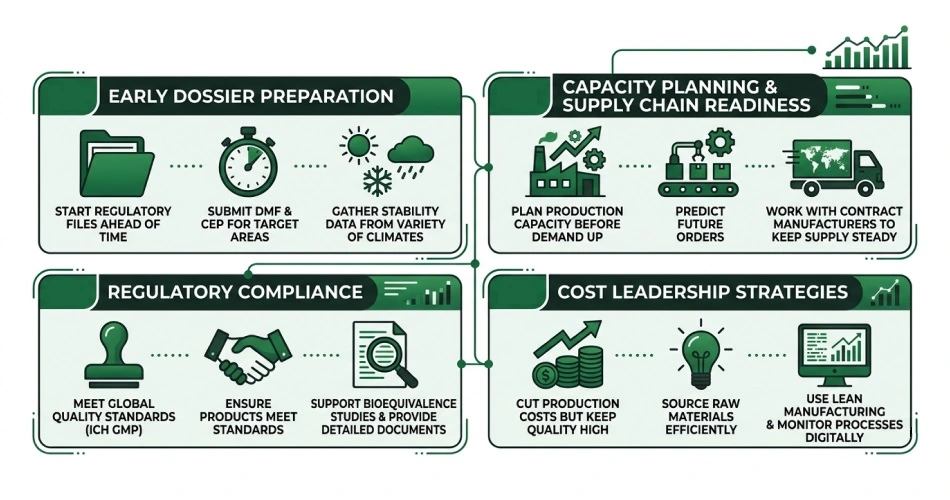
Early Dossier Preparation
API makers need to start working on their regulatory files ahead of time.
These files should include things like DMF and CEP submissions for the areas where they plan to sell their products.
It’s also crucial for them to gather reliable stability data from a variety of climates.
This will show that the API stays safe and effective.
Capacity Planning & Supply Chain Readiness
Companies need to plan their production capacity. They should do this before demand goes up after a patent expires.
Predicting future orders helps. Working with contract manufacturers keeps the supply steady.
This helps avoid shortages of generic medicines. It’s a pretty straightforward approach that works well.
Regulatory Compliance
Manufacturers must meet global quality standards. These standards follow ICH good manufacturing practices.
They must follow rules to ensure their products meet standards. They support bioequivalence studies.
They also provide detailed API documents. This helps importers and regulators check product quality and safety.
Cost Leadership Strategies
API companies need to cut production costs but keep quality high.
Sourcing raw materials efficiently, using lean manufacturing, and monitoring processes digitally can boost productivity.
This lets manufacturers offer better API prices.
Role of Indian API Manufacturers in the Next Generic Wave
India is crucial for supplying APIs. It helps large pharmaceutical companies and makers of generic drugs.
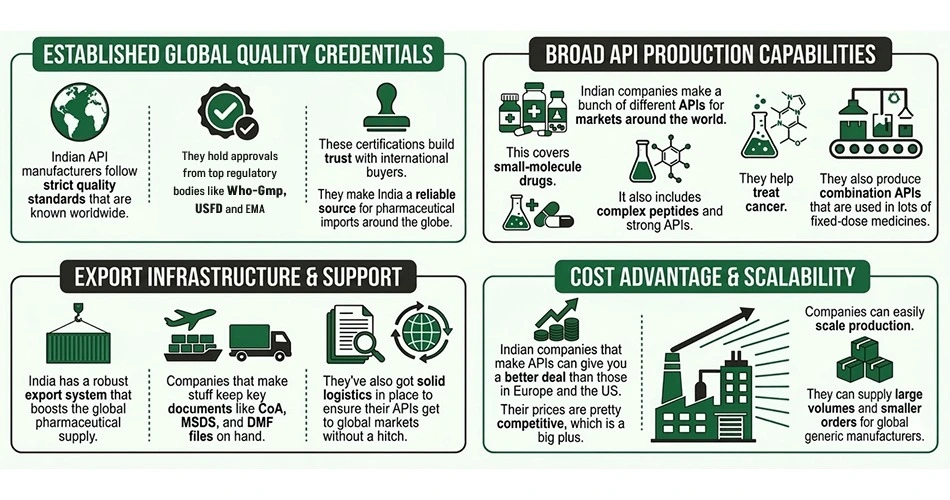
Below are India’s quality standards:
Established Global Quality Credentials
Indian API manufacturers follow strict quality standards that are known worldwide.
They hold approvals from top regulatory bodies like WHO-GMP, USFDA, and EMA.
These certifications build trust with international buyers.
They make India a reliable source for pharmaceutical imports around the globe.
Broad API Production Capabilities
Indian companies make a bunch of different APIs for markets around the world.
This covers small-molecule drugs. It also includes complex peptides and strong APIs.
They help treat cancer. They also produce combination APIs that are used in lots of fixed-dose medicines.
Export Infrastructure & Support
India has a robust export system that boosts the global pharmaceutical supply.
Companies that make stuff keep key documents like CoA, MSDS, and DMF files on hand.
They’ve also got solid logistics in place to ensure their APIs get to global markets without a hitch.
Cost Advantage & Scalability
Indian companies that make APIs can give you a better deal than those in Europe and the US.
Their prices are pretty competitive, which is a big plus. Companies can easily scale production.
They can supply large volumes and smaller orders for global generic manufacturers.
Case Studies: Early Movers Win More
Companies that plan for patent expiry early often get a market edge.
This lets them seize more sales opportunities.

The case studies below show how API suppliers can tap into new generic markets:
Empagliflozin API Entry into Africa
An Indian company exports APIs. It had all the needed regulatory papers.
It also had stability studies ready before the patent expired.
They were set to go, having sorted everything in advance.
Stability data was ready early, so regulators processed applications faster.
This lets generic manufacturers register products fast. They could do this in many African markets.
Apixaban Generic API Deals in LATAM
API suppliers came to Latin America by signing multi-year deals with local drug firms.
Manufacturers won public tenders. They secured long-term anticoagulant API contracts.
They achieved this with competitive pricing.
They also provided strong quality documentation and ensured a reliable supply.
Dulaglutide Biosimilar API Launch in ASEAN
API makers teamed up with local drug formulation firms in Southeast Asia.
Clear DMF documentation helped biosimilar developers. Strong technical support made approvals faster.
This helped them start dulaglutide treatments in growing diabetes markets.
Challenges and Mitigation Strategies
The generic API market offers strong growth but also brings operational and regulatory challenges for manufacturers.

The following explains key risks companies face and practical strategies used to manage regulatory, technical, and market uncertainties.
Regulatory Complexity
Each country has its own rules for medicines. They differ in terms of regulations, the way they format documents, and how they carry out inspections.
Managing approvals across regions is tough. This can slow down API registrations and product launches.
Companies form global teams. They track rules in various markets. These experts make accurate dossiers.
They guide submissions. They also help manufacturers respond quickly to regulatory changes.
High-Potency API Risks
High-potency APIs in cancer and hormone drugs must be handled carefully.
Workers can be at risk of exposure. The environment may also get contaminated.
This occurs when facilities don’t have proper safety and containment systems.
Manufacturers use special containment equipment.
They also install advanced environmental monitoring systems.
These measures keep workers safe. They also ensure products stay pure.
They make sure strong pharmaceutical ingredients are produced safely.
API Price Volatility
Prices of APIs can change fast. This is because of raw material shortages and supply issues.
Lastly, competition grows when patents expire.
Price swings can impact profits and change long-term production plans.
Companies sign long-term contracts for raw materials. They also broaden their API product lines.
This strategy keeps costs steady and lowers financial risk when global prices change.
Quality Documentation Delays
Incomplete or inconsistent documents slow down approval. They also hold up shipments.
This can lead to delays in getting things moving. Missing data in reports or files can really slow things down.
This can hold up importer reviews and product registrations. It’s not just the reviews that are affected, but also the registration process.
Companies that make API products put together standard documents for each one.
Keeping files organized, data validated, and formats consistent makes it easier for regulators and buyers to review information and get products approved quickly.
This helps speed up the whole process.
Actionable 2025-2030 API Opportunity Roadmap
Big opportunities are coming in the API space. Many major drug patents will expire worldwide in the next few years.
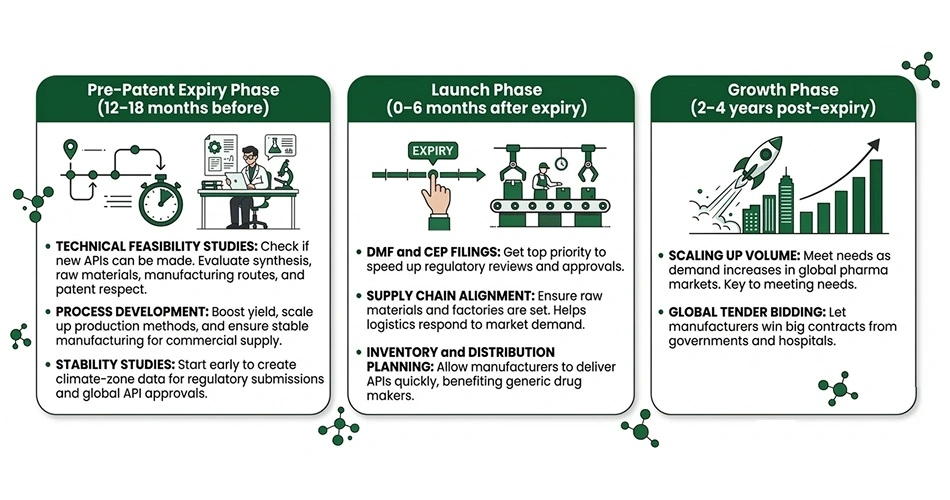
Key steps manufacturers should take before a patent expires to seize generic market chances include:
Pre-Patent Expiry Phase (12-18 months before)
API manufacturers should prepare early, before their patents run out.
This helps them get generics to market quicker.
Planning is a big help when it comes to research, developing processes, and getting ready for regulations.
This allows companies to have their APIs ready to go once the generic market kicks in.
Launch Phase (0-6 months after expiry)
This phase comes right after a patent expires. It is key to the quick entry of generics and being ready to supply them.
Companies need to align their regulatory filings.
They should also match these with their production planning.
It’s crucial for fast API delivery and to support new generic drug launches.
Growth Phase (2-4 years post-expiry)
After a few years of competition, things start to pick up in the market.
Demand goes up, and price wars get more intense.
Companies aim to boost production capacity and secure big supply contracts.
Conclusion
From 2025 to 2030, the global pharmaceutical industry will hit a major patent cliff.
This period is going to be tough as many key patents expire.
As blockbuster medicines go off patent, demand for generic drugs and APIs will really take off.
This is going to trigger a big surge in generic API production all over the world.
Indian API makers are all set to lead the way in this growth.
They’ve got high-quality standards, plenty of production capacity, and prices that are hard to beat.
Companies that plan and follow the rules will have a real edge in global markets.
They need to keep their quality docs in order, too. This way, they’ll be well ahead of the competition.
