


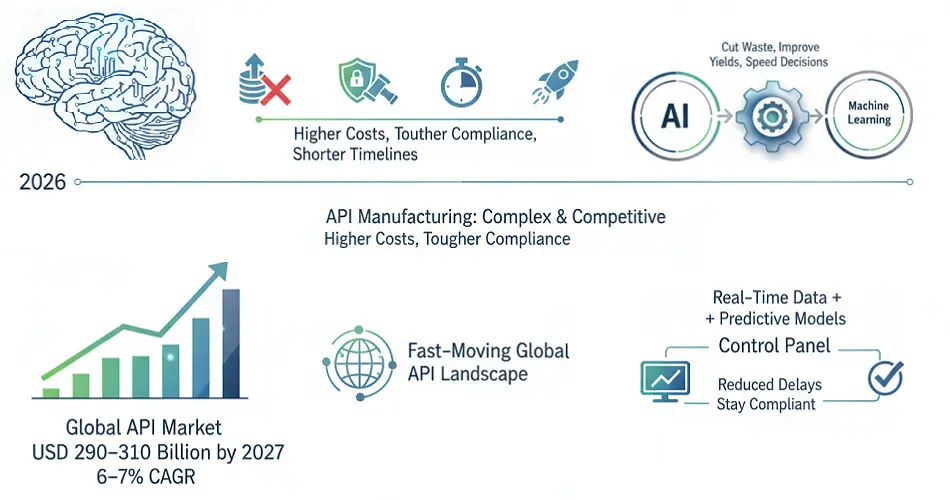
In 2026, API manufacturing is more complex and competitive than ever. Producers face higher costs.
They also deal with tougher compliance rules. Launch timelines are getting shorter, too.
At the same time, global demand is growing, with the API market projected to reach USD 290–310 billion by 2027, growing at nearly 6–7% CAGR.
To survive this pressure, AI and machine learning are no longer optional tools.
They help manufacturers cut waste, improve yields, and speed up decisions.
Companies use real-time data and predictive models to gain control.
This helps them reduce delays and stay compliant in a fast-moving global API landscape.
Understanding AI & ML in API Manufacturing
AI and machine learning help API plants use data more effectively.
They improve control and make production faster, safer, and more efficient.

What AI Brings to Pharma Manufacturing
AI tools turn factory data into smart insights. They assist teams in spotting problems, automating tasks, and maintaining quality during API production.
Predictive analytics
AI studies past and live batch data to predict results early. Teams quickly adjust process settings to boost yields and cut down on failed batches.
Process automation
Smart systems run mixing, heating, and feeding steps with less manual work. This reduces errors, saves time, and keeps production stable.
Digital twins
Virtual copies of equipment and processes let teams test changes safely.
They can plan improvements and fix problems without stopping real production.
Real-time monitoring & anomaly detection
Sensors and AI watch processes continuously. They spot unusual patterns, alert teams early, and help prevent quality issues or equipment breakdowns.
Quality prediction models
Machine learning predicts purity and other quality targets while production is happening.
This helps teams fix issues early and release API batches that are consistent and compliant.
ML Models Used in API Production
Machine learning gives API plants a boost in yield, quality, and control.
It uses various models to analyze data, guide changes, and predict outcomes. This makes production safer.
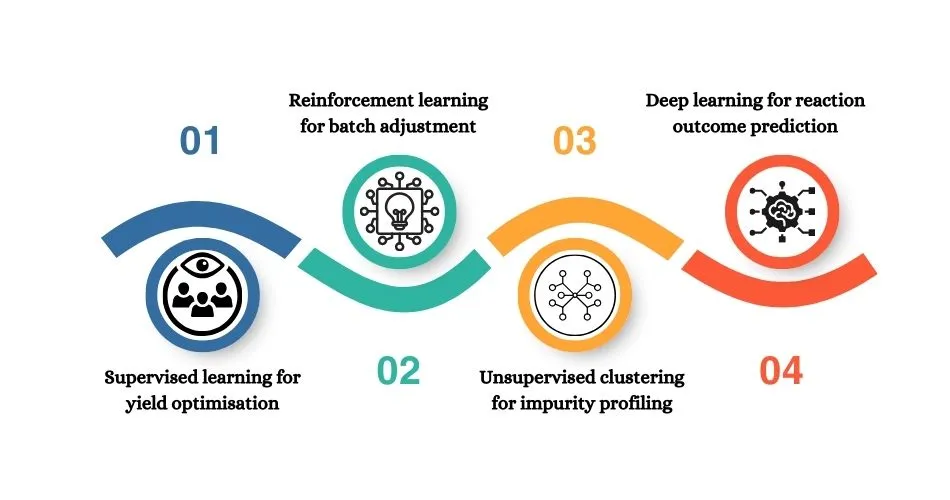
Supervised learning for yield optimisation
Supervised models study past batch data and settings. They find the best process conditions.
This helps teams boost yield, cut waste, and maintain product quality.
Reinforcement learning for batch adjustment
Reinforcement models learn by trial and feedback. They adjust process settings during batches.
This helps keep output steady. It also improves efficiency as plant conditions change.
Unsupervised clustering for impurity profiling
Clustering models group similar data without labels. They spot hidden impurity patterns.
This helps teams spot unusual contaminants early. It also improves purification and control steps.
Deep learning for reaction outcome prediction
Deep learning models study complex reaction data. They predict yields, stability, and by-products.
This helps plan reactions better. It also helps develop processes faster and smarter.
Key Applications of AI/ML in API Production
AI and ML help API plants run smarter and faster. They improve process control, yield, quality, and cost by learning from real production data.
Process Optimization
AI models help teams improve factors like temperature, pH, catalyst load, and pressure.
Machine learning predicts the best reaction pathways using past data.
This cuts down on trial-and-error work and helps speed up scaling.
Many plants report up to 20–30% fewer failed batches after AI-driven optimization and monitoring.
Yield Enhancement
Machine learning helps reduce impurities by learning from previous batch data and processing signals.
It predicts batch outcomes before full scaling. This allows for early adjustments.
In continuous manufacturing, AI adjusts in real time to keep reactions stable.
Many API facilities see around 5–12% higher overall yield with these tools.
Cost Reduction
AI systems study energy use, solvent consumption, and raw material flow.
They suggest better settings that lower energy demand and reduce the use of costly reagents.
Waste is minimised, and batch consistency improves. In many API workflows, AI-driven optimisation can cut manufacturing costs by 10–25%.
Quality Control & QC Automation
AI tools automate HPLC data checks, speeding up lab analysis.
Machine learning reads spectra from NMR, FTIR, and MS instruments with high accuracy.
It can predict out-of-spec batches before release. AI helps create regulatory documents and validation records quickly.
This boosts compliance and makes inspections easier.
Predictive Maintenance
Sensors and AI track equipment health across reactors, dryers, and centrifuges.
The system spots unusual vibration, heat, or pressure patterns early.
Maintenance teams get alerts before breakdowns happen.
This method cuts unplanned downtime by 30–40%. It also ensures API production runs smoothly and safely.
AI in High-Potency APIs (HPAPIs)
AI helps ensure safety, quality, and control in high-potency API plants.
Here, even small exposure risks are important.
Oncology Focus
HPAPIs are widely used in oncology API manufacturing. AI helps with complex processes, tight dose control, and strict containment.
It helps safely handle highly potent cancer ingredients. It also keeps production stable.
It makes it repeatable in specialized facilities.
Smart Containment
Robotics and AI guide material handling inside isolators and closed systems.
Automated charging, weighing, and transfer cut down on human contact.
These smart systems contain better materials. They lower the risk to operators.
Also, they help make the daily manufacturing of potent compounds safer.
Contamination Risk
AI models study airflow, clean data, and batch history. They do this to predict cross-contamination risks.
They alert teams early if residue or mix-up chances increase.
This keeps a clear divide. It helps protect product quality in facilities with multiple HPAPIs.
Exposure Simulation
Digital simulation tools create virtual models of production areas and workflows.
AI checks exposure risk during handling, cleaning, and transfer steps.
Teams can safely test scenarios and adjust controls before real production.
This boosts safety planning and aids in regulatory readiness.
AI for Supply Chain & Inventory Management
AI and ML help API manufacturers plan smarter. They enhance forecasting, cut waste, and ensure raw materials and shipments flow smoothly.
Raw Material Forecasting
AI looks at past prices, demand trends, and global events. Then, it predicts cost changes in solvents and intermediates.
Machine learning checks vendor reliability and delivery risks.
Smart systems optimise buffer stock levels. This helps cut holding costs by 12–20% and keeps production steady.
Logistics Optimization
AI sensors check the temperature. They also track conditions during storage and transport.
This helps protect sensitive materials. Smart tools choose safer routes for hazardous shipments using traffic and weather data.
Digital twins build virtual supply chains. They test for disruptions, which helps improve planning.
This reduces delays and safety risks.
Regulatory Framework for AI Adoption
Regulators now guide how AI is used in pharma manufacturing.
The focus is on safety, transparency, data integrity, and lifecycle control.
Current Global Guidelines
Global agencies are creating clear, risk-based rules. These rules aim to ensure safe and responsible use of AI in medicine and API manufacturing.
Requirements for API Manufacturers Using AI
API manufacturers using AI need to add digital tools to quality systems. They must follow GMP rules.
This ensures safe data use, validated models, and clear oversight.

GxP Integrity
AI systems must follow GxP data integrity rules. Training and process data need to be accurate.
They must also be traceable, secure, and well-controlled. This is important for the model’s lifecycle.
Model Explainability
AI models used in critical steps should be explainable. Teams must understand and justify how the model makes decisions affecting quality, safety, or release.
System Validation
Machine learning tools must be validated using the updated GAMP5 guidance.
Validation covers design, testing, performance checks, and ongoing monitoring within the defined intended use.
Audit Logs
AI platforms should maintain automated logs of data, changes, and decisions.
Clear records help inspectors check activities and ensure compliance during audits.
Barriers to AI Integration in API Production
Many API plants seek AI benefits. However, real-world challenges hinder adoption.
This affects systems, teams, and regulatory environments.
Data Silos
Many factories store data in separate systems that do not connect well.
Old records may be incomplete or messy. Weak historical data complicates AI training.
It also delays valuable insights for process improvement.
High Investment
AI needs sensors, software, cloud tools, and system upgrades. These require high upfront spending.
Smaller API companies may delay digitalisation because returns take time, and budgets are limited.
Regulatory Fear
Some teams worry regulators may question AI decisions or data use. The lack of clear rules creates hesitation.
Companies fear audit issues, so they move slowly with AI adoption in critical manufacturing steps.
Talent Gap
The API sector has a limited number of AI and data science experts. Process teams may lack digital skills.
Without trained staff to build and manage models, many companies struggle to successfully implement AI systems.
Future Outlook: AI-Driven API Manufacturing (2026–2030)
AI is set to change pharmaceutical manufacturing across the world.
It will bring smarter systems, safer processes, and quicker production in API plants everywhere.
Autonomous Smart Plants
Future API sites will run with high automation and AI control.
Systems will adjust parameters, monitor quality, and manage equipment with little manual input.
These smart plants will boost safety, speed, and consistency in complex manufacturing.
End-to-End Twins
Digital twins will mirror full factories, from raw material entry to final API output.
Teams will try out changes, spot failures, and boost efficiency online.
This helps reduce risk, save time, and support better planning decisions.
Continuous AI Manufacturing
AI-powered continuous manufacturing will soon be a standard model in the industry.
Real-time data and smart controls will keep reactions stable and reduce waste.
Regulators back these systems, so continuous production will likely be the new norm.
Predictive Regulatory Systems
AI tools will make regulatory submission packages better. They will use process data and quality trends.
Automated reports and checks will speed approvals. The global digital pharma manufacturing market might reach over $70 billion by 2030. This shows strong growth.
Why Indian API Manufacturers Are Leading AI Adoption
Indian API companies are rapidly adopting AI. This helps them be more efficient.
It also improves quality and keeps them competitive in the global pharmaceutical market.

Cost-Efficient Integration
Indian manufacturers use AI tools to cut production costs and enhance planning.
Affordable software and local tech support make it easy for companies.
Scalable systems help them test AI quickly. They save money without needing a big investment or facing long delays.
PLI Scheme Support
The PLI scheme offers government incentives to promote modern API plants using automation and AI tools.
Financial support helps companies invest in smart manufacturing.
It also cuts reliance on imports and builds strong local production for critical molecules.
Digital First Plants
Many new Indian API facilities are built with digital systems from day one.
Automation, sensors, and AI controls boost quality checks and batch tracking.
They help plants work faster and meet global regulations.
Complex API Growth
India is moving towards complex APIs and highly potent APIs. These require strict control and advanced monitoring.
AI helps manage precision, safety, and consistency. This makes Indian plants more capable of producing high-value pharmaceutical ingredients.
IT Pharma Synergy
India’s strong IT sector supports fast AI deployment in pharma plants.
Software experts and manufacturing teams work together.
They create data systems, predictive tools, and smart dashboards.
These tools help improve decisions in production and supply chains.
Conclusion
AI and machine learning are changing how API manufacturing works across the world.
These tools help improve yields, cut costs, and strengthen quality and compliance at every stage.
Early adopters of AI will have faster, safer, and more efficient plants.
This will give them a strong edge in the global market.
Indian API manufacturers are ready to lead in smart, tech-driven API production and supply.
They benefit from digital growth and supportive policies.
