


Brief overview of the pharmaceutical industry’s importance in global health
Pharmaceutical Industry Growth fuels global well-being with vital medicines and effective treatments.
India’s lively pharmaceutical sector is notable. It accounts for a notable 10% of global production by volume.
It offers health solutions across 200+ countries. It benefits people globally, changing lives.
The country generates huge quantities of generic drugs and stands out in the market.
Current State of the Pharmaceutical Industry
The global pharmaceutical industry is experiencing major growth.
This is mainly because of progress in biotechnology, the increase in generics, and a higher demand for new treatments.
Present current market statistics
The global pharmaceutical industry is booming like never before.
By 2023, the sector’s market value reached $1.48 trillion, with a 7.4% annual growth rate that brings innovation worldwide.
The global oncology drugs market was valued at $217.18 billion in 2025, and is projected to reach $360–400 billion by 2034, growing at a CAGR of 6–7%.
Drug development costs are increasing. This trend poses new challenges for R&D investment.
Biotechnology and generics are projected to drive 70% of market growth by 2025.
The rising demand for new drugs, particularly in cancer and AIDS treatment, is boosting growth in the sector.
Breakdown of Regional Contributions
The pharmaceutical market thrives due to growth in various regions.
We may predict a significant increase in the Asia-Pacific region.
United States
The U.S. pharmaceutical market is massive, and it keeps growing.
In 2025, the industry will reach $660.04 billion due to biotechnology advancements and generics growth.
India
India’s pharmaceutical market was valued at approximately $55-68 billion in 2025, and is projected to reach $120-130 billion by 2030.
The demand for generic drugs is high, especially in oncology and chronic diseases.
China
China’s pharmaceutical market is thriving. Government investments improve healthcare and expand medication access nationwide.
Europe
Europe’s pharmaceutical market stays steady. It focuses on regulatory compliance, new drug development, and better access to treatments for chronic diseases and rare conditions.
Emerging Trends Shaping the Future
Pharmaceuticals are evolving rapidly, driven by technology and consumer demands.
Here are key trends shaping the future of pharma:
AI Revolution
Artificial intelligence is changing the workbench of the future.
It helps us find trends, speeds up our actions, and boosts success rates.
Organizations must be agile and responsive to thrive in today’s market.
Understanding Human Biology
New technology and data are helping us gain a deeper understanding of the human body.
As a result, we are developing better treatments, creating new medicines, and finding improved ways to prevent diseases.

Affordable Medicines
There’s a worldwide effort to cut drug prices. Governments and companies are collaborating to make medicines more affordable.
This shift is crucial for patients and the industry alike.
Empowered Consumers
Consumers are getting more involved in their healthcare choices.
They now use data from wearables and other tools to make informed decisions.
This shift pushes companies to provide better value and service.
India’s Role as Global Pharma Leader
India has risen to prominence in the pharmaceutical landscape, earning the reputation of being the “pharmacy of the world.”

It is a major player in the global medicine supply, representing over 20% of total medicines.
This includes roughly 40% of generic medicines in the U.S. and nearly 60% of vaccines sent globally.
India is seeing lower manufacturing costs.
Exports are rising, and the country is rapidly advancing in digital tech.
All these factors help India strengthen its role in the future of healthcare.
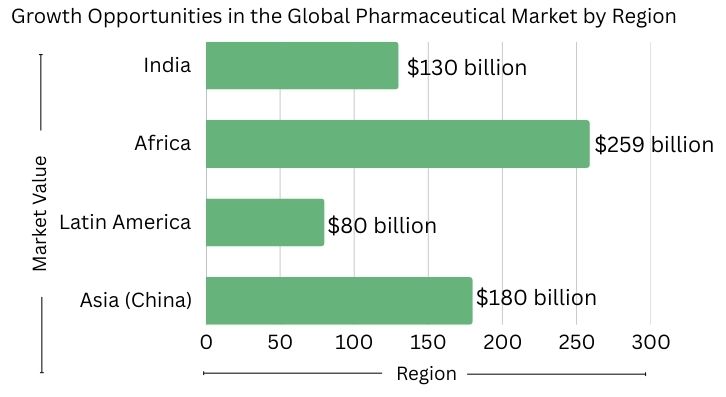
Growth Opportunities by Region
To find growth opportunities in various regions, look at the economy, industry trends, and local populations. Here’s a closer look at promising regions:
India
India’s pharmaceutical market is about to change significantly.
It is projected to grow to $130 billion by 2030, up from $41 billion in 2021.
This shift is fueled by exports and affordable generics that enhance access to essential medicines.
Africa
Africa’s healthcare spending is set to hit $259 billion by 2030.
Urbanization and a larger population boost the demand for important medicines.
As a result, effective healthcare solutions are more crucial than ever.
Latin America
Latin America is seeing a healthcare boom, with rising investments.
The pharmaceutical industry is rapidly expanding and is predicted to rise by 7% annually.
By 2026, it should hit a remarkable $80 billion.
Asia
Asia’s pharma industry is rising, particularly in China and Southeast Asia.
By 2025, China’s market is projected to reach $180 billion.
This growth comes from advancements in technology and healthcare.
What is the growth rate of the Indian pharmaceutical market?
The Indian pharmaceutical market is projected to grow by 5.92% each year.
India’s pharmaceutical market is projected to reach $120–130 billion by 2030.
This growth is driven by a rising need for affordable medicines.
Our strengths in exporting generics and vaccines support digital innovation.
Challenges and Roadblocks
India’s pharmaceutical industry is up against a number of tough challenges that are slowing it down.
This damages its prospects for growth and success.
Unstable Pricing Policies
Regular pricing changes lead to an uncertain environment.
Companies can’t spend or come up with new ideas when they don’t know what will happen.
As a result, it affects the availability of affordable drugs.
Innovation Issues
India falls short in innovation, especially in clinical research and talent growth.
The government needs to boost its support for new drug discoveries and clinical trials.

Dependence on External Markets
India is heavily dependent on imports for key ingredients like APIs.
Since almost 80% of these ingredients come from China, any supply issues can lead to price changes and shortages.
Quality Standards and Inspections
The high number of FDA inspections in India demands regular investment to boost quality.
Focusing on quality can take attention and resources away from other key areas.
How Actiza Pharmaceutical is Best Positioned to Serve this Market
Actiza Pharmaceutical Pvt. Ltd. is a leader in transforming global healthcare.
We work to keep prices low. we also focus on high quality and welcome innovation.
India’s Export Leader in Generics
We are quite active on the generic market. we supply cost-effective, high-quality drugs to more than 60 countries.
our mission is to bring quality healthcare to everyone, everywhere.
Commitment to Quality and Compliance
We make sure all its products meet global quality standards.
we adhere to WHO norms and GMP requirements to ensure product safety and efficacy.

Focus on Innovation and Sustainability
We emphasize innovation by funding R&D to create new treatments.
we strive to lessen our environmental impact. we focus on sustainable practices in manufacturing to do this.
Global Reach and Partnerships
We work closely with global organizations in emerging markets.
we improve access to life-saving medicines for those who need them most.
What is the future of Indian Pharma?
The future of Indian pharma glows with promise and potential.
Growth is expected in local and global markets, positioning the industry for leadership.
Expected market size
The Indian pharmaceutical market is likely to see major growth.
Experts predict it may reach a value of $120 to $130 billion by 2030, increasing from $90 billion.
Growth in key sectors
The pharmaceutical sector is seeing some huge progress, driven by strong growth in a few key areas :
Oncology
The oncology field in India is growing quickly and is filled with breakthroughs.
Cancer treatments are improving, offering better care and results.

Immunotherapy
India’s pharma industry shows great potential in immunotherapy.
Treatments for cancer and autoimmune diseases are achieving breakthroughs.
Generics
Generics remain a vital part of India’s pharmaceutical market.
India is about to become the top generic medication provider worldwide.
Export Growth Strategy
Pharmaceutical companies can tap into huge growth opportunities by breaking into global markets.
Here’s a simple guide to creating an export growth strategy.
Market Research
Grasping the global market is vital for spotting growth opportunities.
Look into global healthcare systems, disease trends, and rules. This will help you find where your products are most needed.
Targeted Marketing
Please get to know your audience; it’s the foundation of successful marketing.
Fit local needs by translating materials and honouring cultural preferences to boost impact.

Regulatory Knowledge
Each country has its own unique rules for pharmaceutical products.
Keep up with regulations to ensure compliance. This builds trust with your international customers and partners.
Protect Your Ideas
Secure your intellectual property before you enter foreign markets.
Get patents and trademarks to prevent unauthorized use of your products. This will help you stay competitive.
Conclusion
The pharmaceutical industry is strong and full of growth potential around the world.
Major players like Actiza Pharma are guiding us toward new opportunities.
India is essential, especially in the fields of generics and vaccines.
These efforts are setting the stage for a healthier global healthcare system.
The industry is on track for ongoing success. This is driven by major tech progress, a need for lower-cost medications, and new treatment options.
Looking to source pharmaceutical products from a trusted Indian manufacturer?
Actiza Pharma offers a complete range of Finished Formulations, APIs, and Advanced Intermediates exported to 60+ countries with WHO-GMP compliance.
Contact our export team for product catalogues and pricing
